

Continue reading Introducing Remington’s Fish Fry Friday! at DeKalb County Online.

Online Services

Whether you’re just starting out with your online business or you’re pivoting your SEO strategy to be more competitive in your online market, SEO competitor analysis is one of the most important aspects of any SEO campaign.
SEO competitor analysis helps you:
However, a lot of SEO competitor analysis content dictates that somehow you already know who all your competitors are.
This might be the case if you’re an SMB or you’re in an extremely niche industry, but for most businesses you may lack a picture of your entire SEO industry landscape.
Ultimately, when it comes to how to do competitor analysis and understand your entire competitive landscape from an SEO point-of-view, you’ll need to:
That’s right: keyword research first, and everything else after.
There is a common misconception within the industry that businesses automatically know who they’re biggest competitors are.
While it may be true to a small degree when it comes to knowing who is selling a similar product, it’s rarely within the context of knowing how these competitors are exactly marketing those products and to what scale from an SEO perspective.
Thus by identifying your keywords first and then using them to identify your competitor market, you can determine top industry competitors as well as identify up-and-coming industry competition.
In this article we’ll go into how you can formulate an actionable picture of your SEO competitive landscape and acquire actionable data while benchmarking and eventually surpassing your market competition.
A lot of times you’ll hear advice that says you should go out and just get a list of all of your competitors keywords.
However, there’s a big problem with this:
Additionally, you have a business plan already, built and ready to go. Let your business plan inform your SEO, not the other way around.
So then, how should you build your list of keywords to identify your seo competitors with?
It’s the age old question every visitor asks on a demo call or even when they get to your website: what service does your business provide and how are you better than your competitors?
I’m sure at this point you could dive into an entire monologue on your cutting-edge features and the tireless efforts of your teammates or employees.
But as it should be on your homepage and product pages, your value proposition should be short, sweet, and to the point.
Essentially, these few short words should define what it is your business does and a good value proposition should always:
But why is a value proposition necessary for keyword research?
Well, for starters if you’re going to define your industry by keywords, you need to start with your business first.
Too often there are websites that diversify their products or services to gain an edge within their markt. If this is at the forefront of a business model, it needs to be reflected in your SEO strategy.
If we look go back to the elements of a value proposition, we can break these elements up into significant and unique types of keywords that we want to target:
These are typically going to be more short-tail related keywords and potentially the most competitive keywords in your industry. However, they can be very competitive long-tail keywords as well.
Don’t let that scare you; every business should have its own short-tail version of keywords that they can one day aspire to rank for. Identifying these keywords early on will let you understand who the industry titans are in terms of SEO competition.
Often times these are the H1s of a Landing Page; generic and informative.
Benefit keywords are driven more at descriptive words used to sell a product, and thus are also in high-demand, albeit a bit less than industry short-tail keywords.
Scrolling through most H2s on a product landing page will net you the majority of what these look like.
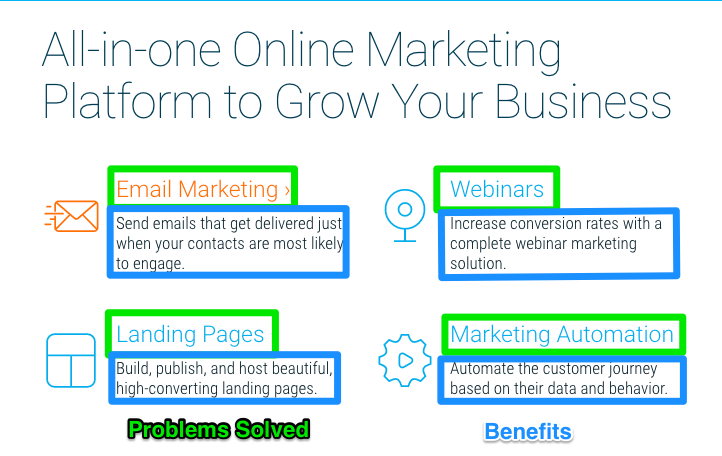
These are your more long-tail keywords that really help separate your brand from your competition. Sometimes you’ll find a combination of different industry keywords blended together to highlight the versatility of a product.
Other times it may be that it’s an extremely niche field and thus is just a simple value proposition that can appear within an H1 or H2 on your landing page anyway.

In the above photo, they highlight that they’re a developer testing tool aimed at recruiters, which combines two starkly different fields with different skill sets.
Uniqueness and benefit keywords should make up the bulk of your keyword list that you want to target or use to define your industry as they’re the largest combination of mid to long-tail keywords.
Once you’ve evaluated your keywords based on your value proposition, it’s time to diversify them for your SEO benefit.
There are a number of free keyword research tools that don’t require sign ups you can use for competitor analysis like:
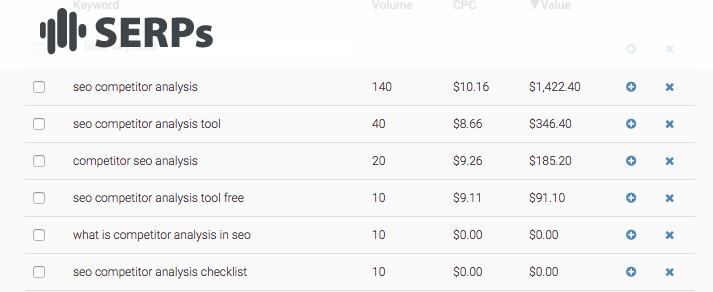
Use these tools to identify keywords with a decent or high search volume based on the keywords you’ve attained through analyzing your value propositions.
The size and scale of your keyword research will depend on the scope of your SEO campaign.
Maybe there’s just a small niche of keywords that you want to become relevant for or quite possibly you’re trying to identify your industry as a whole. Whatever the case may be, keyword research is a mandatory step.
Once you’ve got your list of keywords, it’s time to identify your SEO market competition.
Great, now you have your keywords. How should you go about finding your seo competitors?
There are a huge amount of seo competitor analysis tools out there and we’ve outlined the issues of a one-size-fits-all approach above in terms of just getting their keywords list and basing your strategy off of that.
Remember, your defining your SEO strategy off of your business’ unique value proposition–you have something unique and different to offer consumers with your products. So you need to take an approach to your SEO that highlights and builds off of the strengths of your uniqueness.
So for competitor website discovery in our example today we’ll use Unamo’s Industry Intelligence module, as it was built for the exact purpose of defining a market’s SEO competitor landscape based on pre-selected keywords.
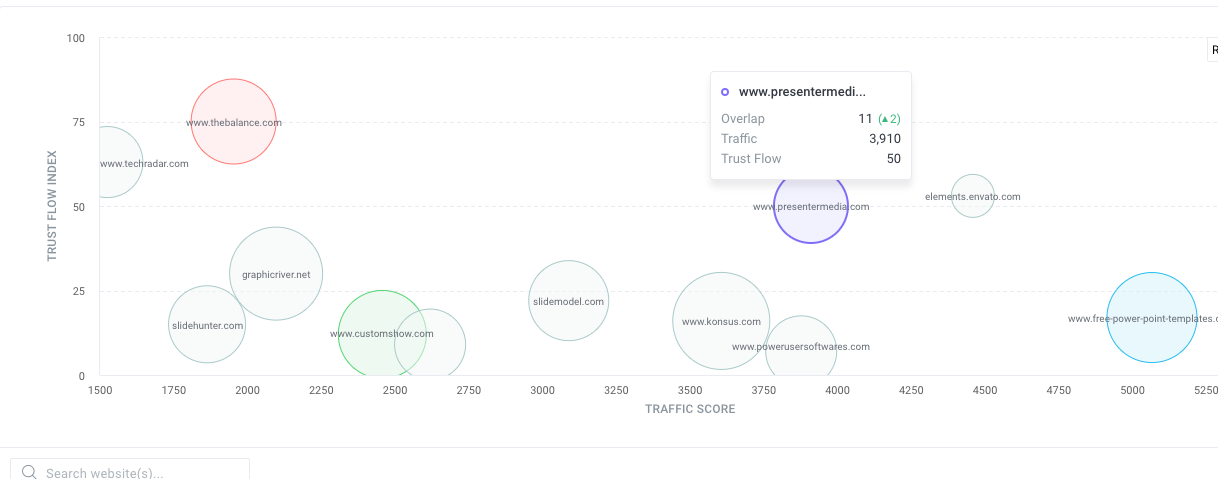
What you get is a defined list of up to 250 domains that are scored by their strength and relevance to the keywords you’ve provided.
From the list, you can begin to understand who your top SEO competitors are and begin to deconstruct their strategy or use it as a benchmark to monitor your progress over time.

In addition to your list of seo competitors, you’ll have definitive data on:
This can help you tackle a few different avenues concerning their SEO strategy.
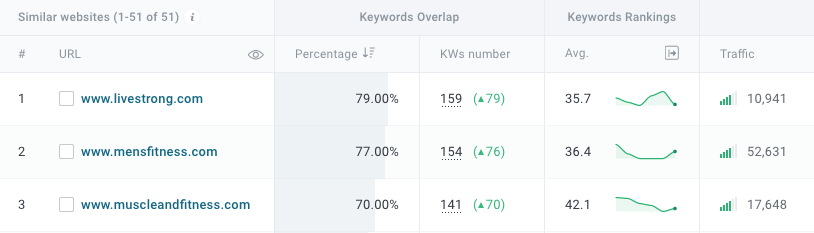
First and foremost you’ll know which of your target keywords each domain is ranking for. The higher their overlap percentage, the greater their total relevancy is toward your website.
To put it simply, your digital presence is similar.
But what will distinguish their efficacy with these keywords is there estimated traffic. Websites with a high overlap and a higher traffic estimation will undoubtedly be the industry benchmark you want to emulate and surpass one day.
Once you’ve understood which domains are the ones you want to target for your analysis, you can begin to pick away at the different parts of their SEO strategy.
Each facet of SEO has a what and a why behind it, thus by knowing which websites are the ones you want to get more in-depth data on, you can begin to pick away at their strategies.
Each website has its own digital make-up. Whether they’re using specific subdomains, ccTLDs, or gTLDs, you can begin to understand how your competition chooses to tackle their SEO strategy based their website’s technical makeup.
If you’re focal point for a specific search engine is country based, you can identify if most of your competition is using a gTLD like a .com or if they’ve gone a ccTLD route and used a .co or .pl.
Google has come out in the last few years and said that using a specific gTLD won’t affect your rankings whereas ccLTDs can help Google distinguish a website that is targeted at a specific country.
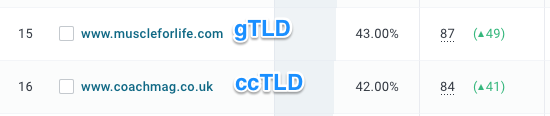
This is all obvious information you can glean at a glance from your list of industry domains; however, getting into the details of their technical SEO strategy will require the use of additional tools.
I would recommend crawling an entire site with certain technical SEO tools to determine how they structure subfolders and subdomains, internally link, and use on-page SEO as a whole.
Tools I recommend for this are:
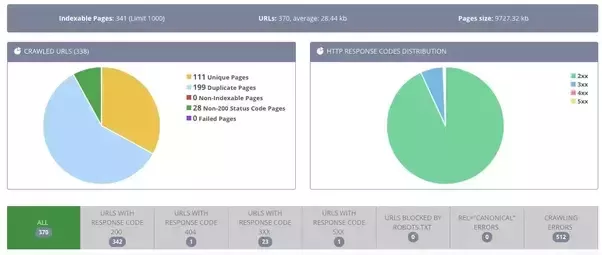
On a macro SEO scale, you can identify if you need to make any structural changes to your site that may seem to be giving your competitors an advantage.
They’re not only good for understanding site architecture, but you’ll be able to glean the:
While things like link-depth may not seem too important, they’re actually important metrics in determining how often Google crawls your site and how users may navigate from page to page.
Understanding a competitor’s technical seo approach especially comes in handy when you’re taking a micro approach to your competitor’s content performance and want to make changes based on competitor data.
To analyze top-ranking pages, simply locate the keyword you want to find SERP links for in your Industry campaign.

This list can also be exported to create a keyword gap analysis spreadsheet so you can better understand which keywords certain competitors are ranking for that your website isn’t ranking for.
Furthermore, from an on-page perspective, you can plug in the SERP link into a technical audit tool to glean their on-page SEO elements and analyze the differences across each one.

This is invaluable as far as expediting the amount of time you spend researching their on-page optimization strategy goes.
Technical SEO competitor analysis has the benefit of being two-pronged in its micro and macro scale; you can attain enough data on either with one tool to implement big or small changes to your site based off of your competitor analysis.
This is where some more robust backlink tools may come in handy as they can provide you with a website’s complete backlink profile.
You can then find out where the bulk of their highest quality backlinks are coming from and emulate that content.
Great tools for this process include:

I would recommend doing this more on a page-by-page basis; find their highest performing content and analyze its backlink profile first. It’s much easier to create a high quality piece of content and build links from it than it is to try to acquire a huge amount of links to your homepage.
Thus, with your list of domains and their specific SERP links for target keywords, you’ll be able to identify the difficult of surpassing your competitors in terms of backlink quality and quantity as well as have a good idea of what kinds of sites you can also earn backlinks from.
Be sure to try and emulate not just the link quality but the overall domain quality of each link you go through if you’re planning on earning links from the same site.
Most SEO competitor analysis templates have long argued that the keyword research portion of your analysis needs to happen after you find your top competitors.
However, I would argue that each business has a separate value proposition and that your SEO strategy should be built to strengthen this value proposition.
Locate the top keywords that best define your business and build your SEO strategy around them. Once you do, you’ll have a much more actionable list of direct competitors to base your competitor analysis on.
Good luck!