Online Services

Category: Security

  • Security Advisory: Stored XSS in bbPress

    Security Advisory: Stored XSS in bbPress

    Exploitation Level: Easy/Remote DREAD Score: 6/10 Vulnerability: Stored XSS Patched Version:  bbPress 2.5.9 During regular research audits of our Sucuri Firewall, we discovered a Stored XSS vulnerability affecting the bbPress plugin for WordPress which is currently installed on 300,000 live websites – one of them being the popular wordpress.org support forum. Vulnerability Disclosure Timeline: April
    Read More

    The post Security Advisory: Stored XSS in bbPress appeared first on Sucuri Blog.

  • What Hackers Do With Compromised WordPress Sites

    What Hackers Do With Compromised WordPress Sites

    We often talk to site owners who are surprised that their sites are targeted by attackers. Most of them assume that if there isn’t any juicy data to steal, like credit card numbers, that compromising their site is a worthless exercise. Unfortunately they are wrong. Aside from data, a compromised site’s visitors can be monetized in various malicious ways.  The web server can be used to run malicious software and host content and the reputation of the domain name and IP address can be leveraged.

    Last month we ran a survey that included the following open ended question for people who reported that their site had been compromised:

    What did the hackers do to your site?

    We received a total of 873 responses that could be categorized, which we did by hand. The chart below reflects the results. Many of the responses described multiple categories, so the percentages on the chart below deliberately add up to greater than 100%.

    We did not include categories for “installed backdoor” or “installed malware”. We consider that to be more of a means to an end. Instead we focused on answering the question, “what’s in it for the attacker?”.

    what_attackers_do_to_wordpress_sites

    As you can see from the chart there are a wide variety of things that attackers are doing with compromised WordPress sites. Let’s take a look at each of them, so we can better understand the motive behind the attacks that we are constantly defending against.

    Defaced Site / Took Offline

    In some cases hackers replace your content with their own. The most common was political content from terrorist groups and the like. The next most common was hackers simply bragging that they hacked your site. In all of these cases the attacker is doing absolutely nothing to obscure what they have done, anyone who visits the site immediately knows that you’ve been hacked.

    In other cases the attackers just destroy your site in some way, taking it offline. Based on what we see when performing forensic research on hacked sites, in the majority of these cases the attacker just screwed up what they were doing and accidentally took your site down.

    Example of defaced website courtesy of opennet.net


    What’s in it for the attacker?

    For the attackers who replace your site with political propaganda, your site is just free advertising for their cause. Those that brag about taking your site down are looking for recognition.

    Send Spam

    Spam email continues to be a huge issue. According to Statistica, 54.4% of all email traffic on the internet was spam in December of 2015. According to our survey respondents, 19.8% of compromised WordPress sites are used to send email spam.

    In many cases the site owner was not aware that it was happening for quite some time. In some cases they notice a slow down in site performance or a spike in server utilization that tips them off. Or their host recognizes it and alerts them.

    Unfortunately a very high percentage don’t find out until their domain has been blacklisted by spam watchdog services like Spamhaus. If you depend on email for communication with your customers or others it can have devastating consequences.

    What’s in it for the attacker?

    The attacker gets two huge benefits. First they get to use the server resources that you’re paying for free of charge. Second, until they ruin your reputation, their email delivery benefits tremendously from originating from your domain and IP address. Ultimately they are trying to get people to click through to their malicious websites.

    SEO Spam

    There are a number of ways attackers can leverage your website to improve their search engine rankings. The first is to simply host pages on your domain, accruing the benefits of your Domain Authority and clean reputation. Example page below.

    The next is to plant links throughout your site to the site(s) they want to give an SEO boost. Since backlinks are still the most important SEO ranking factor, an attacker who compromises a large number of sites can game search engine rankings in a big way.

    Many of our respondents used the term “pharma hack” to describe this type of attack, because it has recently been used a lot to boost the rankings of pharmaceutical sales sites.

    example_subsite

    Example of an html page that an attacker hid on an infected site.


    What’s in it for the attacker?

    As I’m sure most of you know, ranking well for popular search terms is a great way to drive traffic to websites. By gaming the system with SEO spam, attackers are able to divert traffic away from legitimate sites toward their own.

    Malicious Redirect

    Redirects are an incredibly effective way for attackers to funnel traffic to malicious websites. The unsuspecting user doesn’t have to click on a hyperlink or advertisement for it to work, they are taken there directly.

    Sometimes the attacker will take a very aggressive approach, redirecting all traffic to a malicious site or sites. But in many cases the attackers will employ measures to avoid detection, such as only redirecting some URL requests, and in some cases only activating the redirect for specific browsers or device types.

    What’s in it for the attacker?

    The motive here is simply to drive traffic to their malicious content.

    Host Phishing Page

    Phishing pages attempt to fool the visitor into providing sensitive information. In some cases they impersonate a bank or retailer and try to get you to give them valuable information like credit card numbers directly. In others they try to capture your username and password to various sites, including your WordPress site if you’re not careful.

    Phishing page example courtesy of eff.org


    What’s in it for the attacker?

    The value of your credit card number is obvious. They can use other data to break into important online accounts, use it for social engineering or spear phishing attacks or to steal your identity.

    Distribute Malware

    Once they have compromised your site, attackers can install malware that in turn installs malware on your website visitor’s computers without their knowledge. This is an incredibly scary proposition for you as a site owner.

    If Google detects that it is happening they will flag your site via their safe browsing program. This will cause your SEO traffic to drop significantly. For more details please read our recent blog post on the impact of a hacked website on SEO. Worse than that, site visitors that are infected will not be happy with you.

    The impact to your reputation could be significant and long lasting. Luckily only 2.9% of respondents reported this.

    What’s in it for the attacker?

    Installing malware on hundreds or thousands of your site visitor’s computers gives the attacker direct access to steal information or wreak havoc on them.

    Steal User Data

    Given that most people we talk to assume that attackers are interested in stealing their data, we were surprised to learn that only 1.1% of our respondents reported it happening.

    We think the main reason is that the majority of WordPress sites do not store sensitive data beyond user credentials for that site and maybe email addresses. It would also be very difficult for the owner of a hacked site to detect data theft if it occurred, so the numbers are likely understated.

    What’s in it for the attacker?

    Stolen user credentials could be used to regain entry to the site, even if the site has been cleaned. The username / password combinations can also be attempted on other sites in hopes that the user is repeating use of passwords.

    Stolen email addresses can be used for spamming. Obviously more sensitive information like credit card numbers would be even more valuable.

    Attack Site

    In some cases an attacker will decide to use your web server as a platform to launch attacks on other websites. This is relatively rare based on our respondents, who only reported this happening 0.7% of the time.

    What’s in it for the attacker?

    The attacker gets to use your server free of charge for their malicious activities. They also are much more likely to slip past their targets’ defenses with the attack originating from your domain and IP address. At least until they ruin your reputation.

    Ransomware

    Ransomware is malicious software that blocks access to your website and demands that you pay a ransom in return for having access restored. This kind of attack has been receiving a lot of attention on blogs and in the press recently. So we were surprised to have only 0.6% of respondents report it.

    A screenshot of the screen that TeslaCrypt displays when your files are encrypted. Courtesy Bromium Labs.

    A screenshot of the screen that TeslaCrypt displays when your files are encrypted. Courtesy Bromium Labs.


    What’s in it for the attacker?

    If you don’t have backups that you were able to keep out of the hands of the attacker, you may decide that paying the ransom is worth it.

    Host Malicious Content

    Hackers will very often use your web server to host malicious files that they can call from other servers. They are essentially quietly using your hosting account as a file server.

    What’s in it for the attacker?

    The attacker gets to store their files free of charge on a server with a domain and IP address that have a squeaky clean reputation.

    Referrer Spam

    If you use Google Analytics you are likely familiar with referrer spam. Referrer spam is bot traffic to your site set up to look like it is coming from a fake referrer. The spammer is trying to get the website owner to check out where the traffic is coming from, driving traffic to the site.

    Referrer spam example courtesty of phpmatters.com


    What’s in it for the attacker?

    As with a lot of the nefarious attacker activities we have already described, they get to use your server free of charge under the cover of your pristine IP address. Their ultimate goal is to drive traffic to one of their websites for reasons that often turn out to be malicious.

    Conclusion

    If you were of the opinion that your site couldn’t possibly be of interest to hackers, we hope that this post has changed your mind and given you some insight into their motives and methods.

    Regardless of what you use your site for, how much traffic it gets or how inexpensive your hosting plan is, an attacker can figure out how to make use of it if they can break in. To learn about how attackers gain access to WordPress sites, check out our blog post from last month.

    The post What Hackers Do With Compromised WordPress Sites appeared first on Wordfence.

  • Ask Sucuri: Differentiate Between Security Firewalls

    Ask Sucuri: Differentiate Between Security Firewalls

    Question: How should a website owner differentiate between Firewalls? What do they do? The term “firewall” is not new. It is common terminology in the world of technology and security, and possibly common enough that even non-technical people have a basic understanding of what a firewall is. Its meaning actually extends beyond security. The brick walls that
    Read More

    The post Ask Sucuri: Differentiate Between Security Firewalls appeared first on Sucuri Blog.

  • Announcing a new Firewall, a Threat Defense Feed and a New Approach

    Announcing a new Firewall, a Threat Defense Feed and a New Approach

    This morning at 9am Pacific time we rolled out a new kind of firewall to over 1 Million active WordPress websites. The new Wordfence firewall comes with a Threat Defense Feed that updates our firewall as new threats emerge. It also continuously updates our malware scan as we discover new malware patterns through our forensic research.

    If you have auto-update enabled in Wordfence, you will automatically be upgraded to 6.1.1 today which will include the new firewall and features. You can manually update by signing into your WordPress site and upgrading to Wordfence to 6.1.1 or you can download Wordfence from the official WordPress plugin repository.

    I want to share with you some of the journey that we took to arrive at this day. About 9 months ago we took a long hard look at Wordfence and asked the question: “How can we do a better job of stopping hacks and detecting them early?”.

    We also looked at existing firewall providers and discovered they could be doing a better job. And then we looked at our own malware scan and realized that it could benefit from a few improvements.

    So we set ourselves an ambitious goal:

    • Build an excellent forensic analysis team to discover the newest malware infections and new attacks that are used to break into sites.
    • Build a new kind of firewall that stops all attacks immediately, including zero day and emerging attacks.
    • Radically improve intelligence in our scan.
    • Continually feed the data our forensic team uncovers into our firewall and scan.

    We worked for 7 months on the project and about 2 months ago we thought we had finished the firewall. But then we discovered a way to radically improve our protection against SQL injection attacks. It meant building an SQL parser into Wordfence that is both extremely fast and is able to understand SQL the way a database does and determine if something is malicious or not. It was worth taking the extra time to include this important functionality and so we did exactly that.

    Then a few weeks ago, once again we thought we were ready and we realized we could build protection into the firewall against privilege escalation attacks. When you run Wordfence’s firewall, it knows who your users are so the firewall is able to make decisions about what to block more intelligently. So we went ahead and built that into Wordfence 6.1.1 too.

    Instead of letting the marketing team rule, we gave the engineers enough space to solve these very hard problems with innovative solutions.

    During the past month we have been quietly beta testing Wordfence 6.1.1 and our beta community has been an invaluable source of feedback and bug reports. Thank you very much to everyone who kindly participated in our public beta testing. You have helped turn Wordfence 6.1.1 into a rock solid enterprise-ready WordPress protector.

    We have also been running Wordfence 6.1.1 Beta on this site for longer than a month and it has worked perfectly. At times we have had over 3,000 concurrent users on the site and huge traffic spikes. Last Thursday and Friday thanks to the huge amount of press we received for our ground-breaking research into how the Panama Papers were leaked, we experienced a large sustained traffic spike and the Wordfence firewall just yawned and carried on doing a great job of serving up pages and protecting us from attacks.

    It’s really cool watching your own software block hackers in real-time. Instructions on how to watch that below.

    Today we are officially announcing the release of Wordfence 6.1.1 along with our Threat Defense Feed. Here are the details:

    The Firewall

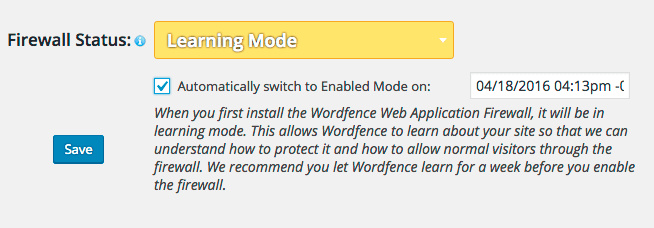
    The Wordfence firewall is installed with 6.1.1 and you will see a new ‘Firewall’ menu option appear in your Wordfence menu. When you arrive on the firewall configuration page, Wordfence should be in Learning Mode if you just upgraded to 6.1.1. It will look like this:

    Screen Shot 2016-04-11 at 4.13.56 PM


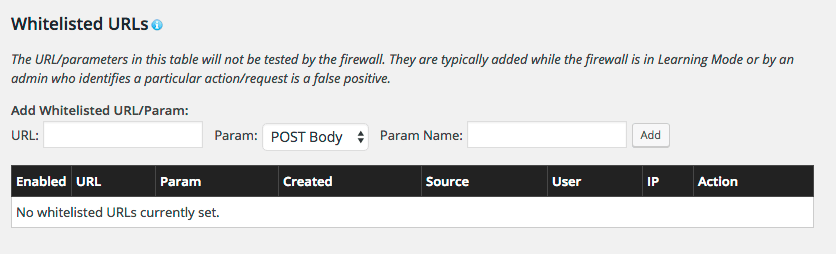
    Wordfence firewall will learn for a week and then automatically switch to “Enabled and Protecting”. During this one week learning period, anything that would have been blocked will automatically be whitelisted. You can scroll to the bottom of the firewall page and see the list of whitelisted items as they grow:

    Screen Shot 2016-04-11 at 4.16.35 PM

    If you don’t like something that has been whitelisted during Learning Mode or think it may be a real attack, you can simply remove it once the firewall is enabled.

    If you don’t want to wait a week you can speed things up by:

    • Visiting all pages and taking all actions you can think of on your site. This includes working in the WordPress admin console, submitting forms on your site and doing everything else that normally happens on your site. This will allow Wordfence to rapidly learn about your site.
    • Then enable the firewall and keep an eye on what it blocks in live traffic. Read on to understand how to view firewall activity in Live Traffic.

    Changes to Live Traffic and How to see what the Firewall has blocked

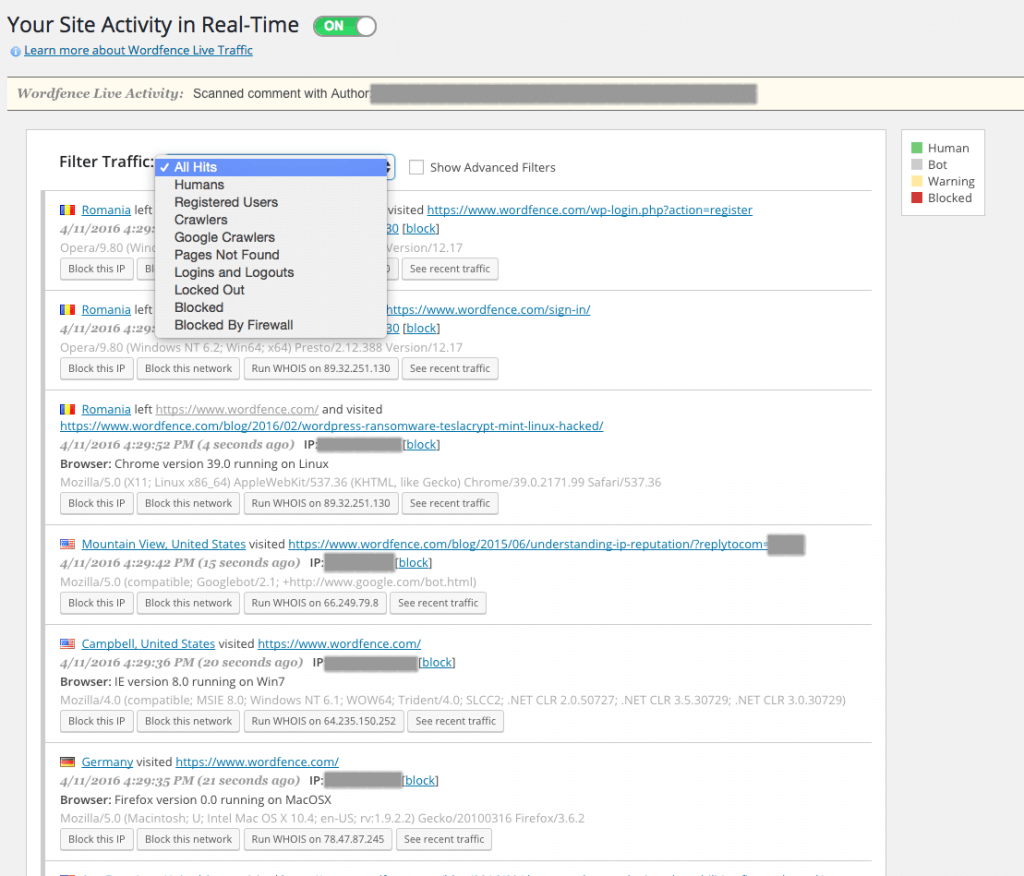
    Wordfence Live Traffic has been given a redesign that I can only describe as spectacular. We have added a drop-down list that lets you filter what kind of traffic you want to see:

    Screen Shot 2016-04-11 at 4.29.35 PM

    Simply select the option “Blocked by Firewall” to see what your firewall has blocked recently. You’ll be surprised what shows up. We have had quite a few attacks on our own site blocked by Wordfence 6.1.1.

    You’ll notice that Live Traffic has an advanced filters option that lets you filter your live traffic any way you can possibly imagine.

    A Threat Defense Feed through Excellent Forensic Analysis

    A great firewall and great scan engine are no good without continuous updates. We started by building an excellent forensic analysis team. Every day our team goes out and analyzes hacked sites and brings that on-the-ground intelligence back into Wordfence.

    Malware samples are turned into signatures used by our scan engine. New attacks are turned into firewall rules which update our firewall logic.

    We unified this flow of data under a single umbrella called the Threat Defense Feed. This feed constantly updates Wordfence’s ability to block attacks and to detect infections or malicious activity.

    Our premium Wordfence customers receive a real-time version of the feed. If a new threat emerges, we can update your rules within minutes. Our free customers receive a delayed version of the Threat Defense Feed.

    Changing the Game on Attackers

    We realized that the status quo isn’t going to cut it if we are to succeed in our mission of making the web safer and protecting our customer’s sites. Wordfence 6.1.1 isn’t just a new product with new data flowing into it. It is an organizational change for us.

    We have had to build a forensic analysis team by bringing senior analysts on board with tremendous depth of experience. Those senior team members have been developing processes and training up more junior colleagues to rapidly get them up to speed.

    We have also had to scale up our operations, make new capital investments in hardware, in software and in operations personnel.

    We have also brought on board additional senior engineers and customer service staff. We have been hiring so quickly that we decided to turn hiring into a software problem which you would have experienced if you’ve been through one of our tests for forensic analysts. Don’t worry, you still get to talk to us humans as part of the process.

    What we’ve ended up with is one of the fastest growing and best performing information security organizations in the world. It has been an incredible experience for me personally during the past 2 years, hiring people who are smarter than I am, stepping back and watching them guide our product, serve our customers and create engineering solutions that are incredibly innovative and that provide a new kind of protection that is able to defeat the new threats that we are seeing.

    I’m incredibly proud of our team for creating, testing and shipping Wordfence 6.1.1. Special thanks to Matt Barry our lead developer and Matt Rusnak our QA analyst who both worked tirelessly to improve, find new ways to break and then continue to improve 6.1.1. Thanks guys, you are both legends. Thanks also to the rest of the team who contributed tremendously, you know who you are and you’re amazing!

    I speak for the whole team when I say that we are proud to have your trust and to have you as a customer. We are working hard to deliver the level of engineering, research and innovation you have come to expect from Wordfence. And we look forward to a long relationship with our community and our premium customers as we continue to deliver the best available protection for your WordPress website.

    Mark Maunder – Wordfence Founder & CEO – April 2016.

    Update: At 11am Pacific time we release 6.1.2 which is a point release that fixes a minor issue. It fixed fatal error when using a whitelisted IPv6 range and connecting with an IPv6 address. This is an edge case and would have only affected a small number of sites.

    Official Press Release available here.

    Press contact: Dan Moen at press@wordfence.com.

    Wordfence is hiring. If you’re passionate about tracking attackers and their methods and want to join our forensic analysis team, we’d love to hear from you.

    The post Announcing a new Firewall, a Threat Defense Feed and a New Approach appeared first on Wordfence.