Online Services

Tag: WordPress Security

  • SEO Spam Campaign Exploiting WordPress REST API Vulnerability

    SEO Spam Campaign Exploiting WordPress REST API Vulnerability

    SEO Spam Campaign Exploiting WordPress REST API Vulnerability

    Just over a week ago, WordPress released version 4.7.3 to patch multiple security issues. Despite the automatic update feature provided by many hosting companies, there are still many WordPress websites that have not been updated. In fact, we are seeing quite a few sites that are still using versions 4.7 and 4.7.1, which are vulnerable to the WordPress REST API vulnerability patched in early February  (version 4.7.2). This more serious vulnerability allows attackers to create, delete, and modify posts on vulnerable websites without authorization.

    Continue reading SEO Spam Campaign Exploiting WordPress REST API Vulnerability at Sucuri Blog.

  • Malicious Subdirectories Strike Again

    Malicious Subdirectories Strike Again

    Malicious Subdirectories Strike Again

    In a previous post, we illustrated how attackers were fetching information from compromised sites under their control to display spam content on other hacked websites. By adding malicious files into a directory and using the victim’s database structure, attackers were able to inject ads and promote their products.

    This time, attackers used a similar technique with a little bit more sophistication to achieve their goals.

    Essay Spam Campaign

    This technique is now being used to distribute essay spam targeted at students.

    Continue reading Malicious Subdirectories Strike Again at Sucuri Blog.

  • WordPress Used as Command and Control Server in 2016 Election Hack

    On Friday evening the Department of Homeland Security released a report [PDF link] containing updated and broader analysis of Russian civilian and military intelligence organization’s attempts to interfere with the 2016 US election.

    This Wordfence report is an analysis of the new ‘Enhanced Grizzly Steppe Report’ and the data it includes. We show that one of the websites used in the attack was a WordPress website that was (and still is) vulnerable to a SQL injection attack. We describe how it became part of the ‘cyber kill chain’ used in the attack described in the DHS Enhanced Grizzly Steppe report.

    Background

    ‘Grizzly Steppe’ is the name that the United States intelligence community, specifically the FBI and DHS, have assigned to Russian civilian and military intelligence services associated with trying to hack the US 2016 election.

    On December 29th, US intelligence released the first Grizzly Steppe report that provided several indicators of compromise or IOCs. These IOCs were indicators of the presence of hacking tools used by the attackers described in the Grizzly Steppe report.

    The day after the original Grizzly Steppe report, we released our own analysis of the data in which we shared the actual sample of the PHP malware described in the report, which we had reverse engineered.

    On Friday evening, February 10th, DHS released an ‘enhanced analysis’ of Grizzly Steppe with several new IOCs. The report includes 17 PHP malware samples. These all appear to be different variants of P.A.S. which is the malware in the original report which we reverse engineered.

    The new report includes some additional data on 9 domain names that were used in the incidents that DHS analyzed and how Windows malware communicated with those domains. In the report below we focus on one domain specifically which is a WordPress site that was used as a command and control (C2) server as part of the attack.

    Understanding the Cyber Kill Chain

    The term Cyber Kill Chain is a term that Lockheed Martin came up with to describe a sequence of steps that an attacker needs to achieve their objective. It is a way for security analysts to think about and analyze an intrusion.

    The diagram below is from Lockheed Martin and is an illustration of each of the steps in the Cyber Kill Chain. [Source: Lockheed Martin]
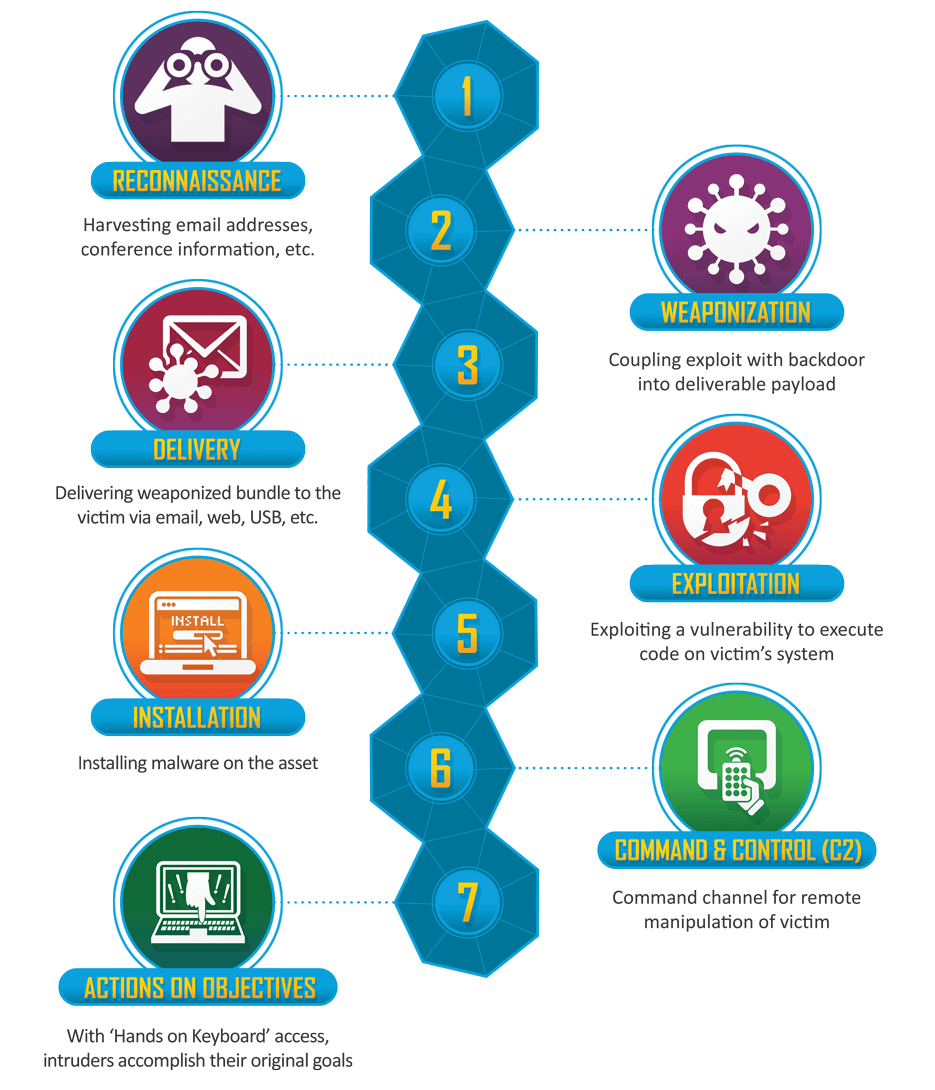
    This metaphor is used widely in the intelligence community as a way to think about intrusions. It is also used in the latest DHS Grizzly Steppe report. So we will use it here to analyze how WordPress was part of a kill chain targeting an individual or group.

    How WordPress Became Part of the Attack Chain

    One of the malware samples included in the Enhanced Grizzly Steppe report is a Windows DLL.

    The malware provides a range of capabilities to an attacker. According to the report:

    “The program provides an operator access to a reverse shell on the victim system. Additionally, the malware provides an operator the capability to enumerate the victims Windows Certificate Store, and extract identified digital certificates, including private keys. The application also allows an operator to enumerate all physical drives and network resources the victim system has access to.”

    The malware is relatively new in the security community and only appeared in VirusTotal on December 29th when the original Grizzly Steppe report was released.

    This malware falls into the Installation step in the kill chain above. To be useful, it needs to be able to communicate with its operator. That is where a command and control or C2 server comes in.

    WordPress as the Command and Control Server for Windows Malware

    According to the enhanced Grizzly Steppe report, the malware above communicates with a website called cderlearn.com. The report goes on:

    The application attempts to download data from a C2 server and write it to a randomly named .tmp file within the users %TEMP% directory. Some of the file names used to store this downloaded data within our lab environment are displayed below:

    -—Begin Sample File Names—-
    TEMPCab5.tmp
    TEMPTar6.tmp
    TEMPCab7.tmp
    TEMPTar8.tmp
    -—End Sample File Names—-

    Our Analysis of ‘cderlearn.com’ – How it was Compromised and Used

    The website this malware is communicating with is a WordPress site. Looking at archive.org, it has been a WordPress website at least since 14 March 2016.
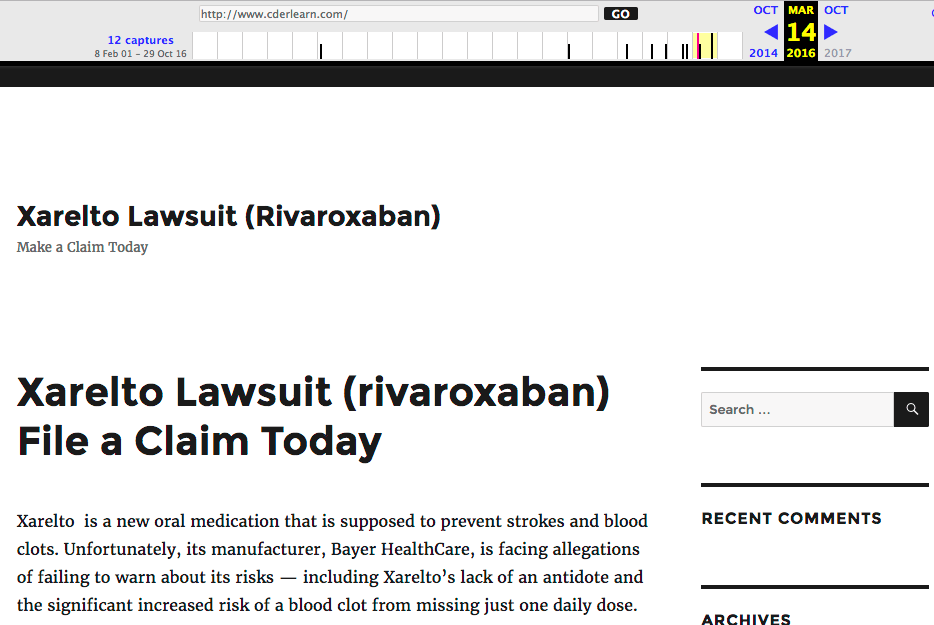
    On that date, if you view source on the archive.org snapshot of cderlearn.com, you can see that it was running a plugin called affiliate-wp, version 1.5.6.

    On March 16th, 2015, one year earlier, the vendor of Affiliate-WP announced that there was a serious SQL injection vulnerability in the plugin.
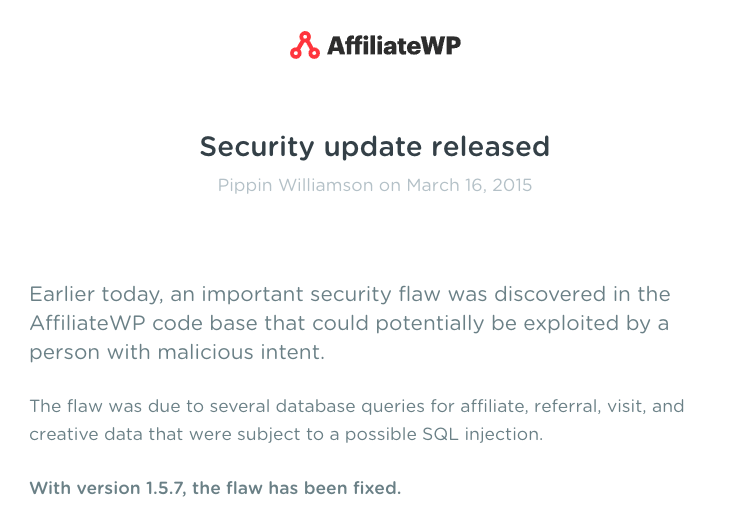
    cderlearn.com was running a vulnerable version of Affiliate-WPin March of last year, which may have been used to compromise the site.

    cderlearn.com was then used as a command and control server for malware that was designed to give an attacker remote control over a windows workstation. The DHS report provides a few samples of the network traffic between the Windows malware and cderlearn.com:
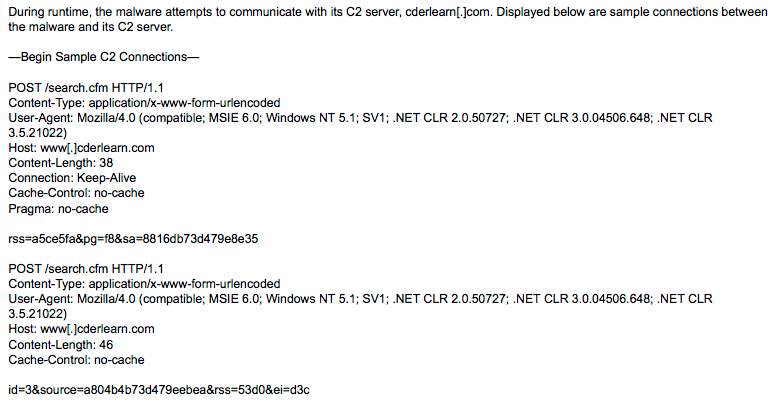
    The malware appears to be sending POST requests to a ‘search.cfm’ script which is part of the command and control malware installed on cderlearn.com and is disguising itself as a Cold Fusion search script.

    Surprisingly, the website in question appears to still be using the same vulnerable version of the Affiliate-WP WordPress plugin, even today.

    Conclusion

    In the example above, a vulnerable WordPress site was used in the ‘Command and Control’ step in the kill chain to provide a command channel for remote manipulation of a victim’s workstation. As you can see, this is a sophisticated attack that requires several distinctly separate hacks to achieve its objective. Compromising a WordPress site and using it as a C2 server is only one of those steps, but is a critical part of the kill chain that the attacker needs to achieve their objective.

    When we think about securing our WordPress sites, we usually think about the personal impact that a hacked site might have on us, our business and our customers. The story above illustrates how a compromised WordPress site can be used as part of a sophisticated kill chain, used by a nation state actor to attempt to change the outcome of an election.

    Securing your website by using a firewall and malware scanner like Wordfence is important, not just to protect your own interests and your customer data, but to help secure the wider Internet as a whole.

    Final note regarding comments: Please note that due to the political nature of this issue, we won’t be publishing any comments with political overtones. Our focus is simply on the data that DHS released and the data we are seeing ourselves and our analysis of it. Thank you.

    The post WordPress Used as Command and Control Server in 2016 Election Hack appeared first on Wordfence.

  • A Big Thank You to our Premium Customers for Powering Wordfence and Helping Secure the Community

    At Wordfence we are intensely customer focused. A few years ago when we made our first non-founder hires, we hired two amazing people: Matt Barry and Tim Cantrell. Matt is a spectacular engineer and immediately took ownership of the Wordfence code base and eventually wrote the core of what is the Wordfence Firewall today. Matt is also amazing to work with – one of the smartest and nicest people you’ll ever have the pleasure of meeting.

    Tim is a customer service engineer, and since day 1, he has done a spectacular job. He is also just a super nice guy. We have all worked closely together since then, and today we are a team of almost 30 people including a much larger engineering organization and a sizable customer service team. Our core focus still reflects those early hiring decisions: Great engineering and excellent customer service – and Tim and Matt have driven much of that ethos from early on.

    In our organization, we behave very much like most commercial software companies. We focus on code quality, stability and innovation. We have a constant feedback loop from our customer service team that feeds your wisdom and insights back into Wordfence. But the one thing that makes us a bit different from many large software organizations is that only 6% of the websites who use our product are paying customers. Or put differently, 94% of our users use the free Wordfence product.

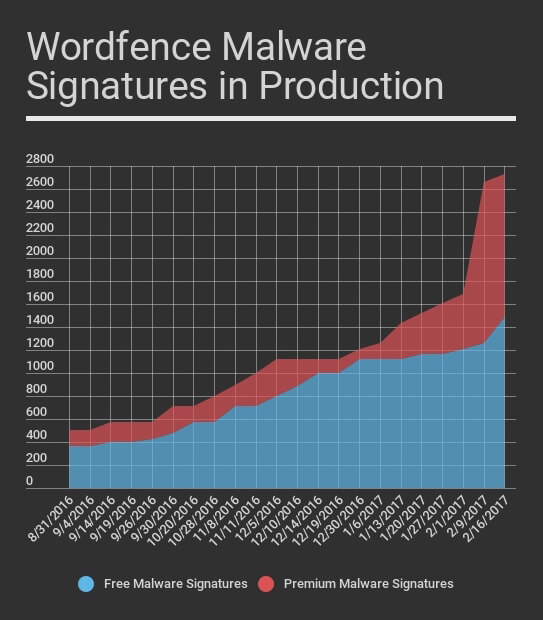
    When I published our post last week describing how we turn malware into new detection capability in Wordfence Scan, I included a chart that shows the number of malware signatures we have added over time in the past 5 months:

    One thing that struck me when looking at this chart is how clear it is that our Premium Wordfence customers are powering an incredible free product for the community. The chart above really shows just one of the final products of the organization’s work: scan signatures that continuously improve the malware detection capability that Wordfence has.

    As you can see in the chart, all malware signatures eventually, after 30 days become available to everyone in the community. That big jump in Premium signatures recently will also be reflected in the free signatures in a couple of weeks, and those signatures are not going away. They are gradually accumulating over time. The same is true for our firewall rules.

    As we grow the Wordfence engineering team, customer service team, QA team and other areas, our free customers are all benefiting because most of Wordfence’s features are available to the community completely free. These free features include:

    • The best malware scanner for WordPress in the business – which includes the ability to help clean hacked sites.
    • A powerful web application firewall that blocks a huge number of attack variants.
    • The ability to view your website traffic, web crawlers like Google and attacks on a live dashboard and react to them in real-time.
    • Brute force attack prevention.
    • A rate limiting firewall to help protect your content.
    • A range of other tools like whois lookup, diagnostic tools and much more.

    Our Wordfence Premium customers are the ones that are powering all these features and the team behind them. Our Premium customers also power the free support you receive on the WordPress.org support forums from our team.

    Our Premium customers have also powered the incredible free WordPress Security Learning Center that we have created with tons of content, including professionally produced videos. It’s all free and exists to help secure the WordPress community.

    And finally our Premium customers are the ones who power our ability to produce and publish ground-breaking research here, on this blog. We are also able to help our team attain new security certifications and maintain existing certifications. In addition our team can attend security conferences like RSA and DefCon to share insights with other security professionals.

    Our Premium customers also empower us to continue to maintain and build a team of security professionals that are the best in the business when it comes to WordPress security.

    So today I would like to extend a sincere and heartfelt thank you from our team and from all our community Wordfence users to our Premium customers for your support. Your decision to upgrade to the Premium version of Wordfence has empowered our team and the Wordfence product, and by extension your decision has helped secure the WordPress community and the 94% of our customers who use the free version.

    Thank you!

    From Mark Maunder, Wordfence Founder & CEO and the whole Wordfence Team.

    The post A Big Thank You to our Premium Customers for Powering Wordfence and Helping Secure the Community appeared first on Wordfence.