Last week we blogged about the advantages of endpoint security over a cloud firewall solution. We wrote about how cloud WAFs can be bypassed. We also blogged about how it is more challenging for a cloud WAF provider to write complex firewall rules because cloud WAFs don’t know if a user is signed in or what their access level is.
Part of the forensic research we do at Wordfence involves analyzing attack data we receive from sites that use Wordfence. We use a scaleable database cluster to perform big data analysis on WordPress attack data. We identified many attacks that were bypassing Cloudflare and being blocked by Wordfence. So we dug a little deeper.
Cloudflare Pro provides a web application firewall that is designed to perform a similar function to the Wordfence WAF. We are in that sense, direct competitors. We wanted to evaluate the Cloudflare WAF and to get access to it you have to get a paid ‘Pro’ account for $240 per year or $20/month. So we bought and paid for the Cloudflare WAF.
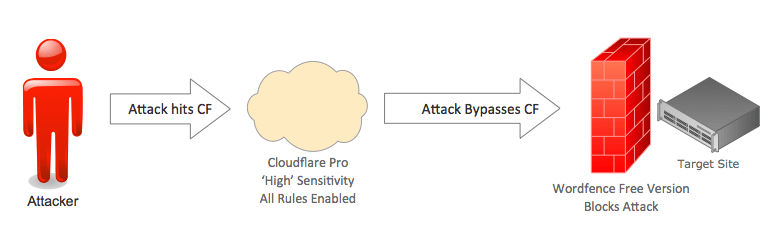
The default Cloudflare WAF sensitivity setting is ‘Medium’. We increased the sensitivity setting to ‘High’. That is the highest sensitivity setting before your users have to get through a captcha to access your site.
We also enabled every rule we could find in the Cloudflare WAF. That includes 11 rules in the “Cloudflare ruleset” and 20 rules in the “OWASP ModSecurity Core Rule Set”. We also put that ruleset on “High” sensitivity. We also enabled the “browser integrity check”.
We enabled absolutely everything we could find and put everything on “High” sensitivity.
We then confirmed that we could bypass the Cloudflare Pro WAF with the following attacks using no special techniques:
- Revolution Slider – We gained a remote shell. This went through completely undetected.
- MailPoet – We gained a remote shell. Also completely undetected.
- Gravity Forms – We gained a remote shell. Also completely undetected.
- Timthumb – Gained a remote shell using the .phtml form of the attack. Detected but not blocked.
These results were surprising. We used off-the-shelf hacker scripts without any special modifications. It’s well known that RevSlider, Gravity Forms and Timthumb are three of the leading causes of hacked websites. According to one report, 25% of hacked sites are hacked through one of these three WordPress exploits. Cloudflare Pro at $240/year with a ‘High’ sensitivity setting and all rules enabled allows these attacks through.
The free version of Wordfence blocks all of these attacks.
Why do these well known attacks bypass Cloudflare?
We don’t know why Cloudflare allows these attacks through, as surprising as it is, but I’d like to share a few observations. Firstly, Cloudflare is not WordPress specific. They are trying to be a firewall for all web platforms which is a difficult, perhaps impossible, challenge. Wordfence is WordPress specific, so we are able to tailor our rules for attacks that we know target that platform specifically.
Cloudflare is a ‘cloud WAF’ and, as we have pointed out previously, because their servers and rules run out on the Internet, they don’t have access to authentication and authorization data to make their rule decisions. Wordfence on the other hand knows if a user is signed in, what their identity is and what their access level is, so we are able to write more complex and stricter rules.
Demonstration
We have created a video demonstrating Cloudflare being bypassed by these exploits. In the first test we have a site that is filtering traffic through Cloudflare Pro with all rules enabled and on a ‘High’ sensitivity setting. In this test we also enable the free version of Wordfence on our target site. This allows us to see the attacks bypassing Cloudflare and being blocked by Wordfence.
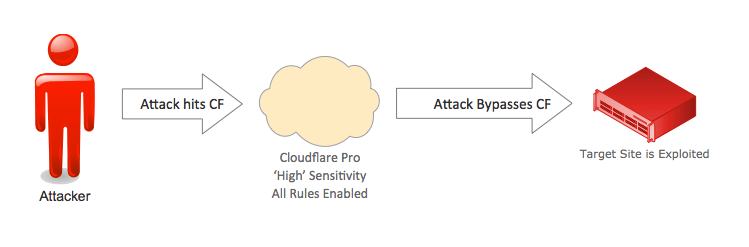
In the next test, we remove Wordfence completely from the target site and demonstrate how, without it, the site is exploited by an attacker, completely bypassing the Cloudflare Pro WAF on ‘High’ sensitivity.
The following is a video demonstration of this attack. In it we use two Linode servers, one as our attacker and another as our ‘Victim’. We use a Cloudflare Pro account on ‘High’ sensitivity with all rules enabled. We also download and configure the free version of Wordfence for the first part of the demo, and then remove it.
Why does this matter?
The free version of Wordfence blocks all of these attacks. They are what we consider “the basics” when it comes to WordPress security. If you pay us $99 a year you also get a real-time feed of emerging threats. Cloudflare are selling a web application firewall for $240 per year that allows through the best known and most dangerous WordPress attacks.
That means you can get better protection by using our free product than by using the $240/year Pro Cloudflare WAF. Then, if you choose to upgrade to our paid option, you know you’re protected against the newest emerging threats against WordPress.
It’s important to us that our customers know this. We feel we would be doing you a disservice if we didn’t share this comparative data. If you want to protect your WordPress site from a hack, you need a WordPress specific firewall that runs on the endpoint and protects you against “the basics” and also against emerging threats.
Conclusion and Technical Notes
We have provided a public Github repository that include tcpflow packet captures from the perspective of the attacker and from the perspective of the victim. The repository also includes the four exploits we used. Note that you will need to edit the exploit files to add in your own target hostnames. In the case of Timthumb you will also need to add a server from which timthumb can download an attack shell.
We have not included the vulnerable plugins or theme. However, we are supplying their versions. They are: Gravity Forms 1.8.1, MailPoet 2.6.4, Revslider 2.3.91 and Timthumb version 1.12. You can find these in the WordPress.org repository, in other repositories on github and elsewhere.
If you do download and test one of these vulnerable products and find you’re not able to exploit them, you may be using an old version that has a back-ported security fix. So please note that you need to find both a vulnerable ‘version’ of the product and one that has not had a back-ported security fix applied.
As always I welcome your comments and questions.
Trademark notice: All product names, logos, and brands are property of their respective owners. All company, product and service names used in this website are for identification purposes only. Use of these names, logos, and brands does not imply endorsement.
The post Revslider, MailPoet, GravityForms Exploits Bypass Cloudflare WAF appeared first on Wordfence.