Online Services

Category: Ideas Blog

  • Integrate Google Search Console With Unamo SEO

    Integrate Google Search Console With Unamo SEO

    Now you can integrate your Google Search Console properties with your Unamo SEO Campaign with GSC data storage for up to 2 years!

    You’ll have all of your relevant SEO data on one platform to expedite your analytics and decision making processes.

    The integration will pull all of your data from GSC into Unamo with additional abilities to mix and match your data over longer periods of time.

    Benefits include:

    • A familiar interface and user experience straight from the original Search Console with a more user-friendly design
    • The ability to view ALL of your data from Search Console. GSC limits the amount of records you can see from the platform; but Unamo’s GSC integration will extract all of your data so that there are no holes in your analytical process.
    • Up to 2 years of Search Analytics data storage vs. Google’s 3 month limit
    • 2 years of Sitemap storage vs. Google’s 1 month limit
    • Filtering and aggregating the data anyway you like; anywhere from 1 to 720 days of data visualizations
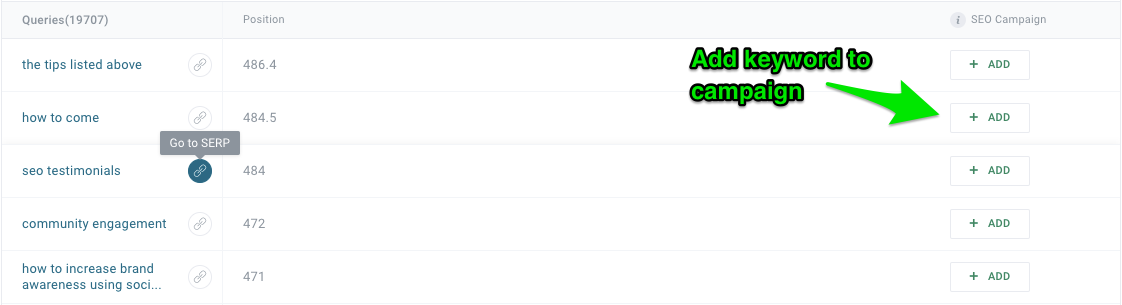
    • The ability to add queries from GSC as keywords to your Unamo SEO campaign

    To integrate Search Console to your Unamo account, please contact our sales team at sales@unamo.com.

  • A Guide to International SEO: Strategies and Guidelines

    A Guide to International SEO: Strategies and Guidelines

    You have a business.

    Your business has a website.

    You use localized keyword research and traditional SEO tactics to help your business rank well online. You have a diversified backlink profile and high domain authority.

    Congratulations!

    But now you want to expand. And this is where it gets complicated.

    How do you create an international SEO strategy that works just as well as your localized efforts? How do you merge international SEO strategy with localized keyword research and optimization?

    Can’t you just translate your content? Don’t you just need one of those little flag icons at the top of your landing page?

    International SEO strategy is technical, confusing, and difficult. Partner that with localized keyword research and you’re suddenly doing SEO backwards and in heels.

    This article will:

    • Help you decide upon an international SEO strategy that works for you.
    • Show you how to handle content translation and localized keyword research.
    • Explain how to track keywords locally in multiple locations as a part of international SEO.

    1. International SEO Strategies Can Start With Local Keyword Research

    How do you decide where you will expand your business?

    Almost every business with international expansion on the brain will end up conducting some sort of market research. But if you’re waiting for an SEO signal, there are two factors that can help nudge you in the right direction.

    • You notice a spike in organic traffic from a foreign market that piques your interest.
    • You notice a spike in users or customers from a particular country or region.

    You don’t have to be an astrophysicist to understand that a spike in users from a particular place often translates to a demand for your product or service on that market. That’s easy.

    Local keyword research comes into play when you get a spike in organic traffic from a foreign market.

    country traffic report international SEO

    So, your first response?

    Conduct research to see what’s attracting new traffic from foreign markets.

    Ask yourself:

    • Which local keywords are driving the spike in organic traffic?
    • Are they keywords related to my lead-generating content?
    • Are they keywords with a history of high click through rates (CTRs) and conversion?

    If you can answer “yes” to these questions you may have found a new market to optimize for.

    2. Do You Need to Look Beyond Google to Localize Keyword Research?

    The next step in preparing your international SEO strategy is to choose a search engine. Depending on which country you target, it may be time to think bigger than Google.

    Here’s a list of the leading search engines from around the globe:

    • Google (Global Leader)
    • Baidu (China)
    • Yandex (Russia)
    • Yahoo (Japan and Hong Kong)
    • Seznam (Czech Republic)
    • Naver (South Korea)

    If you’re not planning to expand to countries where other search engines dominate, then can you limit your keyword localization to Google?

    The most recent data suggests that you can. To a point.

    Google is killing it on large markets such as Brazil and India where it has a 95.07% and a 94.53% market share respectively.

    On a global scale, Google takes the cake over all other search engines with a 91.66% total market share. Bing comes in second, taking a 2.51% share.
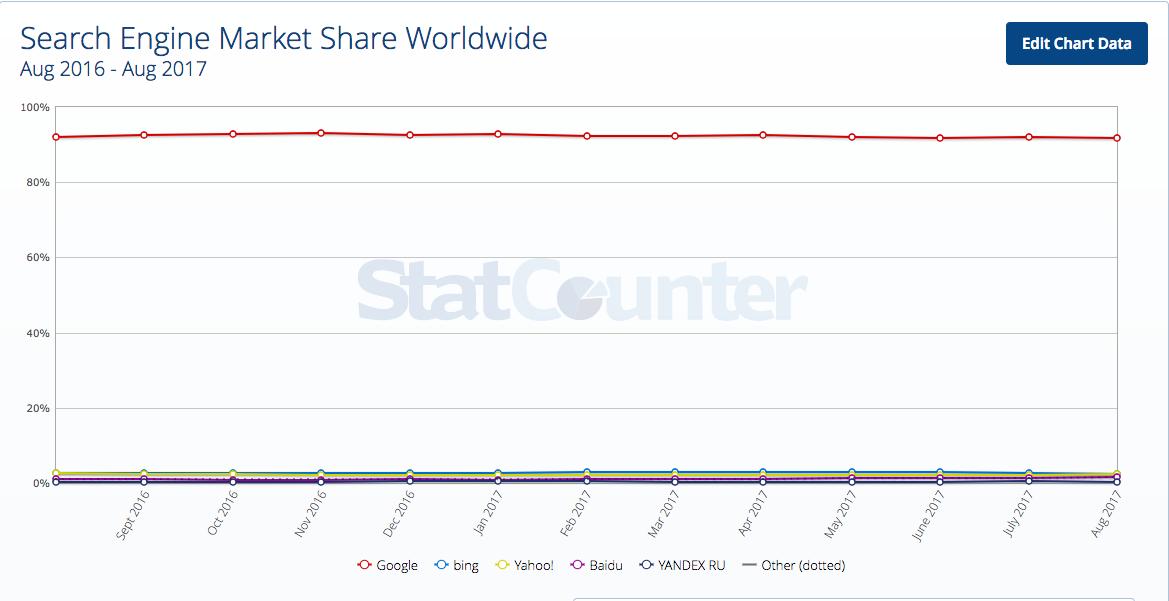
    google's market share of search engine queries

    And when it comes to mobile, there’s no competition. Google controls a 97.07% global share of the mobile search market.

    On the other hand, Google isn’t omnipresent.

    In the US, you may still want to do local keyword research and international SEO for Bing, as Google only has a 80.67% market share.

    And let’s say you do want to expand to China or Russia.

    In that case, Google has almost zero presence in both countries. To be more precise, Google has a 4.73% market share in China and 42.09% in Russia. That means you’ll need to optimize your websites for Baidu and Yandex respectively if you want to succeed on the local market.

    Let’s say you are staying within a market where Google has the monster share of search traffic. Austria is a good example. Google has a 94.16% market share of Austria’s search traffic. So, let’s tailor our international SEO strategy to reflect Google trends and local keyword research.

    Pro Tip: Each search engine has its own analytics tools for tracking keywords locally in multiple locations. Be sure to use the correct tools when optimizing content for Baidu, Yandex, or Naver.

    3. International SEO Targeting Choices – Language, Country, or Both?

    What is international SEO?

    International SEO is the way you tell Google (or other search engines) that you’re targeting specific countries or that you’re using different languages to conduct business.

    That’s why international SEO strategies cover everything from deciding how to handle your URL structure to using hreflang tags.

    But before you get into all the fun technical stuff, you need to decide if a language or country-based international SEO strategy is best for you.

    How do you make that decision? And what’s the difference?

    The first question you need to ask yourself:

    • Does my product or service change if a person in a different country uses it? (Excluding the language differences.)

    SaaS and cloud-based companies should answer “no.” A foreign customer comes to your website. They pay. They use the product or service online. Happy customer.

    The only change you may need to make is to have your website, blog, and other content in that happy customer’s native language.

    To illustrate further, let’s say that language is German. Ask yourself:

    • Will German-speaking people from different countries still use my product or service if I do nothing but provide them with German content?

    If yes, you will want a language-based international SEO strategy.

    Let’s say that’s not the case. The product or service you sell in Germany is different than what you’ll need to sell in Austria.
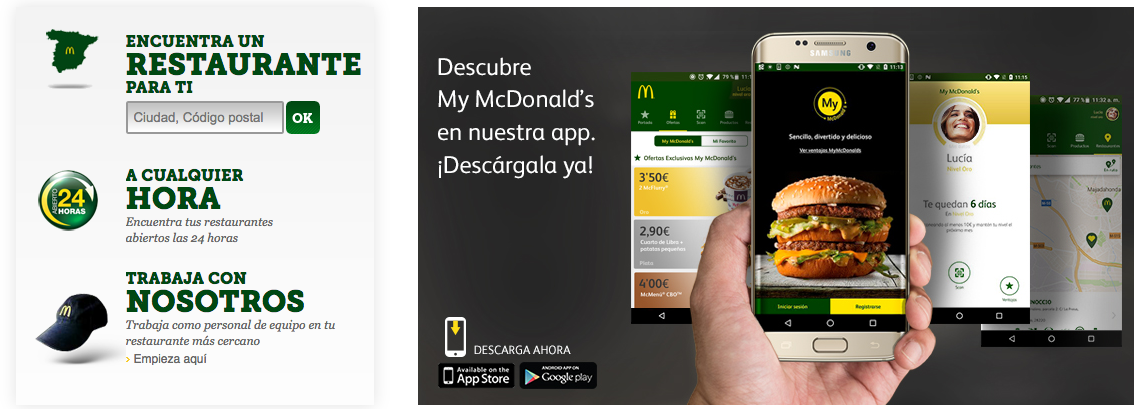
    language and country targeting for International SEO

    That will be true for:

    • Brick-and-mortar Retailers (McDonald’s)
    • E-retailers with Country-specific Offers (Amazon)
    • SaaS Companies with Regulated Offers (Netflix)
    • Mixed Retailers (Brick-and-Mortar/ E-commerce) (H&M)

    In that case, you can make your international SEO strategy country-specific. What does that mean? We’ll get to that in minute.

    4. Conduct Localized Keyword Research for Your New Target Market

    Again, before we get into all the fun technical stuff behind international SEO strategy, you’ll need to conduct your first round of localized keyword research.

    Here are the two most crucial tips to follow when conducting localized keyword research for a foreign market:

    • Never machine translate keyword research. Try using online translation services like Gengo to help you or hire a native to do keyword research for you.
    • Never assume that high-volume keywords will remain the same across markets. Even if the language is the same as your original market.

    You can approach localized keyword research one of two ways.

    First, you can start from scratch and conduct all new keyword research in the desired target language.

    Second, you can use the keywords you’ve amassed from your original site as a springboard. There is no one-size-fits-all solution.

    Once you’ve done that, assess the search volume behind your new list of keywords. You may be surprised at what you’ll need to rank for in your new market.

    Pro Tip: If you’re entering a bigger market (e.g., US), you may want to check search volume across multiple regions to check for consistency in strength. For example, you may find that a keyword’s search volume is different in New York, Chicago, and Los Angeles.

    regional search volume and interest for seo research

    5. Conducting Competitor Research for Your International SEO Strategy

    The next step is to conduct competitor research.

    Now, you’ll want to take your new localized keyword research and feed it through a rank tracking tool. But let’s say you don’t have access to one.

    Then you can feed each keyword one-by-one into Google to see which websites make a habit of appearing in the top 10 results.

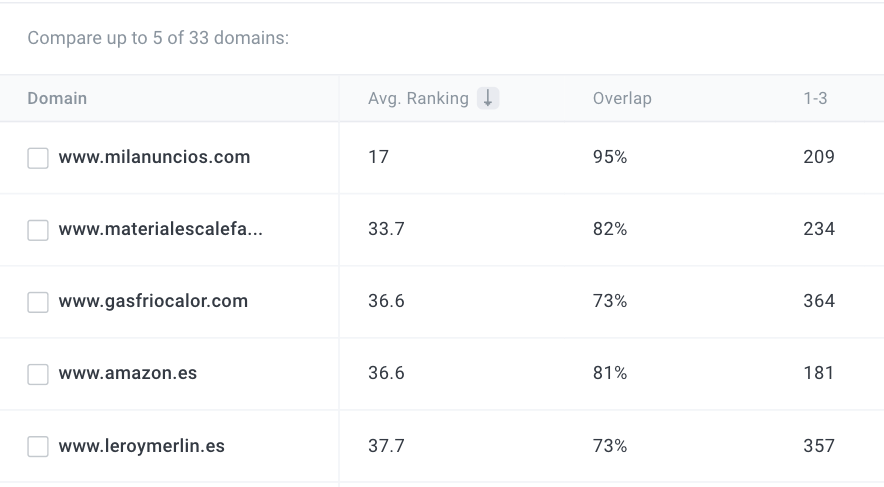
    For example, we translated a list of keywords into Spanish and then ran them through Unamo’s BETA industry research tool.

    We selected Google Spain and the tool populated a list of domains ranking for at least 20% of the list of keywords we entered.

    Here’s how it looks:

    conducting seo market research for competitors in international markets

    In total, the tool identified 33 competing domains for that market. We only counted competitors that ranked in the top 100 results for at least 20% of our keyword list. Here’s a snippet of our list:
    list of industry seo competitors

    From the list above we can further identify:

    • Which keywords are causing competitors to rank.
    • How many keywords overlap with our target keywords.
    • What kind of domain URL structure each competitor is using.

    But what do you do leverage this information for your international SEO strategy? Again, here’s what you want to achieve:

    1. Who are your top competitors on your new market?
    2. What percentage of overlap is there for top ranking keywords
    3. Are there keywords “up for grabs” and if so, what is their search volume?

    Analyzing Industry Competitors for Information

    Once you find out who your top competitors are, you can take a look at how they do things.

    You always want to do what’s best for your company and your needs.

    At the same time, looking at the competition may give you a better understanding of what already seems to work on that market. To get a better understanding of what you’re up against check out:

    • Site Structure and URL Structure
    • Offer, Content, and Images
    • On-page Optimization

    For SEO purposes, the least you can do is check out your competitor’s content and on-page optimization. Having that information is crucial if you want to assess the potential for creating better content and outranking your competition.

    Working Overlapping Keywords into Your International SEO strategy

    Let’s say you share 90% of the keywords you want to target with your competitor. How can you become number one in the SERPs?

    You need to work overlapping keywords into your international SEO strategy the same way you do with your local SEO strategy.

    • Create superior content.
    • Do a superior job of on-page optimization.
    • Build a superior backlink profile to your content.

    That’s why it’s so important to check out your competitor’s content and on-page optimization. You can’t click your heels and magic your way to number one. But you already know that.

    How to Take Advantage of Localized Keywords That are Up for Grabs

    You may notice that there are some keywords from your list that your competitors haven’t discovered yet. These keywords are up for grabs.

    They are a great starting point for creating new content.

    Just be cautious in situations where most of your keywords are related to products or services. The reason your competitors might not rank for a product keyword may have something to do with that product not selling. An example might include rankings for “wool scarf” in Australia.

    Pro Tip: Don’t be intimidated by competitors. Their presence indicates a market need for products and services like yours. All you have to do is know how to mine them for a lead.

    6. Deciding URL and Site Structure for a Killer International SEO Strategy

    Here’s the thing. The debate is ongoing about which URL structure is best for international SEO.

    Google says there isn’t one strategy that’s inherently better than any other. Other experts say there are better and worse strategies.

    So, here’s the bad news – there is no blanket strategy that works best.

    There are better and worse ways to structure your site and your URLs for international SEO results. But there is no good way to tell what will be better and worse for you.

    Is there any good news? Yes.

    You can more or less end up in the right place by understanding how URL structures work and by planning long term.

    So, let’s start with options:

    1. Country-coded Top-level Domains (ccTLDs)
    2. Subdirectories (Subfolders)
    3. Subdomains with Generic Top-level Domains (gTLDs)

    There are also URL parameters, but even Google does not recommend using them.

    • International SEO Strategy Using ccTLDs

    Let’s say your main site is:

    www.company.com

    Using a ccTLD URL structure would mean that you would create a separate, country-specific website for your new market. For example:

    www.company.pl (Poland)

    Examples of companies that choose to have separate sites for different countries:

    • McDonald’s
    • Amazon

    ccTLD URL structure for international seo

    Why did they both choose a ccTLD structure? What do the world’s largest e-commerce retailer and brick-and-mortar franchise restaurant have in common?

    Both companies have vastly different offers from country to country. Also, both companies are highly recognizable global brands.

    Benefits of having a separate site:

    • You’re giving Google a clear message that each site is for a country-specific audience.
    • Your offers and content are clearly divided, making targeting easier.
    • Sister sites for high authority brands like Amazon won’t have trouble ranking.

    The downsides?

    Let’s say you want to expand to 50 countries.

    Not one, not two – 50. You will have to build 50 individual websites.

    Let’s say you don’t have brand authority yet.

    Now, you will have to build your new sites from nothing. Even if your main site ranks well on your home market, you’ll have to roll up your sleeves to get your new site to rank just as well.

    • Building multiple ccTLD sites can be expensive and time consuming.
    • You will need to manage offers and content across multiple sites.
    • Low brand awareness means building domain authority from zero.

    Pro Tip: Long-term planning can help you decide if ccTLDs are right for you. Are you limiting your expansion to one or two markets? Do you have the time, money, and know-how to build multiple sites and domain authority from scratch? Then ccTLD URL structures might be for you.

    • International SEO Strategy Using Subdirectories

    Again, your main site is:

    www.company.com

    Using a subdirectory or subfolder URL structure means keeping everything under the umbrella of your main site. For example:

    www.company.com/pl (Poland)

    Examples of companies that choose to keep their country-specific offers and content under the umbrella of their main site:

    • H&M
    • Ikea

    subdirectory URL structure

    Why did they both choose a subdirectory structure? What do Swedish fashion and furniture retailers have in common?

    Notice that both are big online retailers with brick-and-mortar locations. Their offers and content will vary by country, but not by much. They can translate much of their inventory across sites.

    Benefits of having subfolders:

    • You’re still giving Google a clear message that you are geo-targeting your content.
    • Translating offers and content across multiple pages on one site saves time and money.
    • Subdirectories will keep the strength of the main site’s domain authority.

    The downsides?

    • Visitors might have a more difficult time identifying country-specific offers.
    • You might be tempted to duplicate content, layout, and user experience across the site.

    Can’t you just make sure that visitors get the correct page through automatic redirection?

    Google says no. Automatic redirection is bad for international SEO.

    Just in case you’re not on the same page, (pun intended) auto redirect is when a website detects a user’s IP address and uses that information to serve them country-specific pages.

    What’s wrong with that? Many things. One example:

    Your user is an Italian living in Canada for a few months for work.

    He wants to buy shoes for his wife. He’s going to miss her birthday while he’s gone.

    He goes online to buy shoes and your website detects that he’s in Canada. So, it feeds him the Canadian version of the site. Now, you have an Italian customer who has to figure out how to get to the Italian version of your site by himself.

    So, what’s the likelihood that his wife is getting a pair of your shoes for her birthday?

    And that’s only one of many things that can go wrong with auto redirect. Are there exceptions to the rule? Of course.

    One online company that uses IP detection and automatic redirect as a part of its international SEO strategy is Netflix. They sell television programs and television is subject to international copyright law.

    Thus, It’s illegal for them to sell some TV shows to customers from certain countries.

    How do they know which country you’re from? Your IP address. So, they auto redirect to country-specific subdirectories and they place their content behind paywalls.

    The moral of the story?

    Unless your products and services are subject to such regulations, don’t use automatic redirect. Instead, consider using the Accept-Language header to detect your user’s browser language.

    • International SEO Strategy Using Subdomains

    One last time, your main site is:

    www.company.com

    And using a subdomain URL structure also means creating a new site. For example:

    pl.company.com (Poland)

    Examples of companies that choose to use subdomain URL structures include:

    • Alibaba
    • Facebook

    subdomain URL structure for international SEO

    Why did they both choose subdomain structures? What do a Chinese e-retailer and the world’s largest social media site have in common?

    Well, nothing. They just both use a subdomain URL structure.

    Benefits of having a subdomain:

    • Some web design teams prefer working with subdomain URL structures.
    • Keeps offers and content clearly divided by country just as well as ccTLDs.
    • For some, keeping the “company.com” part of their URL is important.

    The downsides?

    • To rank, you will need to build the site’s domain authority from zero.
    • Some users may not understand from the URL that they’re browsing locally.
    • Need to maintain and manage multiple websites.

    One example where using a subdomain may work well:

    Your product or service is different and you add that as your subdomain.

    For example:

    event.company.com OR product.company.com

    A good real life example is:

    maps.google.com

    Now, remember deciding if you were a language or country-based operation? Here’s where that becomes important for international SEO.

    Let’s say that you’re a cloud-based company who only needs to geo-target for languages. You won’t need to change your URL structure, but you will need to tell Google there are different languages on your website.

    You need to add language tags to your URL structure to tell Google to feed language-based pages to the correct users.

    Google uses something called hreflang tags. Here are instructions on how to implement hreflang tags for your site. Once implemented, you can track your tags in Google Search Console to make sure there are no mistakes. And making mistakes with hreflang is common.

    Note: Some companies will need to use language tags even if they’re going the country-based route for URL structure.

    Do keep in mind that you may need to target multiple languages within one country. For example, you will need to tell Google if your Canadian customer gets a French or English version of your offer.

    Pro Tip: Do keep in mind that Bing uses something different than hreflang tags. They use something called the meta language tag. Need to optimize your site for Bing? Here are instructions on how to implement the meta language tag for your site.

    7. Change Content to Reflect Your New Localized Keyword Research

    Finally, it’s time to prepare your new content.

    But how much content can you translate and how much new content do you need to create for international SEO purposes? Does duplicate content make Google mad?

    Here’s the thing – you can duplicate content. To a point.

    If you’ve got an inventory of 1,000+ items, you will directly translate most of your inventory. At the same time, if you have original blog content or other long-form content you will want to redo your on-page SEO optimization. Otherwise, you won’t rank for your new localized keywords.

    Sometimes, that alone can be enough of a content change to result in non-duplicated content. Let your new localized keyword research guide you when deciding if and when to create new content.

    Keywords up for grabs? Create new content to dominate the SERPs for those keywords.

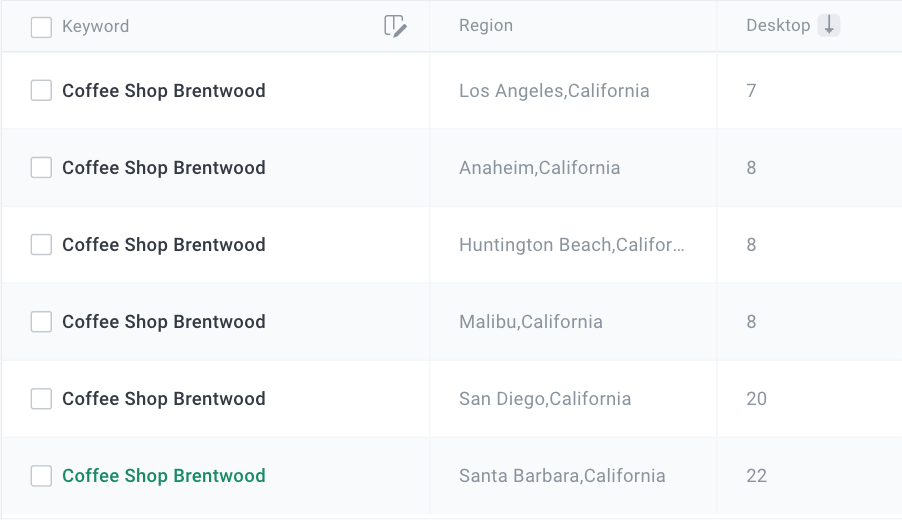
    Also, don’t forget to conduct multi-regional keyword research. Each locale or region will have it’s own set of keywords. And you may rank well for a keyword in one place, and not so well in another.
    tracking local keywords in multiple locations

    That’s why tracking keywords locally in multiple locations is a good idea. You’ll see that you rank well for one keyword in one place and better or worse for that keyword somewhere else.

    8. Change Content to Reflect Your New Market Demands

    Let’s say your offer needs to change along with your content. What are some things that qualify as content changes?

    • Product and Product Descriptions
    • Product Names (Tires in the US vs Tyres in the UK)
    • Pricing (Currency and Pricing Structures)
    • Images
    • Rules and Regulations

    You may also need to change your website layout and user experience. Besides market research and localized keyword research, it’s also best to research cultural differences.

    Images are a good example of content that may need to change because of cultural differences. And a good example of a company that optimizes its images for international SEO purposes is Ikea.

    One recent example was an image of a kitchen. The US market was shown an image of a large kitchen, while the Chinese and European markets were shown smaller kitchens.

    The change of images better reflects the realities of the customers.

    Ikea tries to get customers to imagine what the product would look like at home. Besides the in-store fake rooms can you think of a better way to do that then to show images that look like customer’s homes?

    If you’re changing your offer, your design, and your pricing, you’ve changed enough of your content to not have to worry about duplication. Just be sure to seed your localized keywords through the copy and you’re good to go.

    9. International SEO and Franchise SEO Unite for Brick-and-mortar Locations

    And last but not least, brick-and-mortar retailers will need to remember to implement all localized SEO and franchise SEO tactics before calling it a day.

    Your international SEO strategy needs to include the following local SEO tactics:

    • Standardize your NAP information for easier distribution among local listings.
    • Fill out a Google My Business Profile for every physical location that’s opening.
    • Research all local, online listings and add your standardized NAP information.
    • You will want to create all new social media profiles for your new locations.
    • You will want to be sure to include yourself on all local and relevant review platforms.
    • Customize your schema markups to reflect local aspects of your business.
    • Add your new location as a point of interest to GPS devices and navigation apps.

    Do keep in mind that different markets favor different social media platforms, especially when it comes to combining e-commerce functions with social. A good example is China’s WeChat app.

    Pro Tip: Be sure that your name, address, and phone number (NAP) is uniform everywhere it appears. And make sure it’s uniform down to the last, tiny punctuation mark. Be meticulous. Google doesn’t like discrepancies in NAP information.

    Need to read more about how to apply franchise SEO tactics? Check out our guide: Franchise SEO: How to Apply Local SEO to Multiple Locations

    Conclusion

    Yes, creating an international SEO strategy is a long, complicated process. But the most important aspects are keyword localization and URL structure.

    Start by putting as much effort into your localized keyword research and content planning as you have for your main site. And finish with implementing a long-term plan for your URL structure.

    If you can do that, you’re well on your way to entering new markets with a strong international SEO strategy to guide you.

  • Hurricanes Escalate US Climate Change Debate on Social Media

    Hurricanes Escalate US Climate Change Debate on Social Media

    Is it wrong to discuss climate change during climate disasters?

    Scott Pruitt, the Administrator at the Environmental Protection Agency (EPA), says that it is.

    He told CNN in a phone interview that it’s “misplaced” to “focus on the cause and effect of the storm” during the storm.

    So, did anyone listen to him? Apparently not. People are talking up a storm about climate change on social in wake of hurricanes Harvey and Irma.

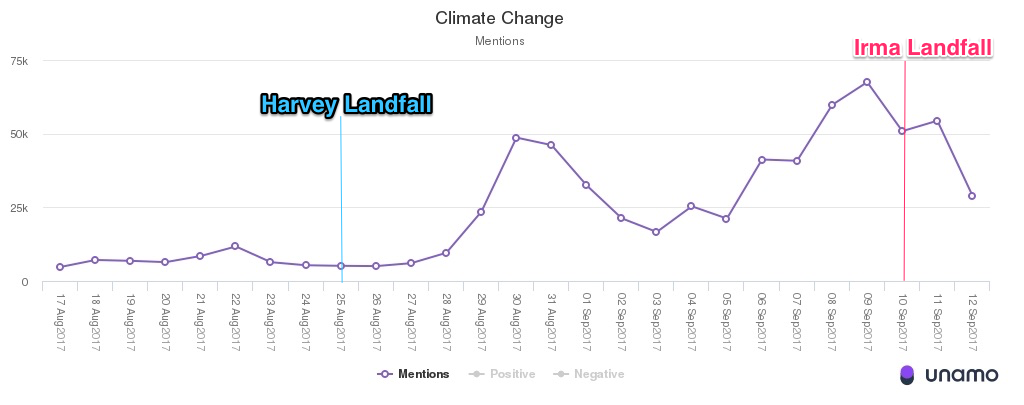
    Climate change mentions on social media

    Hurricane Harvey made landfall on August 25, 2017.

    On that day, there were just over 5,000 social media mentions of “climate change.” Between the 28th and the 29th mentions of climate change more than doubled.

    By the 30th, mentions peaked at nearly 50,000.

    By September, Hurricane Irma became a record breaker in more ways than one. Not only is Irma the strongest hurricane to ever form over the Atlantic, it also created a surge in climate change mentions.

    Mentions hit another low at just over 16,000 on September 3, but skyrocketed to a new high of 67,884 mentions by the 9th. Irma made landfall on September 10, 2017.

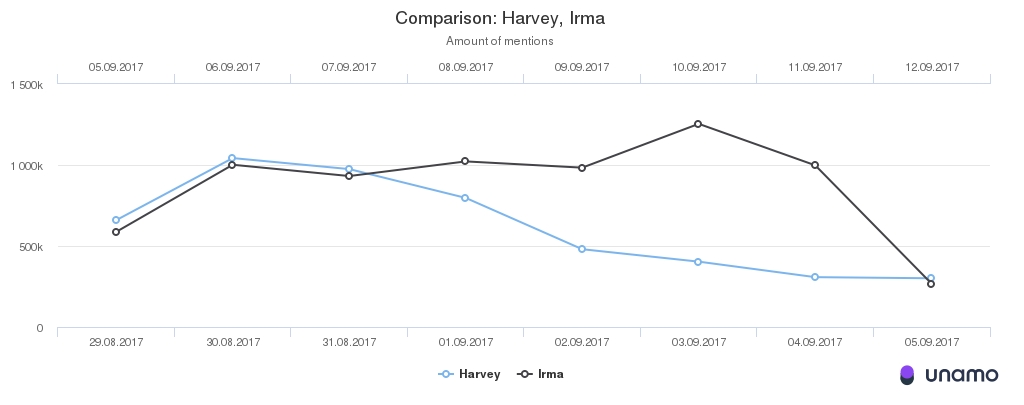
    So, how many people are talking about the hurricanes in general? Millions.

    Social media mentions about hurricanes Harvey and Irma

    Climate Change – Dirty Words or Dinner Conversation?

    It’s natural to talk about the weather. But there are those who don’t want climate change to be a part of the discussion.

    And Pruitt isn’t alone.

    Rick Scott, Florida’s Governor, banned the words “climate change” from all official communications in 2015.

    Meanwhile, Tomás Regalado (Rep.), Mayor of Miami, told the Miami Herald, that this is the perfect time and place to discuss climate change.

    “This is the time to talk about climate change. This is the time that the president and the EPA and whoever makes decisions needs to talk about climate change,” he said.

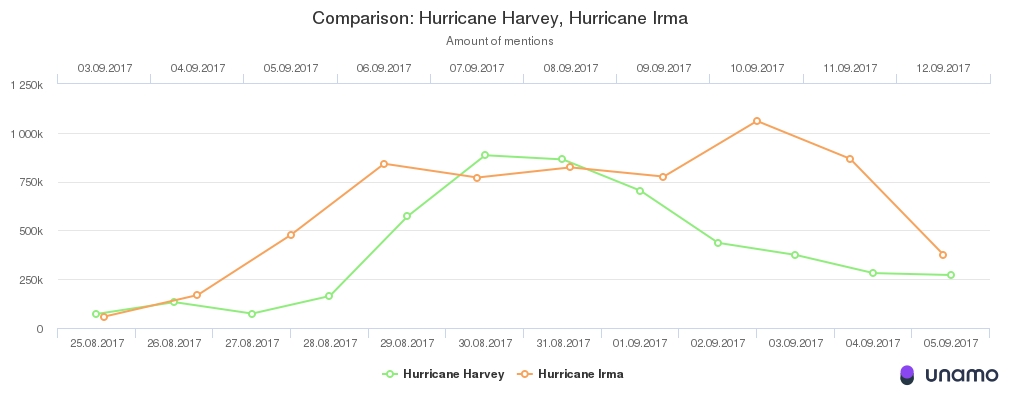
    So, are people really talking more about climate change or the hurricanes? What happens when we filter out mentions containing the phrase “climate change?”

    Hurricane Harvey and Irma social media mentions

    Mentions exclusively about Hurricane Harvey peaked on August 30th at 884,931 mentions.

    Irma’s mentions peaked on September 10th at just over 1 million.

    In comparison, climate change peaked at just over 67,000.

    So, Who’s Doing All the Talking? You Might Be Surprised

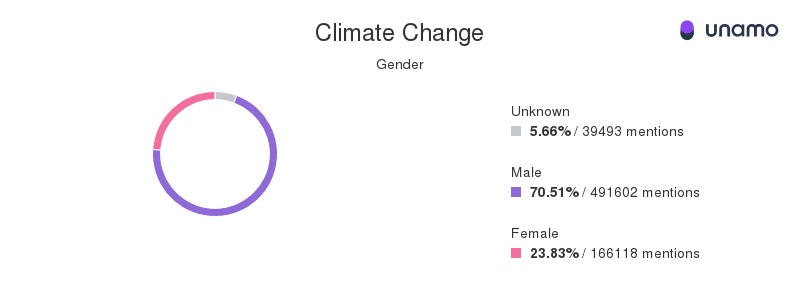
    According to our metrics, men are doing almost all the talking about climate change.

    climate change social media mentions by gender

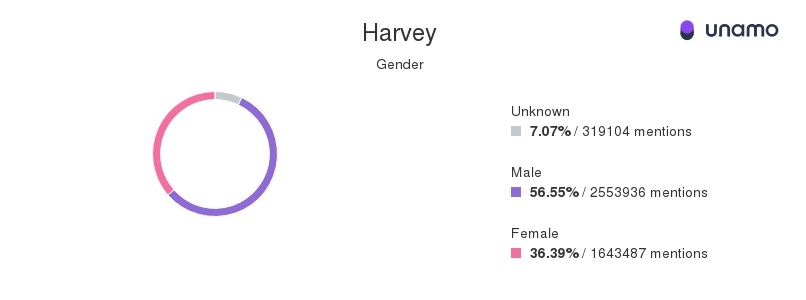
    Women only felt a bit more inclined to mention Harvey in a post.

    Hurricane Harvey social media mentions by gender

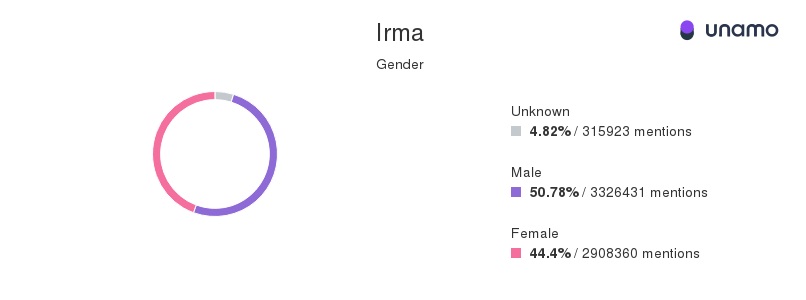
    Yet, it was Irma that inspired most women to speak up on social, with 2.9 million women leaving comments or posting.

    Hurricane Irma social media mentions by gender

    What Do We Talk About When We Talk About Climate Change?

    So, what are people discussing?

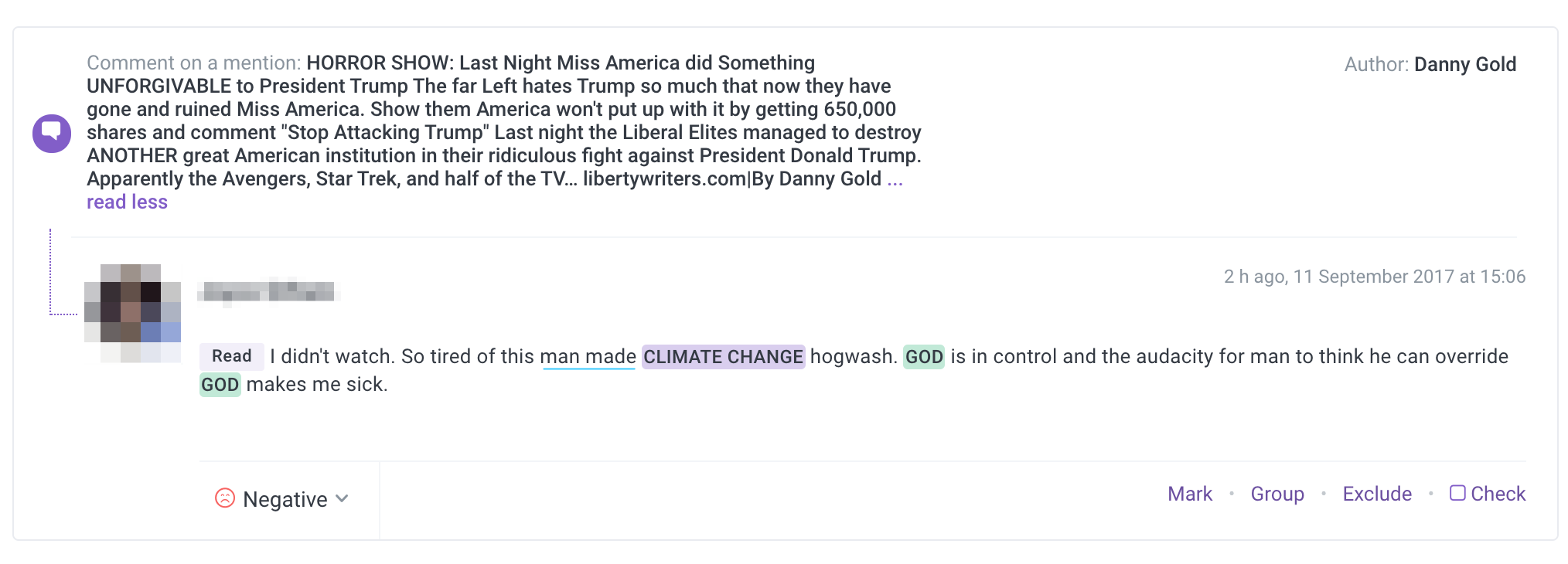
    After an initial scan, the words “man made” and “god” kept appearing in connection with the main phrase “climate change.”

    Out of the 637,000 mentions we tracked, almost 28,000 included the phrase “man made.” A further 59,000+ mentions included the word “god.”

    The number of mentions including the word “god” rose to more than 61,000 after Pope Francis condemned climate change skepticism.

    climate change social media mentions about god

    Further analysis showed that many of the mentions containing these phrases were made in response to posts about Jennifer Lawrence and Cara Mund, Miss America 2018.

    Both ladies made comments asserting that climate change is caused by human activity, sparking backlash on social media.

    man made climate change social media mentions And who are the men making waves?

    Top influencers include Andy Borowitz from the Borowitz Report over at The New Yorker, Dan Rather, Senator Bernie Sanders, and Robert Reich.

    Senator Bernie Sanders has recently called out Scott Pruitt on Twitter for being a climate change denier.

    If you’re not familiar with Andy Borowitz, he writes satirical political pieces. His post below received 12K likes, over 200 comments, and more than 2,500 shares.

    Andy Borowitz climate change social media mention

    On Twitter, the top influencers include:

    • The Washington Post
    • Alternative NOAA
    • Trump Texas
    • PolitiFact

    The list also includes comedians, meteorologists, and journalists.

    Most mentions point to the fact that climate change may have had an affect on the severity of the hurricanes now hitting the US.

    NPR social media climate change mention

    But it’s not just the liberals who are talking.

    Well-known conservative and libertarian influencers, including Rush Limbaugh and John Stossel, are almost exclusively writing posts denying climate change.

    Rush Limbaugh social media climate change mention

    Sean Hannity made a post smearing Jennifer Lawrence for her comments.

    Battle Lines Drawn? User Sentiment is Surprisingly Neutral

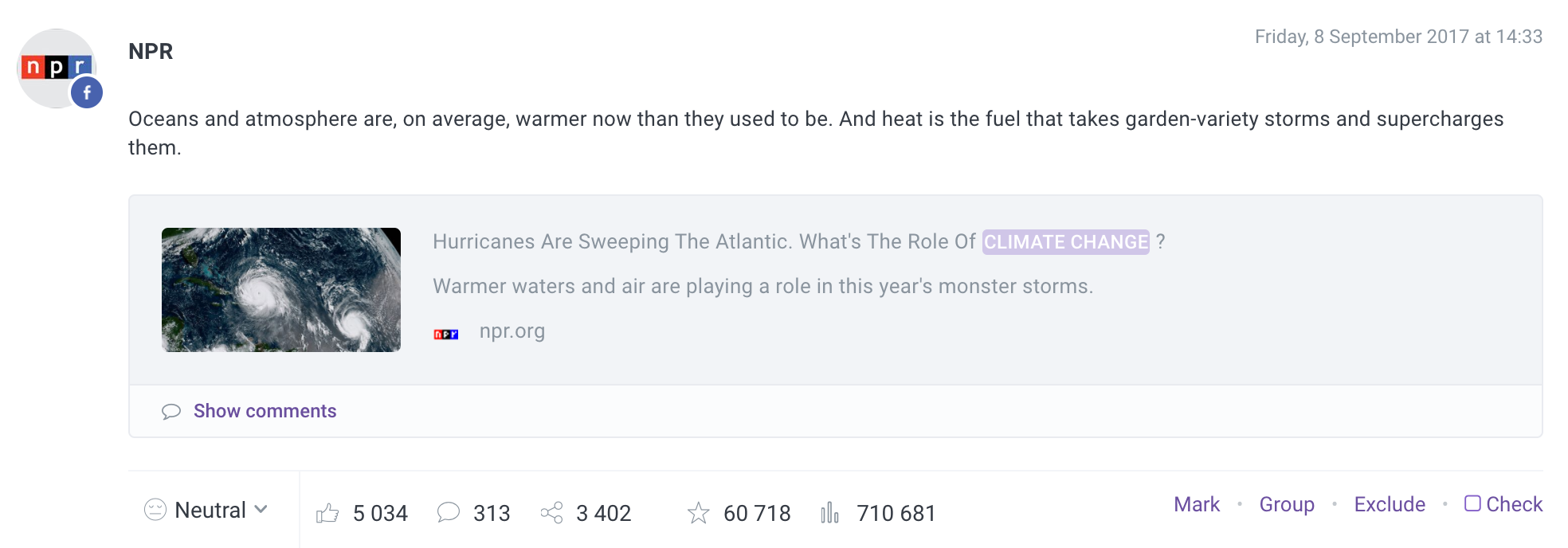
    Notice that the social sentiment for NPR’s post is categorized as “neutral,” reflecting the dominant sentiment of the discussion.

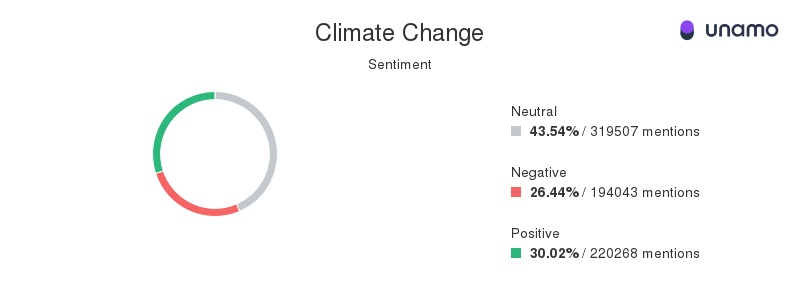
    Below, you can see there’s a fairly even split between negative and positive mentions regarding climate change.

    Climate change sentiment on social media

    NPR’s mention does not use any inflammatory language. All they’re saying is that oceans are warmer and warmer oceans result in superstorms. Thus, the neutral ranking.

    Our tool marked both Borowitz and Limbaugh’s comments as negative, even though Borowitz is using satirical language.

    Not everything is as heavy as all that. There’s also those attempting to add some levity to the situation. Here’s a positive mention from comedian Tim Hanlon.

    Tim Hanlon social media climate change mention

    At the End of the Day, Bad Weather Inspires Climate Conversation

    For North America, 2017 has been a particularly bad weather year, providing endless unusual weather topics.

    • 8.2 Magnitude Earthquake in Mexico (Strongest in a Century)
    • 2 Category 4 Hurricanes Hit US Mainland (First Time in History)
    • Wildfires in the Western US
    • Hail and Tornadoes in the Midwestern US
    • 2 Other Hurricanes (Mexico and US)
    • You Name It

    Natural Resource Defense Council climate change Facebook

    The variety and strength of these climate disasters are starting to take on Biblical proportions and are creating a perfect storm for climate change talk.

    Information from the National Oceanic and Atmospheric Information (NOAA) shows that the US alone suffered nine weather and climate disasters by the beginning of July 2017.

    These climate disasters have loss price tags exceeding $1 billion and have resulted in 57 deaths. The 1980-2016 average is 5.5 events.

    NOAA climate diasaster report
    Image Source: NOAA Statistics valid as of July 7, 2017

    The Governor of Texas said Harvey could cost anywhere between $150 and $180 billion. AccuWeather predicts Harvey will cost $190 billion alone, and that Harvey and Irma combined will have a $290 billion price tag.

    To put that in perspective, Katrina cost US taxpayers in excess of $110 billion.

    But besides the price tags, are these storms out of the ordinary?

    According to the National Hurricane Center, a typical Atlantic hurricane season (June – November) produces 11 named systems, of which 6 reach hurricane strength. By September, an average year would produce 4 named systems and 2 hurricanes.

    It’s September and the Atlantic season has produced 11 named systems and 6 hurricanes, causing NOAA to predict that the season will be “above average” with 19 named storms and 9 hurricanes by end of season.

    While blaming the unusual season on climate change may not sit well, the storm patterns are certainly to blame for creating climate change chatter on social media.

    Conclusion

    Whether it’s right or wrong to discuss climate change during climate disasters is beside the point. People are talking.

    Perhaps it has to do with the White Bear Conundrum. Once you tell people not to talk about white bears, all they can talk about is white bears.

  • Local SEO for Small Businesses

    Local SEO for Small Businesses

    The organic search results are already a tough place to fight for top rankings. Local search results?

    Even harder.

    Besides traditional SEO, there are a variety of local SEO ranking factors that small businesses and even larger franchises have to worry about when jockeying for the top positions for localized keywords.

    These factors include:

    • Google My Business – category, keywords, location, etc.
    • Mobile Signals – mobile friendly site, clicks, check-ins
    • On-page optimization – title tags, meta descriptions, NAP, content
    • Link building – trust flow, authority, amount of links linking to
    • Off-page local signals – citations, listings,
    • Reviews – quantity, quality, source strength, variety
    • Social signals – localized facebook profiles, twitter and instagram accounts, etc.
    • Personalization – your search history, likes, previous reviews, etc.

    In a nutshell, Google has compartmentalized these into three main local ranking factors:

    • Distance
    • Relevance
    • Prominence

    So, how do you separate your business from your local competitors?

    Some people lend more weight to different ranking factors, but as a safety net you should ensure that all of your boxes are checked.

    Start with Google My Business

    Start by heading creating a Google My Business (GMB) profile.
    how to setup your google my business page for local seo

    GMB pertains to each of the three local SEO ranking factors for businesses that Google outlined above, so this is really ground zero for your local SEO efforts.

    Ensure that all of your information is correct and the category you use to describe your business is the most accurate.

    You only need to create one GMB profile for your business and from there you can add additional locations if you’re a franchise.

    how to add a new location in google my business

    Your address will dictate where you appear in localized search results as well as contribute to your business’ appearance in local packs and local teaser packs.

    Since the closure of Google Map Maker, it’s extremely vital to get all of your business’ local information correct here as I would argue proximity is one of if not the biggest local ranking factor as you can see below.

    tracking keywords in multiple locations

    The further away the searcher is, the harder it is to rank highly. Despite this, it’s important to track keywords in surrounding local areas so you know where your business has the most SEO clout.

    The rest of the GMB information is pretty self-explanatory, but just to be sure you should run through this checklist:

    • Accurate addresses across all locations that are consistent with local directories
    • Local numbers for each location (don’t use 800 or 888 numbers)
    • Business hours
    • Category
    • High-resolution images of your products and locations (you can geotag them as well for an added local punch).
    • Get reviews from different sources

    Once your Google My Business profile is up, you should find it in the SERP results for branded queries.

    Google My Business results in local searches for branded queries

    Google Posts

    Businesses can now take advantage of Google Posts. Google Posts is a feature which enables businesses to share relevant content, updates, or offers on their GMB profile in the SERPs.

    google posts example

    The content can come in the form of videos, images, links, or just textual updates that are designed for quick engagement with users.

    For small local businesses, they provide a great way to post about special offers and information to users searching with branded queries.

    Name, Address, Phone Number (NAP)

    NAP is one of the strongest ranking signals that tells search engines your website and business is a possible solution to a localized query.

    Given that your NAP will cover Relevancy and Distance – 2 out of the 3 most important factors – it’s extremely vital that you are consistent on these fronts.

    NAP example local SEO

    NAPs are what will appear in citations around the web when other websites (like local listings) mention your business.

    For small businesses with one location, ensure that your NAP information is consistent and place it into as many local listing sites as possible.

    If you have multiple websites then it’s a good idea to keep a database of every location you have and ensure that every detail is catalogued somewhere.

    You can simply add in a new location as noted above with your Google My Business account.

    Do not attempt to increase the breadth of your business’ reach by allocating your business to a larger area; they already know where you are.

    You can create your NAP with the Local Business Schema.

    Local Listings: Where to list your business and how to check consistency

    Barnacle SEO will play a big part for small businesses in sending local signals to Google that other people have reviewed your business and that the information you’ve listed is consistent in different places.

    The listings specifically will help with identifying your website as a local solution (distance), within the right categorical listings (relevancy), and they will help you garner more positive reviews (prominence).

    The most popular citation sites include:

    • Facebook
    • Yelp
    • BBB
    • TripAdvisor
    • Yahoo Local
    • Yellowpages
    • And more

    Once you’re present on a variety of different citation sites, you should run a check to make sure all of the information is correct on each one.

    You can use tools like Yext to identify which local listings your business is showing up in and correct any mistakes you find.

    local citations checker yext

    Appearing in as many relevant local citations as possible will send good local signals to Google that your SMB is a solution for related queries in the corresponding areas.

    Don’t just shoot for the top listings though; city specific listings are important as well as the national or worldwide directories.

    It’s important to keep your own database of where your business has been listed so you don’t duplicate any of your local listings. This can cause the search engines to index the wrong data and affect your rankings for localized queries and local pack appearance.

    A good way to avoid this is to run checks for your business’ name, address, and phone number individually when inputting your business into a new local listing.

    This includes old phone numbers, previous businesses names, and former addresses. Even abbreviating something like Pine Tree Avenue to Pine Tree Ave. could cause you to miss a previous listing.

    Once you’ve ensured that everything is consistent, you can double-down on your listings with each of business location to garner more reviews and help your business’ prominence signals.

    one local business with multiple locations for SEO citations

    Reviews: Increasing Your Website’s Prominence

    Your business’ online prominence is how prominent or well-known your business is to your local community.

    You and your friends probably have a list of your favorite restaurants you like to visit and recommend to anyone who will listen. Google does its best to emulate that with it’s prominence ranking signal.

    Essentially, Google scours the web to see how people have rated your business and what they say about it. The more positive reviews you have, the more prominent your business is.

    Some citation websites are more prominent than others, with the top 5 in the U.S. being:

    • Google My Business
    • Bing Places
    • Apple Maps
    • ExpressUpdate
    • Axciom

    There are numerous places that Google will pull reviews from and list on your GMB panel.

    increase local seo prominence with good reviews

    Having high scoring reviews will not only help you rank for Local Packs, but they can also be featured in normal organic results as rich snippets reviews, which help with your click-through-rates.

    rich snippets example for local SEO

    Both review types will help convince customers to pay your business a visit, and the higher quality reviews you have, the more prominent ranking signals you’ll send to Google for local results.

    If you’re collecting email addresses from in-store customers via your app, special offer signups, or redeemable gifts, you can automate reviews by sending out special offers in newsletters or in-store to customers who review your business online.

    But remember, quantity isn’t everything. You have to really give them a positive experience for the reviews to shine.

    Don’t be too afraid about a few bad reviews either, as they let Google know that the people reviewing your business are human and no business is perfect.

    On-page Optimization

    There’s a common myth floating around that once you optimize for Local SEO, your on-page optimization and content doesn’t matter as much.

    This is wrong.

    Valuable SERP real estate exists outside of standard Local Packs and your well-optimized content is your ticket to take up that space.

    It’s a good idea for small businesses to extrapolate anywhere they can to send more local seo signals whenever possible to increase the breadth of their relevance to queries.

    Headers and Titles

    Make sure your homepage H1 and/or title tags feature your business name and city as they’ll lend weight to your local ranking.

    Don’t just stop there though. You’ll need to be consistent with your SEO across your entire domain, so make sure to reference the larger metropolitan area if you can (if applicable).

    Your appearance in Local Packs will depend on your actual physical address; however, you can still rank for traditional organic results by placing the larger metropolitan areas your business typically services in your content.

    Location Descriptions

    Too often I’ll see a webpage that just lists store locations and stops there.

    small business multiple location subfolders for local seo

    Instead of opening each location up to its own webpage, the links go straight to Google Map directions.

    This takes away an extra opportunity for small businesses to improve their local SEO content with location descriptions.

    A good location description would look like the following:

    Located just off the 405 freeway in the beautiful Brentwood Area, our customers enjoy our finely brewed European coffee in the heart of West Los Angeles’ burgeoning college community. Sit outside on our patio and watch the sun set just behind the Santa Monica pier or get your coffee to go as you make the short walk to Hollywood Blvd.

    The description lists a few prominent local landmarks not far from the local coffee shop and does so without being heavy handed with keywords.

    It’s a good description as it enhances local SEO efforts without the small business losing any integrity.

    Images

    Small businesses can also add more photos of each location when each has it’s own page. This allows them to optimize the alt tags and filenames with city and state to rank for images.

    Some businesses will geotag their images for more exact location matches, but it’s not a must as Google has gotten exceptionally good at recognizing the locations where images were taken.

    URLs

    To maximize their appearance in local searches, small businesses should create the relevant pages or subfolders for each location.

    subfolder for each location in local seo for small businesses

    With the city and/or state in your URL, you’ll send stronger local ranking signals. If you’re going to change your URL structure, make sure to set up 301s to the new URLs so you don’t lose any traffic or link juice.

    Meta Descriptions

    Optimizing your meta descriptions with local keywords will help drive CTRs for people looking at your business in the organic results.

    Meta descriptions are not direct ranking factors; however, a well written meta description can entice users to click and build up your on-page metrics, which do affect rankings.

    Local Link Building

    Building links from other local peers can build up your sites relevance and prominence ranking signals.

    Small businesses should be looking for links that are from:

    • Locally relevant sites
    • Industry relevant sites
    • Highly authoritative sites

    The goal is to push your website up the SERPs from obscurity to relevancy, and the more quality local SEO signals you have the more locally featured your website will be.

    small business seo link building from local sources

    Many small businesses don’t have the time or budget to hire a content creator. Most of the time they need to rely on local articles and publications to feature their business for a variety of reasons.

    How do they do this?

    Small business owners can reach out manually to a few different local publications such as:

    • E-magazines
    • Local papers
    • Review blogs
    • Schools to sponsor kids
    • Local event hubs

    These websites spend time and effort to give valuable content to their readers, so if a small business provides value and interest, they will feature it.

    You can also post in job directory sites if you’re hiring. The links aren’t super valuable, but with enough they can give you a small boost.

    Local Packs

    Ranking in Local Packs is akin to winning the local SEO lottery.

    seo local pack results

    This is where all three main local SEO factors come into play:

    • Prominence – user reviews are compiled here
    • Relevance – the category of your business is in conjunction with the query
    • Distance – displaying local results that are close to the searcher.

    When a searcher has their location settings turned on for queries that contain near me, close by, closest, etc., Google will typically show the closest results.

    However, when I searched for “pizza near me” on a desktop device with my browser’s location settings with allowed permissions for Google, I received a Local Pack result with three pizza restaurants.

    As a direct search for restaurants in close proximity to me, I should expect that these may be the three closest pizza restaurants.

    This was not the case.

    local pack results without desktop geolocation

    There were approximately five other pizza restaurants closer to my exact location than the 1st Local Pack result.

    When typing the same query from the same position on a mobile device, I got the exact closest three results in real time.

    mobile local pack results with geolocation turned on

    Location settings on mobile devices are more user friendly in terms of the user’s knowledge about whether or not they’re turned on.

    Thus it’s more atypical that a searchers direct location is known by the search engines and they return more results based on a business’ direct proximity and not prominence.

    When local queries are entered without the “near me” or “close by” keywords, more of the traditional local SEO factors come into play such as:

    • Address proximity – how close is it to the searcher
    • Citation consistency – having all citations listed exactly the same
    • Citation authority – how strong are the citation domains referencing a business
    • Your domain strength – it’s SEO prominence is a big factor here
    • Business category – its overall relevance to the query
    • On-page factors – bounce rate, time on page, etc.

    You can track your appearance for the Local Pack SERP feature in any Unamo SEO campaign so you know when upticks in web or foot traffic may be incoming.

    monitor local pack results for your business

    Social Media Profiles & Listings

    Don’t forget that social media channels like Facebook act as their own citation sites.

    social media citations with facebook places

    Sections like Facebook’s Places list their own reviews, descriptions, and locations of listed businesses. Make sure you create individual listings for each location so you can separate business hours, special offers, and more.

    Always link to and from your site with your profiles to foster more engagement and reviews. While the biggest ROI for small businesses usually comes from search, social media platforms have their own role when the search engines are overcrowded and competitive.

    Remember, people still visit your website from your social profiles, which help with your on-page metrics.

    If your business is on Twitter or Instagram, take advantage of local hashtags that your business can be found on.

    localized hashtags on social media

    Optimize as many social media profiles as possible for each business location you have to increase your local signals and engage with potential customers.

    Conclusion

    Small businesses attempting to solidify themselves as top ranking domains for local searches need to ensure that their local seo efforts are as coordinated as their traditional SEO efforts.

    There have been too many documented cases of local businesses being buried in the search engines due to bad keyword optimization, inconsistent NAPs, poor business categorization, a lack of industry related links, or just poor service in general which leads to too many bad reviews.

    Execute your local SEO as flawlessly as possible and you’ll at the very least ensure that you’re one of the top ranking domains in terms of categorizational proximity.

    Monitor your SEO efforts for local and national results and optimize your website in the areas that require the most improvement.