
Do you have a page that’s stuck in the purgatory of lower level search results?
How much would you pay to skip the line and become number one?
What if you didn’t have to pay anything?
Meet featured snippets.
Also known as “rich answers” or “direct answers,” featured snippets are bits of your text that appear in an “answer box” in result 0 of the search results. Where? Result zero?
That’s right. There are some articles that can outrank even the best pages. All they have to do is answer a simple question. And the best part?
You don’t have to be a superbrand or have massive domain authority.
This article will tell you:
- What a featured snippet is and how to get your page to rank for one.
- How to implement SEO tactics for content you want to feature.
- How to track featured snippets once you’ve landed one.
What Is a Featured Snippet? How Google Selects Text for Answer Boxes
What is a featured snippet?
A featured snippet is a bit of text just like this one that Google cuts from a page and places in a box in the zero position above all other search results.
Google features snips of text that answers questions like the one above – what is a featured snippet?
Featured snippets usually include:
- The Answer and an Image
- The Source’s Page Title
- The Source’s Link and URL
Here’s an example of a featured snippet for the common query “how to boil an egg:”

Some important points about how Google selects text for featured snippets:
- A featured snippet always answers a question in a clear, concise way.
- A featured snippet almost always comes from a page that’s already ranking in the top five – sometimes ten – search results for that query. It does not have to come from the #1 position.
- Often, a featured snippet is lifted from a portion of text that is between 40 and 50 words long.
- A featured snippet is formatted in one of the three formats Google likes best – the paragraph, the list, or the table. Often, it’s also accompanied by an image.
Here is the featured snippet for the question “what is a featured snippet:”

As you can see in the example, the featured snippet and the Related Questions box take up the entire results page before the fold. That’s a lot of prime SERP real estate.
So, does the Ahrefs article meet the requirements? Let’s find out.
Does the article answer the question in a clear and concise way?
YES
- The answer is a clear definition of “featured snippet” and includes the phrase “a featured snippet is,” which often boosts the probability of landing in the answer box.
Does the article come from a page that’s already ranking in the top ten?
YES
- The article is ranking 6th for the phrase “featured snippet” and 7th for the query “what is a featured snippet.” Notice that it’s not ranking number one.
Does the article give a definition that’s between 40 and 50 words long?
YES
- The answer is 45 words long, hitting the sweet spot of the featured snippet word count.
Is the article formatted in one of the three featured snippet formats Google likes best?
YES
- The answer is formatted as a paragraph, which happens to be one of Google’s favorite formats at the moment. More on that later.
Now, let’s pick an example that’s a little less niche.
In a lot of cases, you’re going to find that Wikipedia holds the featured snippet position. Here’s an example of a featured snippet for Wikipedia:

So, to grab a featured snippet position all you have to do is identify three things:
- What questions could you answer?
- What questions already have answers?
- How can you make content that will answer questions?
Pro Tip: The above criteria are not foolproof for landing or keeping a featured snippet. At the end of the day, Google’s goal is to answer questions as fast as possible. And Google may find that the best answer is a 90 word paragraph on page 70 of its results. While rare, it’s still possible.
Do you want a full guide on all of Google’s SERP features? Find out how to rank for almost anything! Check it out: A Definitive Guide to Google’s SERP Features
Who Should Try to Rank for Featured Snippets? You May Be Surprised
Now that you know what a featured snippet is, the next question to ask yourself is:
Are featured snippets right for me?
The good news is that featured snippets are for everyone. You don’t have to be a powerhouse brand or have hordes of gold to bag an answer box. Google also doesn’t seem to favor sites with high authority domains or impressive backlink portfolios.
All you have to have is know-how and patience. Think of featured snippets as a chance to rocket your pages past the Godzillas of your industry.
That means that featured snippets are right for most of you. Anyone who creates content that answers users’ questions can qualify for a featured snippet answer box.
That includes websites that have Q&A or FAQs pages.

At the same time, there are those who may want to consider ranking for other SERP features first. A good example is local, brick-and-mortar businesses.
Let’s say you want to drive foot traffic to your local coffee shop. While answering questions about cold brew coffee may drive more traffic to your website, it’s not necessarily going to drive more foot traffic through your front door.
Everything depends on your end game. Do you want to increase traffic to your site? Try for a featured snippet. Do you want to increase foot traffic to your shop? Try for local packs and other local features.
Are you a small, local business? Do you want to find out more about local SEO tactics and how to rank for features like local packs? Check out our guide: Local SEO for Small Businesses
Why All the Fuss? How Do You Benefit From Featured Snippets?
Are featured snippets that big of a deal? they show up in the SERPs anyway?
In a sample of one million SERPs, Getstat found that featured snippets show up in 23.25% of search results in April 2017. That’s up from 9.28% in January 2016 and 15% in July 2016.
It’s obvious that Google is increasing the number of page results that include featured snippets and doesn’t show signs of slowing.
So, what can securing a featured snippet actually do for you?
There are those that say featured snippets are sometimes undesirable. Let’s say your answer to a question is so perfect that anyone who reads it gets all the information they need.
They don’t have to click through to your site because their needs are met. Thus, the traffic and CTR drops, and you lose potential leads and conversions.
While that may be true for some, most experience a surge in traffic and a higher CTR after landing a featured snippet position. That’s especially true for pages that were lower in the rankings prior.
For example, one of our articles containing the keyword, “pinterest marketing strategy,” ranked for a featured snippet between August 25 and September 21, 2017. The CTR for the keyword was 15.41% on average during that period.
Before landing the featured snippet, the article ranking for the keyword “pinterest marketing strategy” had a CTR of 7% on average.

Reasons you may want to rank for a featured snippet:
- Featured snippets increase your visibility in Google SERPs, as you occupy two positions – both the featured snippet and your original SERP position. Double exposure.
- Research shows that featured snippets consistently result in a higher CTR and thereby drive more organic search traffic to your site.
- Featured snippets also increase brand trust and credibility. Ending up in an answer box is a nod from Google to users that your content is the best answer for them.
Let’s say your page is in the top ten, but it isn’t ranking for the number one position.
Ranking for a featured snippet leapfrogs your page over higher results to “position 0” at the top of the SERPs. The shortcut can move you above websites with better backlink portfolios and higher domain authorities than you.
Here’s a table that shows where Google pulls content for featured snippets:

As you can see, Google took the highest percentage of featured snippets from articles ranking in the 3rd and 4th position of the SERPs.
Ranking for Featured Snippets – It’s Not as Hard as It Sounds
As with every other aspect of SEO, content is king. Yes, you’ve heard it a million times, but it’s worth repeating.
You can’t force Google to rank you. All you can do is provide the best content.
For featured snippets, that means providing a clear, simple answer for a direct question. But, how do you decide which questions to answer in the first place?
How to choose between fresh content or old content:
Start by deciding whether or not you want an existing page or a new page to rank for the featured snippet.
If you want an existing page to rank for a featured snippet, then you need to check it’s stats.
In order for Google to choose your page, you’ll need to boost your existing page metrics. Make sure the following page stats are higher than the overall average for your website or blog:
- CTR
- Bounce Rate
- Average Session Length
- Time on Page
- Time on Site
If people are bouncing or the CTR is low, Google may take it as a sign that your information isn’t useful or engaging for your users. In that case, you will need to revamp the whole page if you still want that content to compete for a featured snippet.
How to choose your question for featured snippets:
Let’s say you’ve decided to make new content. In that case you will want to:
- Conduct Keyword Research
- Identify Questions or Invert Keywords
- Identify Keywords Ranking for Featured Snippets
- Decide on a Strategy for Ranking
Before you conduct keyword research, you might want to find out which of your keywords render results for pages with featured snippets and other Google SERP features.
Here you can see that the keyword “rich snippet” renders result pages that contain ten Google SERP features. You can also see that the keyword is already ranking for the featured snippet.
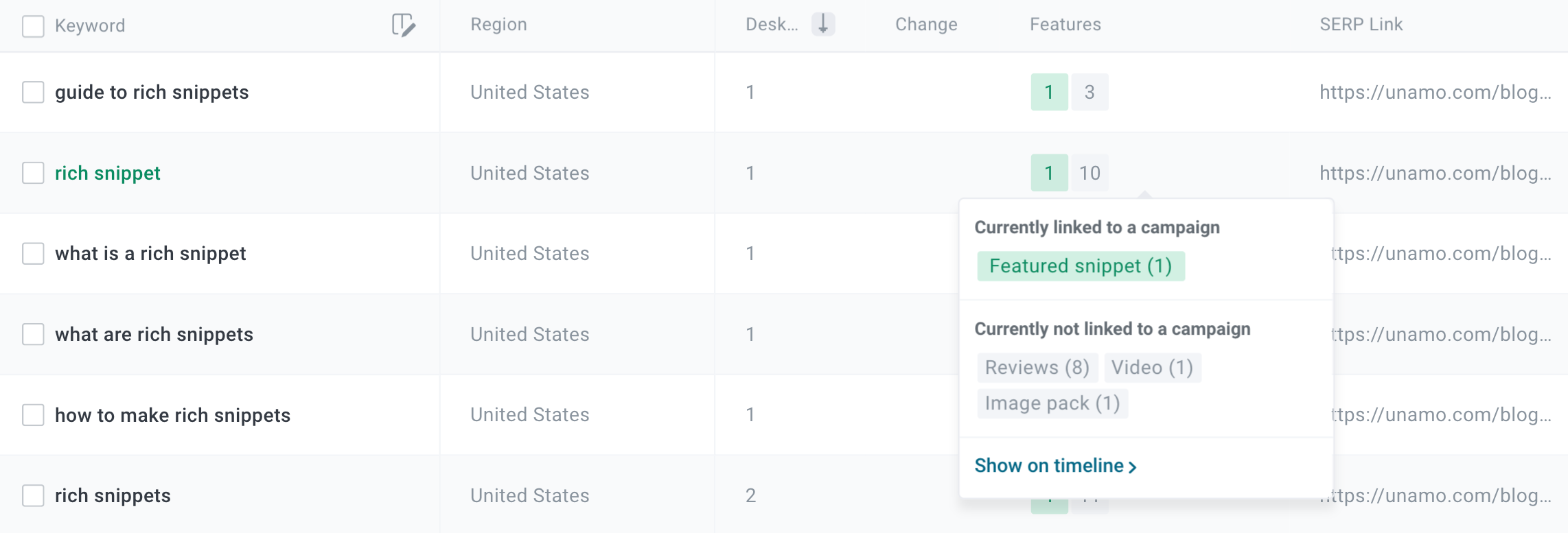
Checking which keywords already render pages containing featured snippets is a good way to conduct competitor research. You can find out if the answer box for your keyword is up for grabs of if you have to compete for the prize.
Now, let’s say you decide that your main keyword is “contact lenses.” It’s best to look up the phrase and see what Google suggests and what turns up in related searches.
Here’s five of the results that we got for contact lenses:
- Contact Lenses Online
- Contact Lenses Costco
- Contact Lenses Near Me
- Cheapest Contact Lenses
- Contact Lenses for Astigmatism
Next, you’ll want to invert the keyword phrases:
- Where can I buy contact lenses online?
- How do I buy contact lenses online?
- Where can I buy contact lenses near me?
- What are the cheapest brand of contact lenses?
- Which contact lenses are best for astigmatism?
Keep in mind that questions that include phrases such as “near me,” often lead to local packs or other types of SERP features. So, you don’t want to choose a question like:
Where can I buy contact lenses near me?
For this question, Google serves the user a local pack featuring local contact lens vendors in the user’s direct vicinity.
So, if you want to rank for a featured snippet you should try for questions with less subjective answers.
How often do featured snippets show up with other SERP features?

Pro Tip: You will also want to avoid questions where answers are quick facts:
What’s the capital of Bolivia? How many feet are there in a mile?
Google answers these questions in another SERP feature called Knowledge Graphs. They take their answers from three sources Wikidata, Wikipedia , and the CIA Handbook. You cannot rank for these SERP features.
Try to choose questions you could answer on a Q&A or FAQ page or with dedicated blog content.
Here are three other alternative ways to find questions people want answered:
Alternative One:
- Think of logical questions often put to people in your industry.
For example:
How do I put in contact lenses?
Notice that there is no featured snippet in the SERPs for that question:
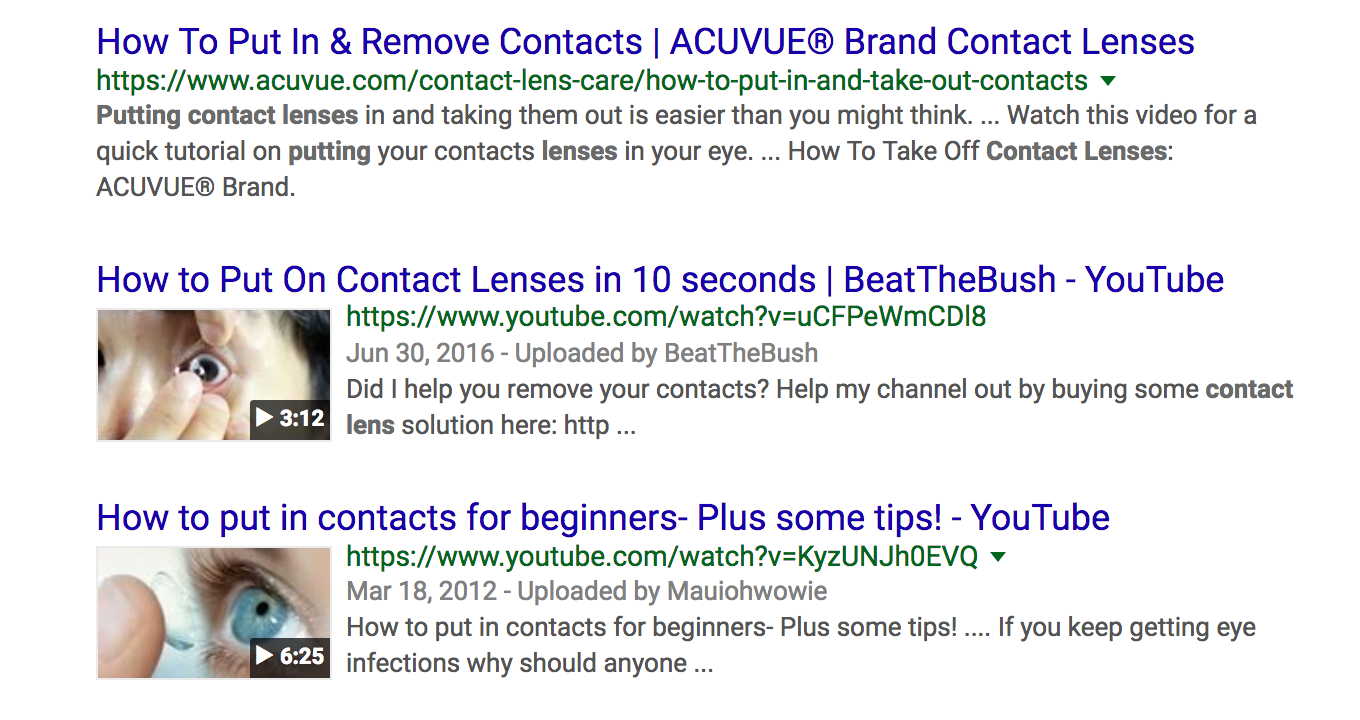
No featured snippet box means that you have an open playing field. When you notice that there is a featured snippet for your query, find out how you can do better. More on that later.
Alternative Two:
- Read the comment sections of articles already ranking for your keyword.
Find out what questions your competitors’ pieces have failed to answer by reading the comment sections of their content. Go through the top 5 or top 10 results for your keyword to see if there’s anything they’ve missed.
You can also check out sites like Quora.
Alternative Three:
- Use a site like Answer the Public to generate questions related to your keywords.
The phrase “contact lenses” generated 181 potential questions. Here’s an example of featured snippet queries via Answer the Public:

Keep in mind that high search volume keywords and longer queries get featured snippets more often. Also check the Related Questions boxes as they are often paired with featured snippets.
By answering these Related Questions, Google may choose you for various featured snippets with similar phrasing.
Here’s an example of one of our articles that’s ranking for a featured snippet across three separate keywords:

How to create content for keywords that don’t have featured snippets:
Now that you have your question, you can start writing your content.
- Start by adding the question as a header in your article, either H1 or H2.
- Repeat the question verbatim in the body of text underneath the header.
- Start your answer by rephrasing the question – What is a dog? A dog is…
- Finish by providing a clear and full answer to the question you’re targeting.
- Try to keep your initial answer between 40 or 50 words long.
- Format your answer in one of the three formats Google favors.
- Consider using tagging
,
- ,
- ,
- After answering the question, provide added value and more details.
- Paragraph
- List
- Table
- Did they leave out any information, details, or examples that I could add?
- Do I have access to fresh or unique data that could spruce up the piece?
- Do I have an original approach to the topic backed by great writing?
-

7 Tips on How to Use Social Media for Market Research
When Dove launched its #SpeakBeautiful campaign in 2016, it relied heavily on social media market research to compile the data it needed for its social media strategy.
They analyzed over 5 million social media mentions on Twitter and found that approximately 80% of female users online had experienced negative body shaming comments.

What happened next was one of the most effective online marketing campaigns of the 21st century:
- 36% decrease in body shaming comments on Twitter
- 63% increase in sales
- 168,000 mentions with the hashtag in a year
What Dove and Twitter used to their advantage, businesses are now turning to in droves – using social media for market research.
Social media market research is the process of gathering quantitative and/or qualitative data from social media platforms to understand social, consumer, or market trends.
Other forms of market research can also be effective – such as surveys, focus groups, online polls, etc., – but are costly, time consuming, and inconclusive.
Social media market research is a better business investment as it:
- Has a higher ROI
- Gives immediate and/or historical data
- Returns results from independent environments
There are a variety of different methods, tools, and tips you can use to uncover market insights on social media, which we’ll cover in this post.
Establish Goals
Every social media market research campaign has to have a clear goal in mind:
- Do you want to conduct market research on your brand, products, online consumer behavior, consumer insights, customer service, or competitor insights?
- Do you want qualitative or quantitative data or both?
- If so, what measurements will help you define this?
- What social media channels do you want to mine data from?
Establishing a clear goal will help you plan and execute the way in which you attain your information.
1. Define Your Target Goal
Researching consumer insights on brands and/or products has long been a staple of social market research.
To define a target goal, you must first definitively state what your business wants information for:
- Product research
- Product launches
- Behavioral insights on target consumers
- Customer service
- Defining buyer personas
In social media monitoring, this takes place on a more granular level; you can parse through each mention and gather feedback as you would an open-ended survey.
On a social media listening level, you can aggregate insights to establish trends and data in quantitative form.

In Dove’s case, they targeted quantitative social media behavioral insights that were affecting their target consumers.
Thus, their market research strategy probably looked like this:
- Identify a target demographic (adult women) and their pain points (beauty / body image).
- Recognize the places (social media platforms) where their target demographic is most confronted with these pain points (body shaming).
- Undergo intensive research on how target consumers are affected in these places (social media market research).
- Create a campaign that gets to the heart of the issue by having the target demographic assess the problem organically (women choosing which door to walk through).
- Publish the data (research findings) in tandem with the campaign (visual content) via the medium or place where the target demographics experience the pain point the most (Twitter).
The end result was a viral campaign that really began with understanding social behaviors on social media.
This is just one example of a brand relying on social behavior to market its products, but there are a variety of ways social media market research can be used to boost business.
2. Choose Quantitative or Qualitative Data or Both
Quantitative data will come in the form of concrete numbers you can use to evaluate or measure your research.
This can come in the form of:
- Likes
- Shares
- Comments
- Mention volume
- Share of voice
- Reach
- Followers
- Subscribers

Depending on the social media platform, there are numerous metrics you can use to compile quantitative data.
Qualitative data will represent more of the “sentiment” and interpretation of certain topics in regard to your research.
Commonly, this kind of data and research is performed daily by social media managers in regard to customer service and identifying feelings about the brand or products.
This can come in the form of:
- Sentiment analysis
- Word contextualization
- Theme categorization
- Industry trends
Qualitative research is usually a precursor to quantitative social media research – it looks to uncover a certain feeling in relation to a topic.

Think of qualitative research as social media monitoring to uncover specific mentions and feelings about a topic.
Then by applying social media listening to understand the more widespread sentiment, trends, and context in aggregate, you can get more quantitative data to draw conclusions from.
For example, a business discovers that they have 1,000 mentions about their product (quantitative) of which 84% of the mentions have a positive sentiment (quantitative).
3. Choose Social Media Channels
Deciding which social media channels to mine data from is the next most important step in establishing how you want to acquire your data.

Different social channels have different demographics depending on region and behavioral norms for the channel.
Conducting social media market research on modeling careers on Twitter, for example, will yield much different results than on LinkedIn.
If we look at the demographic data for each social channel in 2016, we’ll notice a few trends and data groups that can help us choose which channels to pick.

What’s more is that you can pivot your market research goals to these specific channels to try and mine more data from target demographics.

Again, how you choose channels for your social media market research will depend entirely on your goals and strategy, but choosing the right channels is a vital step.
How to Get Social Media Market Research Data
There are numerous social media analytics platforms out there that can help you acquire the data required for actionable insights.
4. Choose The Right Tool
Choosing the right tool is as paramount as defining a goal – businesses need a tool that allows them to:
- Mine a high volume of mentions from the necessary channels
- Clean the data when necessary with features that can fine-tune results
- Provide actionable and conclusive data with advanced metrics.
For our examples we’ve been using Unamo Social Media Monitoring, but there are also a variety of other tools that can help mine the necessary data.
Some tools specifically monitor one channel, while some do a multitude of social media channels, blogs, and news publications.
Choose what’s going to give you the most relevant data for your target goals and demographics.
5. Choosing the Right Keywords
Your keywords are essentially the questions that will shape the results you get.
When coordinating your social media market research, it’s vital to understand which combination of keywords will help you attain the data you want and exclude the data you don’t.
Try to be generic with your search terms to cast a wide net; however, you need to ensure the data you’re getting is as detailed as possible.
For example, if we set up a topic to find out how people feel about the iPhone 8 and 10, then we will want to exclude certain terms that vendors might use that flood social media.
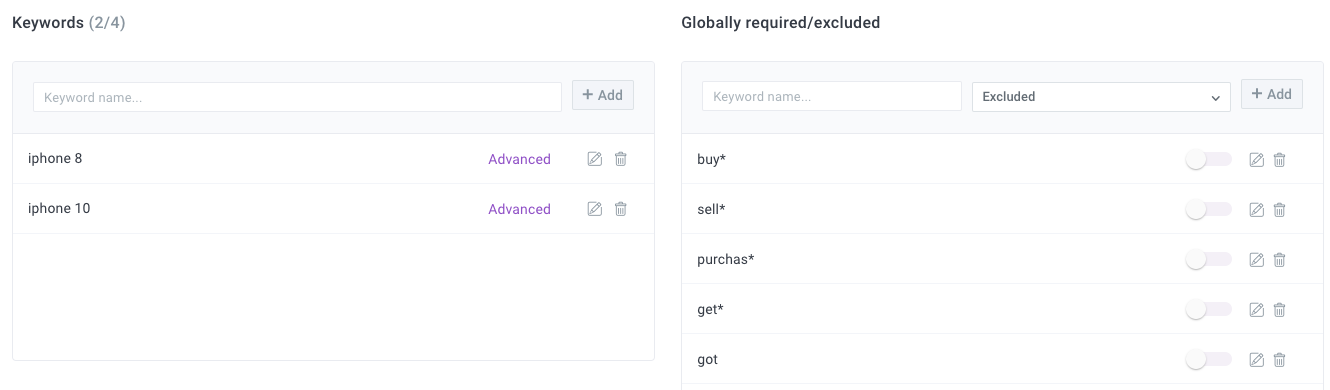
We use the asterisk rule in order to make sure that any variations of the root before the asterisk appear in the results.
This enables businesses to find mentions about the product itself and exclude words revolving around selling the product.
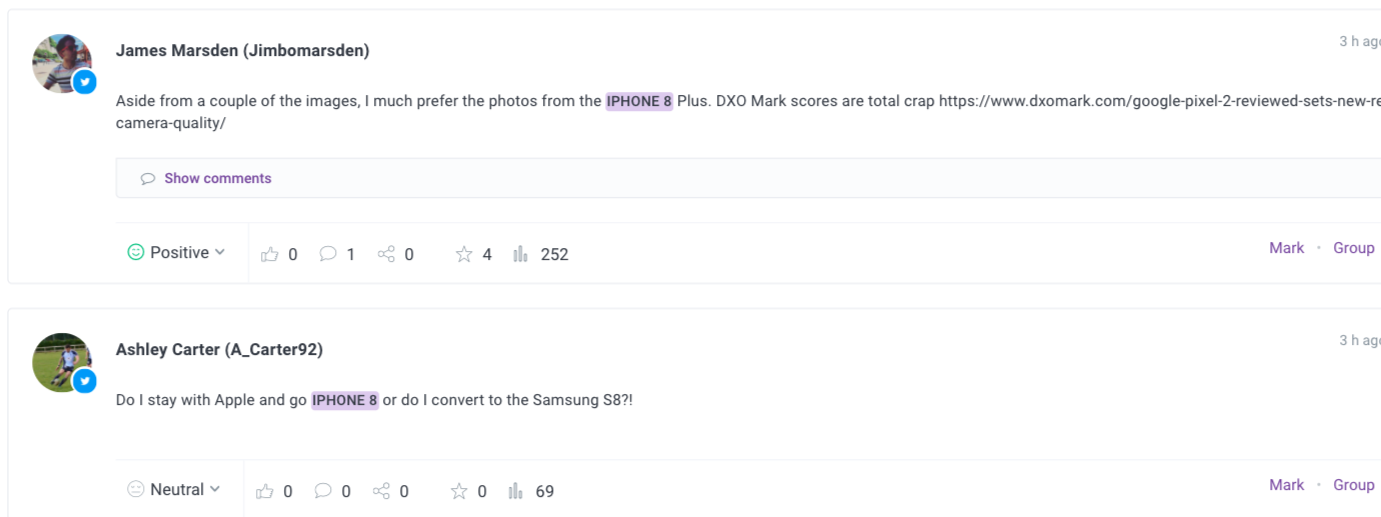
From this qualitative data, businesses can infer that a lot of discussion is taking place about the iPhone 8 camera and batteries, which they can then use to:
- Track additional keywords revolving around these subjects in relation to the product.
- Understand the quantitative data for the new keywords based off the qualitative results
- Formulate a marketing strategy that can capitalize on the positive feedback and pivot against the negative feedback.
We can also easily attain qualitative data from word clouds which depict the most common words appearing in context with the main keywords.
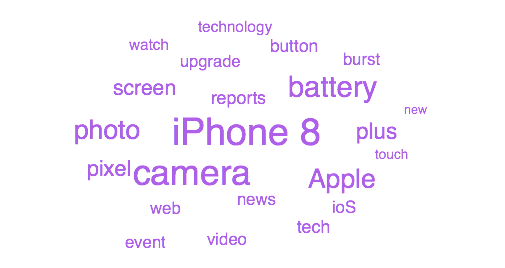
Market research strategies vary depending on research goals, but it’s a good overall approach to cast a wide net and then build a quantitative data strategy with social listening tools.
6. Data Cleaning
Now that we’ve identified a trend within our social media topic, we can further parse the data to uncover more tailored market research data.
Data cleaning is the process of recognizing irrelevant, misleading, or incomplete parts of your data set and modifying your parameters to reflect more accurate data.
This can be one of the most time consuming aspects of social media market research as it requires a lot of time and patience to uncover significant trends that are bringing in unwanted data.
For example, companies like Kleenex, Sharpie, or Google may have an extremely hard time data cleaning for mentions about their brand because their brand names have become nouns or verbs.
Similarly, a brand like Target faces difficulties because the word is both the brand name and a commonly used noun and verb.
Thus, these brands have to be extremely meticulous about how they use additional keywords in conjunction with their brand for social media market research.
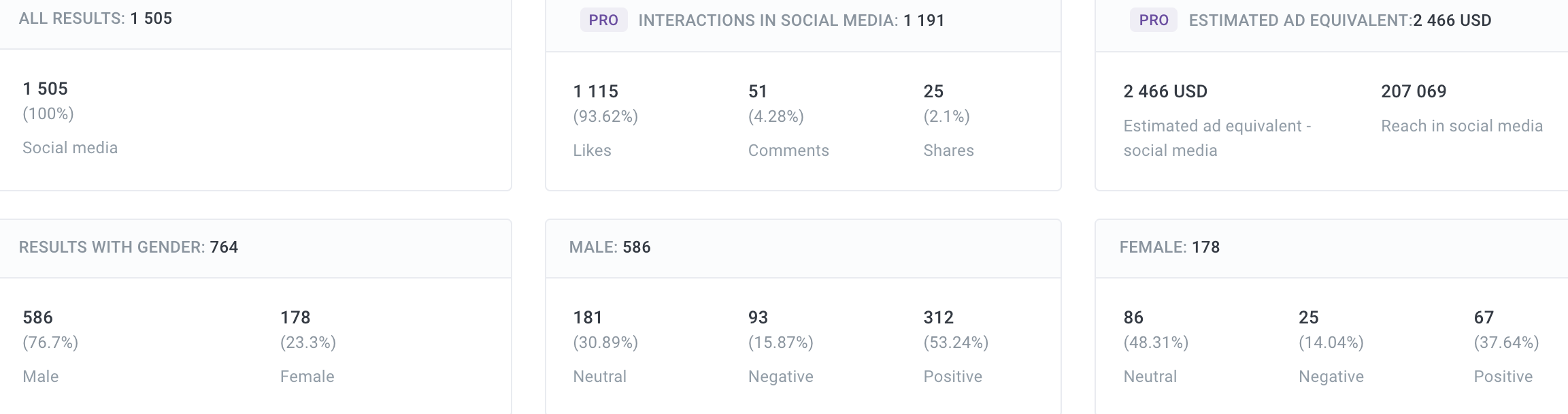
In our example, we’ve homed in on mentions of our main keyword that include “battery” in the mention and exclude vendor related keywords.

This enables us to gain quantitative social media data on our topic to measure the volume of mentions, potential reach, shares, and more.
We can also clean the data by excluding more words, segmenting by male, female, or unknown gender (usually publications or businesses), or filtering by sentiment alone.
On traditional social media platforms, there aren’t a lot of options to filter the data for conclusive market research results, which is why more advanced toolsets are necessary.
Drawing Conclusions
Once we have cleaned our data it’s time to draw conclusions and formulate a strategy.
7. Turn Conclusions Into Strategy
The end goal is of course how businesses turn social media market research into strategy.
Staying within the example above, we can conclude from our social market research that the social reach of the issue decreased significantly over the past few weeks while the amount of mentions stayed fairly consistent.
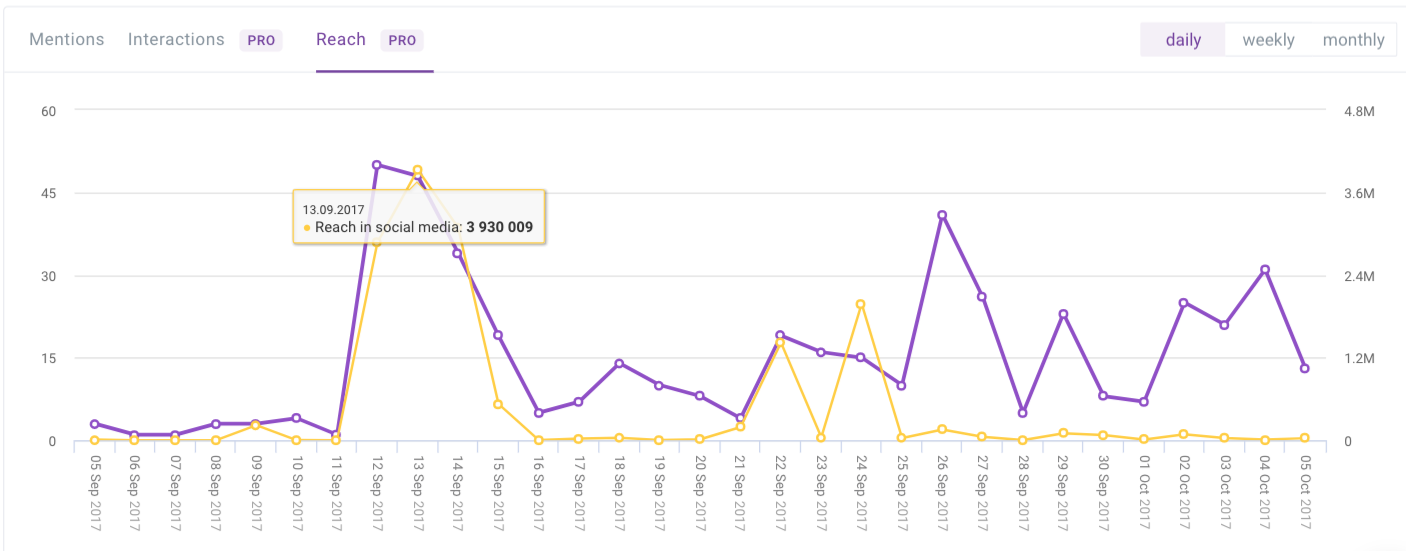
This tells us that many of the tech influencers discussing the topic have moved on – the reach has plummeted – while more modest profiles have continued to mention it.
We also know that the most engagement with the product was via video content as YouTube mentions were the most prolific.

Our social media market research in this example has identified that:
- Tech influencers created a flurry of PR around the topic in a relatively short period.
- YouTube was the primary channel that the product was discussed on.
We can conclude that one potential remedy for this problem would be to reach out to YouTube influencers to get them to promote the product in a positive light to avoid more backlash on social media.
Conclusion
Social media market research is just one avenue businesses can take to gain insights on their target consumers.
Channels like Facebook, Twitter, Instagram, etc., provide businesses a unique look into consumer behavior in environments where insights are given freely and (mostly) untainted.
However, social market research may not be for everyone; it depends on the insights you want, where you’re likely to find those insights from your target consumers, and the metrics needed to quantify and qualify the data.
-
Social Media Management: Examples and Tips
Social media marketing. You know the basics.
Make a Facebook page, tweet, snap a pic for Instagram. Boom. Done. And you understand the benefits of a dedicated place for customers to interact with your brand.
So, why would you need to worry about social media management? What is it anyway?
Imagine this: what if you could eavesdrop on every conversation about your brand that’s happening right now online. Sound like a super power?
Well, good news – it’s not. Social media management let’s you pick up online conversations about your brand so that you can draw conclusions and take action.
A great social media management strategy can help you do the things that make a major difference – from putting out fires before they start to finding influencers to market your product. That’s why you need to know what social media management is and why it’s important.
That’s why this article will tell you:
- What social media management is and why it’s important for your brand.
- How to find out which social media management tools are right for you.
- What a social media manager is and what skills they need for success.
What is Social Media Management and Why is It Important?
Let’s start with the basics:
What is social media management?
Social media management is the act of monitoring and responding to posts and discussions happening in real time across social media platforms and other social gathering places online.
Social media management includes compiling, listening, analyzing, and engaging with mentions. If your business has an online presence, your marketing and customer outreach strategy can benefit from great social media management.
Another way to think of social media management is as the backend of your social media strategy. Yes, you have social profiles. You post content, run advertising, engage with your community, and conduct customer service across multiple platforms.
Social media management goes one step further and let’s you listen to customer conversations happening beyond your branded profiles.
What is social listening?
Social listening is one of the more confusing aspects of social media management. Social media listening is identifying trends and overall sentiment related to your brand. The difference between social listening and social media monitoring is the scale.
Social media monitoring is when you look at individual mentions. For example, one customer tweets that they don’t like your product. You read that tweet and respond with a public apology and offer to resolve the issue in private.
Social listening is recognizing that the complaint was not isolated. You realize that the problem is trending. Your product seems to have a genuine defect.
Instead of responding to individual mentions you decide to address the problem by announcing that you’re company is taking steps to resolve the issue internally.
For example, Apple gets a complaint about a swollen battery in a new iPhone 8 on Twitter. They handle the response. Perhaps there are two or three more that day. All seem like isolated events. That’s social media monitoring – fielding one complaint at a time.

But let’s say Apple has a strong social listening strategy as well. They notice that when they track conversations about their new product online there are certain words that are dominating the conversation:
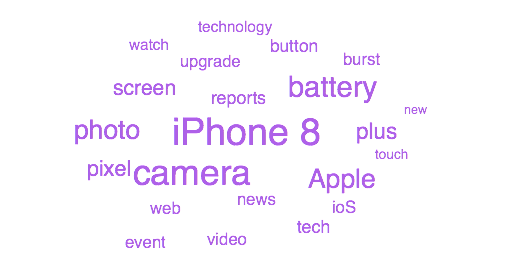
The word “battery” is trending. When they start to look at individual mentions including the word battery, Apple notices that the conversations are about swelling batteries in the new iPhone 8. They can see that the swollen batteries are not isolated issues but rather a more general model defect.
Why is social media management important?
Social media management is important because it lets you know what people are saying about you – good or bad – in real time online, giving you insight in how to react and respond.
Remember when “word of mouth” was a thing? Well, it still is. A long, long time ago, before social media, a customer would tell her friends, mother, and work colleagues about how much she loved or hated your product.
You could count the number of people within her sphere of influence on your fingers.
Now, she can tell hundreds of people that she may not even know how much she hates or loves your product. She can write reviews, she can comment in public forums, and she can interact with your brand before, during, and after her purchasing experience.
The upside for you? You can now know what she’s saying to whom, and you can join the conversation as it’s happening.
If you’re not listening to what she’s saying online, you’re missing out on hundreds of marketing and customer service opportunities.
Opportunities that could not only make her experience better, but her entire audience’s experiences as well.
Here’s what social media management allows you to do:
- Monitor Brand Awareness
- Gauge Customer Sentiment
- Incentivize Positive Engagement
- Address Crisis Situations
- Analyze Customer Demographics
- Conduct Competitor Research
- Track Industry Trends
- Identify Niche Influencers

Great social media management strategies allow you to tackle customer engagement in all its forms – good, bad, and ugly.
What is a social media management tool?
One of the more harrowing choices you’ll have to make when deciding your social media management strategy is which listening tool is right for your brand. But let’s start from the beginning.
What is a social media management tool?
A social media management tool is software that captures conversations about a topic or profile of your choice and stores them in one place for you. Often, the tool will organize the data for social listening and analysis purposes. You can then draw insights and take action within the tool.
Unamo Social is a social media management and monitoring tool. To illustrate how some tools work, we will use our tool as an example. Unamo Social searches Facebook, Twitter, Youtube, and Instagram for public mentions related to a keyword of your choice.
In overview mode, you can see a chart that will show you how many times your keyword showed up in public mentions on any given day over a specified time period.

The tool allows you to track:
- Trending Topics
- Sentiment
- Demographics
- Influencers
- Individual Mentions
Before you choose a social media management tool, it’s best to decide which social platforms you want to track and what kind of insight you’d like to have into your topic of choice.
What is a social media manager?
A social media manager is the person who does all the compiling, reading, analyzing, and engaging with any mentions about you online, essentially implementing all aspects of your social media management strategy.
The person is dedicated to undertaking these tasks, and knows how to use social media monitoring tools to get the job done.
Now, you may begin to notice that more and more people from within your business need to engage with your customers via social media and other online platforms. That means that your social media manager is not the only person who may need to analyze or respond to mentions.
So, while it is beneficial to have someone dedicated to building your social media management strategy, you’ll want other employees to have these management skills as well.
Here are some extra skills you may want a social media manager to have to advance your social media management strategy company-wide:
- Knowledge of Social Aesthetics
- Written Communication
- Customer Service Skills
- Basic Marketing or SEO Skills
Pro Tip: Do notice that there is a difference between a social media manager and a community manager and there are many, many job titles for both positions. It’s best to ask candidates to demonstrate that they have the analytical AND creative skill set necessary for social media management.
Conclusion
Understanding social media management is a necessary step to a holistic approach to social media marketing. It’s no longer enough to hire a fresh graduate to manage your Facebook account. Now, you need to listen to the whole conversation.
The only way to get the full picture of what people think of your brand is to make sure you’re listening everywhere and drawing conclusions from overarching insights. And at the end of the day, you probably will feel like you have a super power.
- , or
in the HTML.
What are Google’s favorite featured snippet formats?
There are three prominent featured snippet formats:
When Google first introduced featured snippets, the paragraph format reigned supreme. Now, lists are slowly taking a bigger share of results.
Here’s a table of how the trends are changing over time from a recent Getstat study:

Image Source: Getstat Study 2017 Here’s an example of a featured snippet in the list format:

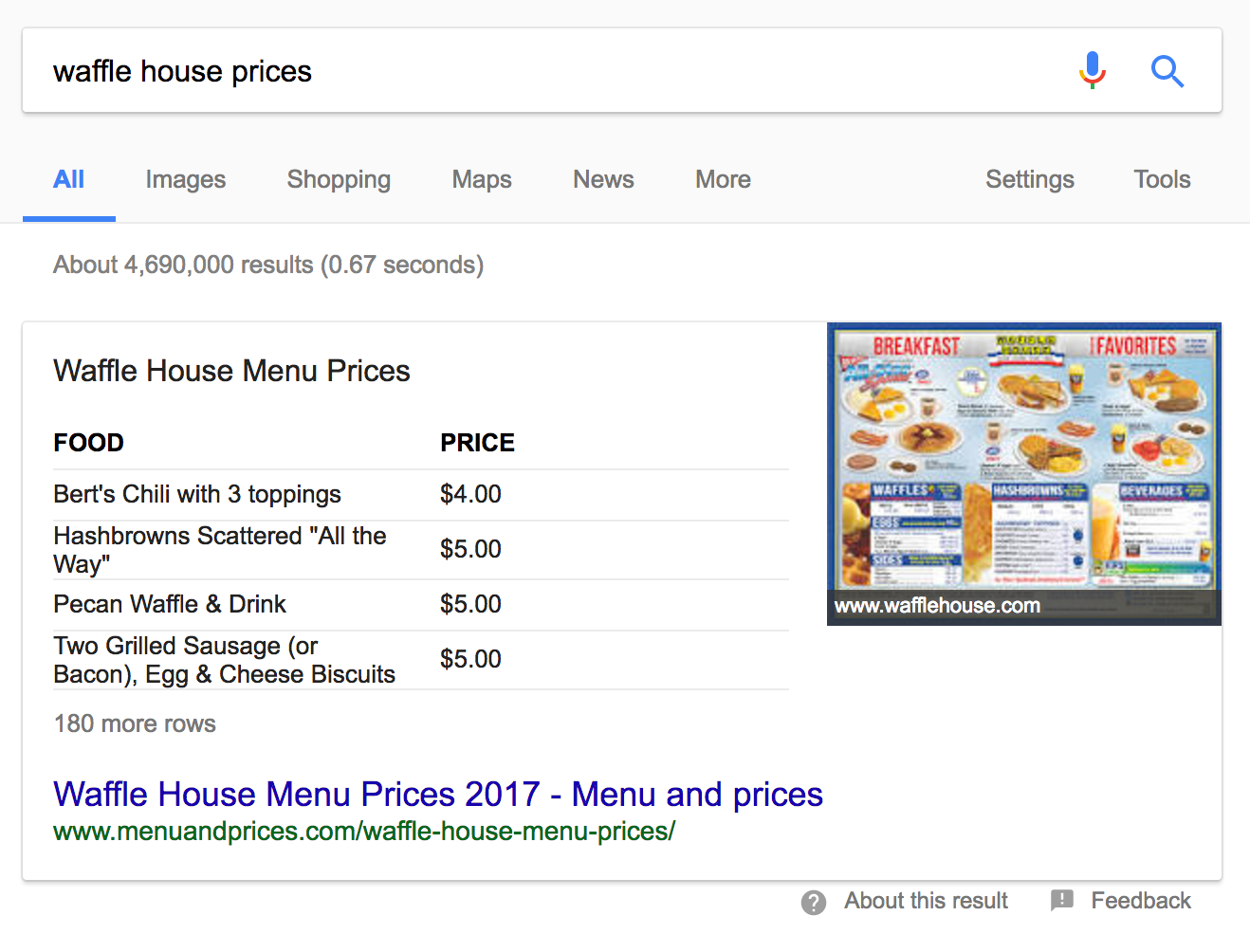
Here’s an example of the featured snippet table format:
How to create better content for keywords that already have featured snippets:
Let’s say the question you’re targeting already has a featured snippet in place. Should you go for it? Sure!
All you have to do is write 10x content.
What is 10x content?
10x content is a piece of writing that’s 10 times better than the content that it aspires to beat in Google SERPs. To achieve 10x content, you need to find out what makes the best content rank number one and build higher quality content with more added value.
See what I did there? I just optimized my content for the question: “What is 10x content?” Will my content end up ranking for a featured snippet about 10x content? That remains to be seen.
How do you make your content 10x better than the competition? Ask yourself:
The goal is to answer “yes” to all of these questions and then use your insight to create the best content on the Internet about your topic.
You can use the 10x content strategy to revamp old pieces that you want to use for a featured snippet piece and to beat the portion of content that’s in the featured snippet box.
Finally, you will want to apply traditional SEO tactics to optimize your content for keywords and your question.
For your featured snippet question, you only have to be sure that it shows up in one of the first headers you use and in the body of the text before the answer. Try to put the question close to it’s header.
And what about images?
Images are a great way to attract attention to a featured snippet, but there’s no way to make google pick one. At times, Google will even lift images from other content.
Here’s an example of a featured snippet for the query:
“What are chicken nuggets made out of?”

Notice that the featured snippet contains text from an article ranking in the 6th position. The National Chicken Council’s text explains that chicken nuggets are made out of breast meat.
Yet, it is paired with a still image taken from a Youtube video about pink slime. The Youtube video is ranking in the second position of the SERPs.
How To Track Featured Snippets Before and After Your Campaign
One downside of the Google featured snippet API is its reliability. One day you’re featured, the next you’re not.
That’s why it’s best to start tracking featured snippets for your keywords.
For example, we first secured a featured snippet for the keyword “rank your site” on September 10, 2017. We lost the answer box the next day.
Tracking featured snippets allows you to go back to your content and make tweaks so that you can regain the featured snippet answer box.
Notice that we reranked for the same featured snippet on September 18, 2017. Also notice, that it disappeared the next day again. Featured snippets tend to be a capricious feature.

Still Not Convinced? Here’s How To Opt Out of Featured Snippets
If you find that your traffic or CTR has taken a hit thanks to getting a featured snippet here’s how to opt out:
Google advises websites that do not wish to rank for featured snippets to use the tag on their page.
Conclusion
Ranking for a featured snippet box is one of the fastest and easiest ways to take your content to the top of the results page. And the best part is that you don’t have to be a big brand with a big marketing budget.
All you have to do is answer your audience’s questions with the best content that you can create. Your users will love you, Google will love you, and you’ll be at the top of your game.
Did we answer all YOUR questions about featured snippets? Does anyone have experience gaining the answer box? What was your secret weapon? Let us know in the comments!