Online Services

Category: Ideas Blog

  • The Top 5 Ecommerce UX Best Practices For 2018

    The Top 5 Ecommerce UX Best Practices For 2018

    Digital presence is important for businesses that are into eCommerce.

    No doubt, digital web design is maturing and by all means, it’s subject to trends, best practices and standards.

    Unfortunately and lamentably, the internet is swarming with too many poorly designed and un-optimized websites. 

    To tap into this lucrative industry which is projected to clock $5 trillion in sales by 2021, you require something more than a run-of-the-mill multivendor marketplace. 

    It’s time we look at the 5 eCommerce UX best practices and gain insights on how to increase ecommerce conversion rate

    Let’s get started.

    UX Best Practices #1: The Rise of Guided Selling

    Let’s understand the different types of audiences:

    • Customers who know what to buy and when to buy
    • Casual web surfers
    • Discount customer
    • New customer

    social selling

    Customers who know what to buy and when to buy have a pre-established mindset. To this type of prospects, it’s fairly reasonable to provide sufficient information to help them make purchase decisions.

    New customers may or may not know what to buy and when to buy. Your website should give them a tour of product offerings. Most importantly, selling should be based on value rather than price.

    Discount customers are price conscious customers. Your website should guide them to product and service categories where deep and perennial discounts are in the offing.

    Can you convert casual web surfers into potential prospects? Of course, yes! The key is to design your multivendor marketplace in such a way that it engages in a need-oriented and interactive dialogue with them. It’s important to identify their latent needs.

    For all intents and purposes, your multivendor marketplace should guide different types of audiences accordingly. 

    UX Best Practices #2: The Presence of Video

    Video is ubiquitous. Videos are everywhere on the web. Though some UX professionals consider video a contentious UX element, I vouch for videos. 

    video marketing

    Why should you use videos in your eCommerce site? There are many reasons:

    • Not so long ago, Google’s algorithm changed from desktop to mobile-first indexing. This can be attributed to the fact that the sales on mobiles exceeded those on desktops. Product description videos are often watched on mobiles. There is no denying that product description videos spark engagement in prospects
    • Customers are likely to purchase more if they get positive reviews from other customers. User generated videos i.e., customer testimonials can work wonders in perpetuating positivity amongst new customers. 
    • More often than not, customers call customer representatives to know about a product, the right way to assemble its parts, etc. Videos can be used to clearly demonstrate how the product is used and how it is assembled. Videos minimize customer care calls. And more importantly, they reduce product returns due to customers’ remarkable ineptitude to utilize them.

    360 degree videos are gaining remarkable traction in 2018. Surely, carefully crafted videos are the way forward!

    UX Best Practices #3: The Significance of Performance

    Of course, design elements and visual entities are indispensable components of UX. But the significance of website performance cannot be discounted.

    performance

    When my clients ask me how to increase ecommerce conversion rate, I insist on paying attention to the following website KPIs (Key Performance Indicators):

    • Loading speed: Don’t keep your prospects waiting. Loading time should be less than 3 secs. To check your multivendor marketplace loading speed, use Pagespeed Insights by Google. 
    • SEO: Website content should be optimized not only for browsers but also for humans. In other words, content should be comprehensible and readable. Letters should be legible. Pay attention to schema and XML sitemaps. And yes, don’t ignore SEO tags and elements. In essence, your website should be SEO savvy.
    • Enabled CMS: Audiences are receptive to compelling and fresh content. But your job isn’t done yet. To attain marketing momentum, you should let your audiences post and edit content. You may use a CMS (Content Management System) in this regard.

    UX Best Practices#4: The Personalization of Delivery

    More often than not, eCommerce enthusiasts pay scant attention to personalization of delivery. This is a harsh reality. 

    target group

    UX or User Experience isn’t confined to website design and themed templates. According to MetaPack consumer research report, 39% of shoppers opined that they shall never shop again with an online merchant following a negative delivery experience.

    E-commerce giants such as Amazon often give free and fast delivery options. Due to Amazon and giants, small businesses are under tremendous duress to offer free and fast delivery options. 

    Can small businesses make profits with free and fast delivery? No!

    delivery

    The key is to be honest with your customers.

    The same report suggests that nearly 35% of online shoppers place convenience above cost. 

    State the exact delivery date, time, and place of delivery.

    Be creative and personalize their delivery experience at an extra price to keep your potential paying customers delighted.

    Do NOT delay.

    Do NOT compromise.

    UX Best Practices #5: The Simplification of Checkout Process

    Many eCommerce sites have shortened their checkout process to enhance user experience.

    Unfortunately, not every step can be eliminated. Single click checkout process is easier said than done.

    The key is to simplify the process rather than eliminate all steps. 

    You can use Checkout wizards which assist customers in understanding the different stages of transaction, where they stand in the process etc.

    There should be enough guest checkout options.

    Incorporate features such as forms and address entry sections to simplify the process.

    Thanks to digital wallet options such as Apple Pay, checkout on mobiles is effortlessly easy.

    A finger print scan should be sufficient! 

    And by the way, primary navigation should also be simplified. 

    Now that you are well aware of the top 5 ecommerce UX best practices, fine-tune and refine your multivendor marketplace. Be prepared.

    Found this post useful and informative? Keep watching this space for insights on emerging trends in eCommerce. 

    If you have any queries or concerns, shoot them in the comments section. I shall reply in a day or two. 

    My best wishes are with you and your eCommerce venture. 

    Cheers!

    The post The Top 5 Ecommerce UX Best Practices For 2018 appeared first on Unamo Blog.

  • 6 Ways to Easily Write Great Long-Form SEO Content

    6 Ways to Easily Write Great Long-Form SEO Content

    Are you tracking your keyword ranking positions?

    Try unamo seo for free

    You might think that in the age of the internet, long-form content has no place, but you’d be wrong

    Long-form posts are great because they dominate SEO (search engine optimization) and attract dozens of links.

    They take a bit of time, planning, and effort, but are definitely worth the work.

    You can make writing great long-form SEO content easier with these six tips.


    Your Idea

    content idea

    Choose your topic carefully.

    Think about what your audience is interested in reading and learning about.

    Focus on topics that are:

    • In-demand,
    • Relevant to your niche,
    • And useful to your readers.

    Search the ideas you are considering and see what comes up in the results.

    You’ll be presented with the most popular articles related to your search terms, and this will give you some direction as to what to write about.

    You can also find ideas by browsing popular blogs in your niche and seeing what topics and ideas have been trending in the past year.

    Once you have some topic ideas you know people are interested in, make sure they are something you can write long-form content about.

    Some topics just don’t warrant a long discussion and are best talked about in a short post.

    Don’t forget to give your post a catchy title to get more visitors and shares.


    Outline Your Goals and Content

    goals

    Begin by asking yourself why you’re doing this.

    • What are your goals?
    • Are you helping to solve a common problem your audience has?
    • Do you want to increase your brand awareness?
    • Maybe you want to connect with customers or grow your email list?

    Next, sketch out an outline for your content, doing this will make your writing much easier.

    Your post’s structure and criteria will be a bit different depending on what kind of post you’re writing, be it:

    • “How-to,”
    • “List,”
    • “Guide,”

    or

    • “Review” content.

    Identify the core sections of your topic and assign them headings in your outline.

    Then break down your sections into subsections, where you consider main sections in more detail.

    The more thorough your outline is, the easier the writing will go and the better the quality will be.


    Structure Your Post

    Your long-form post will contain several different kinds of elements.

    We’ve already talked about creating an outline with headings and subheadings, now we will go a bit more in-depth.

    Structure your posts into paragraphs, as this is much easier for a reader to digest than a wall of text.

    Make your sentences relatively short, and keep your paragraphs to no more than five sentences a piece.

    People can be turned off by articles that are made up of two or three massive paragraphs.

    It’s not necessarily the length of your article that scares readers off, it’s how you structure them.


    Design Strategy

    Design your post to be practical, as well as aesthetically pleasing.

    When you’re creating your content, remember to include features such as sign-up forms, content flow, and social sharing buttons, and integrate them into your design.

    Email sign-up buttons are important because they give more people access to your future content.

    Be sure to include plenty of links to other relevant content you have created; the reader may not be interested in your long-form article but still enjoy another piece of content you’ve created.

    Make it as easy as possible for them to get to it.


    Get Help Writing Long-Form Content

    Writing doesn’t come easily to everyone, so don’t hesitate to get some help from the professionals. Here are some good resources to get you started:

    #1. Via Writing and State of Writing – These are helpful grammar resources you can use to check over your post to make sure it’s grammatically correct. It’s better to have your content checked then to risk publishing it with mistakes.

    #2. UKWritings and Write My Paper – These are proofreading tools, recommended by UKTopWriters, you can access to make sure your content is polished and free of errors.

    #3. Writing Populist and My Writing Way – Check out these writing blogs for ideas and advice on how to improve your long-form content. You’ll find lots of posts explaining how to write better SEO content.

    #4. Essayroo and Academized – These are online editing tools, suggested by SimpleGrad in Academized review, you can use to check over your copy and make sure everything is grammatically correct.

    #5. Academadvisor and LetsGoandLearn – These are writing guides you can access for help completing your long-form post. Even experienced writers can benefit from some extra help now and then.


    Choose Your Keywords Wisely

    Long-tail keywords are not the best idea for lengthy articles.

    If you want to choose good keywords, consider factors such as search volume and the level of competition strength.

    Search volume is a measure of how popular a search term is in a given country.

    The more people searching for that keyword, the more visitors your page should get, and the more potential clients are exposed to your content.


    Analyze the top ten results for your keyword. High ranking keywords will have lots of serious competition, so you’ll have to do some serious observation of their material to make yours even better. Long-form content is a good medium to use to beat the keyword competition – advises Martha Spangler, content writer at EliteAssignmentHelp


    Conclusion

    Writing long-form content takes a little longer, but it’s great for SEO and linking.

    You also get a chance to really expound on a topic that interests you, which is a great deal more difficult to do in a short piece.

    Make sure you:

    • Choose your topic carefully,
    • Outline your goals and content,
    • Structure your post well,
    • Design your content strategically,
    • Get online help writing and editing your piece,
    • And choose your keywords wisely.

    Follow these six tips to easily write great long-form SEO content.

    Are you tracking your keyword ranking positions?

    Try unamo seo for free

    The post 6 Ways to Easily Write Great Long-Form SEO Content appeared first on Unamo Blog.

  • Improve your Real Estate Social Media Strategy in 7 Days

    Improve your Real Estate Social Media Strategy in 7 Days

    The good news:

    Most home buyers still need the help of a real estate agent to buy a home.

    The not so good news:

    Unless you’re selling a home to your grandma, everyone starts online. Gone are the days when yard signs attracted potential buyers to your open house.

    That means that you need a website that converts. Plus, you need a great real estate social media strategy that generates leads.

    Want more good news?

    Setting up a winning social strategy to help you sell is fast and painless. All you need to know is where to start and what to do.

    That’s why this article will show you:

    • How to choose the 5 best real estate social media networks for your agency.
    • 7 tips that can help you improve your real estate social media strategy in 7 days.
    • How to use real estate social media management to track your success.

    Once you’ve got a strategy, it’s time to start tracking your success. Use a social media management tool to help keep track of your campaigns and listen to the whole conversation.

    unamo social media management

    Try Unamo Social Media today! Our tool is fast and easy to use, and free trials are available!

    The 5 Best Real Estate Social Media Platforms for Your Agency

    Here’s a shocking statistic – over 74% of buyers from all generations used the Internet to search for a home in 2017. Of buyers 37 and younger, 56% found their homes online. That’s also true for 51% of buyers between the ages of 38 and 52.

    The first step in the buying process is to look online. As a result, 63% of buyers walk through a home they’ve viewed online.

    The bottom line? You need a solid online and social media presence if you want to stay relevant in today’s real estate market.

    But where should you start? You’re probably too busy selling houses. You don’t have time to tweet all day and upload professional photos of your properties to Instagram.

    That’s why it’s important to take baby steps when you’re just starting. Ask yourself the following questions:

    • How many platforms do I have the time and money to manage?
    • Where is my audience and which platforms would best serve them?
    • How often can I make real estate social media posts?
    • How will I integrate different channels and my website?
    • Do I need tools to help me with scheduling, posting, and tracking?
    • How will I track my success and adjust my social media marketing strategy?

    Let’s say you only have time to manage and run one social media profile.

    In that case, go for Facebook. The platform is the most flexible in terms of use. You can engage with your audience with a variety of content, track your success, and advertise.

    Targeting Millennials? They now make up the majority of home buyers at 36%. Perhaps you should be on Instagram.

    Here are the top five social media marketing platforms to consider for real estate social media:

    • Facebook
    • Twitter
    • Instagram
    • YouTube
    • LinkedIn

    You don’t have to choose them all. Decide where you want to be and what you have time to manage. You can always expand later.

    Facebook Social Media for Realtors

    First, Facebook is the best social media platform for keeping important information in one place. Think of it as an alternative to your website.

    Make sure your contact information is consistent with your website and Google My Business Page. And make sure that it is easy for clients or buyers to contact you. Why?

    Buyers still purchase their homes through agents. In fact, 87% of all buyers purchased through an agent in 2017. That figure jumps to 90% of Millennials. You want to make sure that your Facebook page makes it easy for buyers to contact agents.

    Setting up a Facebook Business page allows you to add a Call to Action (CTA) button like the “Contact Us” button in the example. CTA buttons can help clients book agents, turning your Facebook page into a lead generator.

    Facebook real estate social media

    Next, you’ll want to make sure that your cover image is adding value to your page. Facebook has now made it possible for you to include video and 360-degree images as cover photos. Your cover image is the first thing that visitors see, so you want to make a good impression.

    In the example below, Focus Real Estate has added a dedicated hashtag (#focuseffect) to their cover image. Dedicated campaign hashtags help you track your real estate social media marketing efforts.

    real estate social media dedicated hashtag

    Here’s another example of a cover image with a dedicated campaign hashtag for @properties, a real estate brokerage in Chicago, Illinois:

    facebook real estate cover image

    They’ve created a dedicated hashtag #thelifeweshare. Here, you can see how often people used the hashtag in real estate social media posts:

    real estate social media management

    You can filter out your posts to see how many people are using your hashtag, who is using it, and how they’re using it. When you track dedicated hashtags, you can also see:

    • Reach
    • Sentiment
    • Demographic Data
    • Influencers
    • Estimated Ad Spend
    • Related Keywords

    And the list is not exhaustive. Using a social media management tool is a great way to make sure you’re efforts are successful.

    When it comes to images, the more professional the photo the better. You should consider hiring a professional photographer.

    Let’s say this is not a possibility.

    The next best thing is to make sure that you are at least posting images that you have taken yourself. Don’t be tempted to use stock images. People want to see actual homes online before looking at them in real life.

    real estate social media images

    Note the people in the example. Having people pose in your images helps home buyers imagine themselves living in the home you’re selling. The same is true of real estate social media video content. Besides drone footage and virtual tours, consider staging a home with actors to activate viewers’ imaginations.

    Finally, you’ll want to consider what features to add to your profile. Allowing clients to post testimonials or reviews is a great way to build trust. When choosing an agent, home buyers want someone who is honest and trustworthy above all else.

    Here’s an example of different pages Colorado Realtors chose for their profile:

    Facebook cta for real estate agencies

    A quick side note – notice that the copy for the CTA is different than what Poppy Realty chose. Whether you choose “Contact Us” or “Call Now,” make sure your copy reflects the resulting action. Consider using “Book an Agent” to make the experience as seamless as possible.

    In the sidebar, Colorado Realtors have chosen to include:

    • Events
    • Homes for Sale
    • Reviews
    • Videos
    • Agent Profiles
    • Featured Listings
    • Community
    • What’s Your Home Worth?

    Most of the above are obvious. “Homes for Sale” are listings. “Reviews” are reviews. But what about general real estate social media content? What should you post in your main feed?

    When creating content for real estate social media posts you’ll want to follow the 80/20 rule. You’ll see this piece of advice everywhere. The idea is that 80% of your posts should focus on customers and 20% on your business.

    What does that mean?

    First, look at the “What’s Your Home Worth?” feature on Colorado Realtor’s profile. It’s one of the less obvious pages. Here’s what you see when you click on the tab:

    real estate features for facebook

    Here, users can calculate the value of their property based on their address. It’s useful, informative, and interactive. Now, no the feature is not a real estate social media post. Yet, it exemplifies the type of information found in customer-centric content.

    Here are some real estate social media post examples for your main feed:

    Posts for Customers

    RIGHT

    Real estate buying and selling tips for those with no experience.

    Here’s an example of an infographic that Poppy Realty published. The content shows when different age groups can expect to buy a home:

    facebook advice for homebuyers

    WRONG

    Stock images of properties with pushy sales copy.

    In the worst case scenario, at least tell your audience that you’re using a stock photo:

    bad real estate social media post ideas

    Posts About Your Business

    RIGHT

    Progress that has been made on an ongoing construction project.

    When you’re a larger company that builds homes, creating commercial real estate social media posts that update clients on projects is a great idea:

    commercial real estate social media post

    WRONG

    Advertisements that your followers might have missed.

    When you’re one of the big players you may have millions of listings. In that case, such a post makes sense. Otherwise, don’t turn your real estate social media posts into advertisements:

    bad facebook advertising post for realtors

    Other content that is great for real estate social media posts:

    • Posts about what is happening in and around the community.
    • Showcases of local businesses and neighborhoods.
    • Contests and giveaways – great for engagement.
    • Video walkthroughs of new homes or neighborhoods.

    Pro Tip: Make sure that you set up your Facebook profile as a Facebook Business page. That’s because personal profiles don’t allow for features such as a CTA button. You also can’t add extras in the left-hand sidebar – e.g., testimonials or events.

    Want to read more about optimizing a Facebook Business page for your real estate agency? Check out our guide: 7 Simple Tips to Optimize Your Facebook Business Page

    Twitter Social Media for Realtors

    Twitter can be a bit more personal than Facebook.

    With Twitter, real estate agents can create personal profiles and use them for work. Facebook ends with the company’s profile, but Twitter can extend to individual professional profiles.

    Here are some reasons why agents may want to manage their own Twitter real estate social media posts:

    • To establish themselves as thought leaders.
    • To stay in touch with their personal clients.
    • To send out necessary, frequent updates about their properties.
    • To build trust with clients by sharing more personal tweets.

    Here is Jasmine Botto’s Twitter profile. Jasmine is part of the Botto Real Estate team in North Vancouver.

    realtor twitter profile

    Jasmine tweets listings and advice for buyers and sellers by adding links to Botto’s newsletter:

    At the same time, her Twitter profile has personal touch. Jasmine keeps it light by occasionally posting about something other than real estate:

    Meanwhile, you still want a Twitter handle dedicated to your agency or brokerage so you can generate leads and update clients with time sensitive information fast.
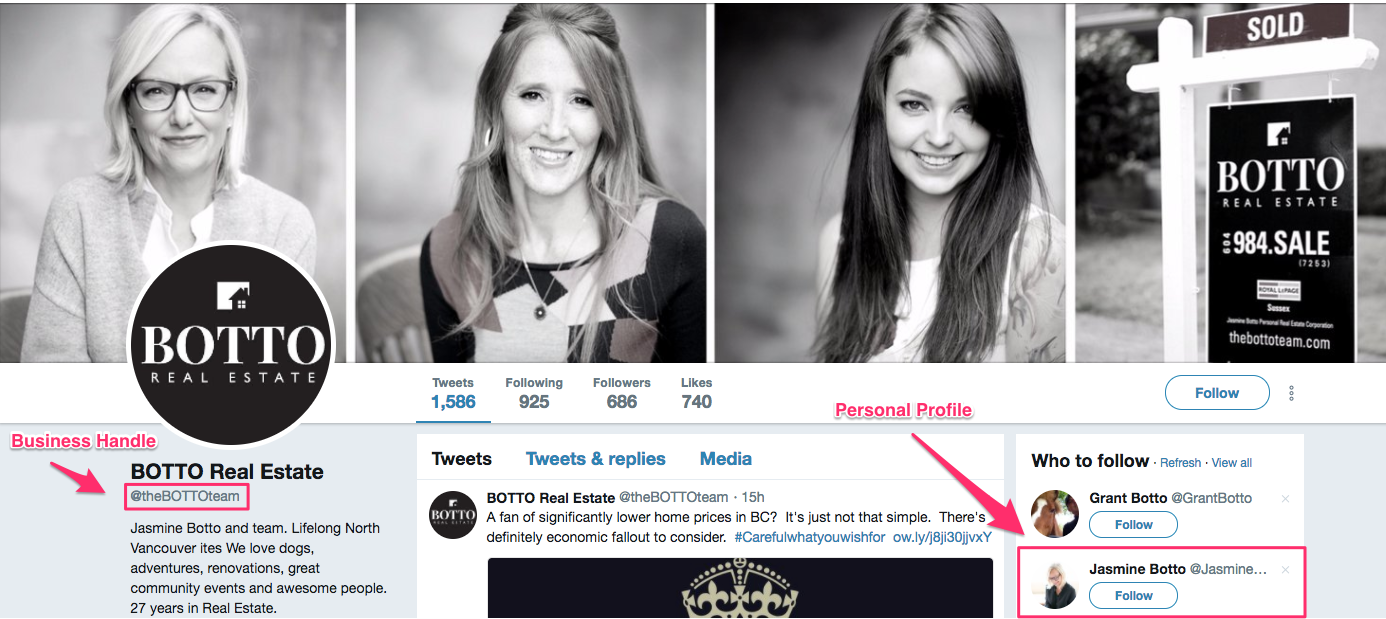
    real estate agency twitter profile

    Here are some real estate social media post ideas for Twitter:

    • Listings for properties with images or videos.
    • Tips and advice on topics like moving or staging.
    • Links to industry-related articles or your blog.
    • Retweets of content from industry thought leaders.
    • Information about events and initiatives.
    • Replies to any tweets left on your page.

    Here’s an example of listing tweeted by NYLA Real Estate, an agency based in Los Angeles:

    So, how often do you need to tweet? Here’s the thing about Twitter. To make the most of the platform, volume is important. That means you need to tweet several times throughout the day.

    The more you tweet the greater your reach and exposure. The greater your reach, the more leads you generate. If you don’t have time to make regular tweets, consider using Buffer, a post scheduling tool.

    Okay, so your profiles are set up and you’re tweeting on a regular basis. What’s next? How do you take real estate social media Twitter strategy to the next level?

    • Connect and engage with local businesses, brands, and influencers. Make yourself recognizable in the community as the go-to person for buyers and sellers.

    To find influencers, you can use a social media monitoring tool and a set of targeted keywords. For example, using the keywords “real estate” and “luxury homes” we found the following influencers:

    real estate social media influencers

    Now, most influencers will probably be other real estate agents. What can you do with this information? It’s great for competitor research.

    You could still run across an Instagrammer or a media source that could promote your content or share your real estate social media posts. Reach out and start a relationship!

    • Set up keyword alerts so that you know when someone is buying or selling a home in your area. You can use this to generate leads.

    You can set up Twitter keyword alerts through a tool like IFTT or by using a social media monitoring tool. Just add keywords (buying home/ selling home) or hashtags like #homeforsale + [Your City] to find out what’s happening in your area.

    Here’s an example using Unamo Social Media:

    real estate social media keywords

    Here’s an example of a tweet found via Unamo using #homeforsale. The home owner has renovated his house and is ready to sell in Georgia:

    But how do you know which keywords or hashtags buyers and sellers use? Some may be obvious, others not so much. That brings us to the next point.

    • Research and use real estate related hashtags. The same applies if you have an Instagram account.

    To research hashtags, try using a free tool like Hashtagify. The tool allows you to check if a Twitter hashtag is popular and find related hashtags.

    For example, #realestate has a score of 76.4, which means it’s popular. You might want to work it into your real estate social media content. Related Twitter hashtags for #realestate include:
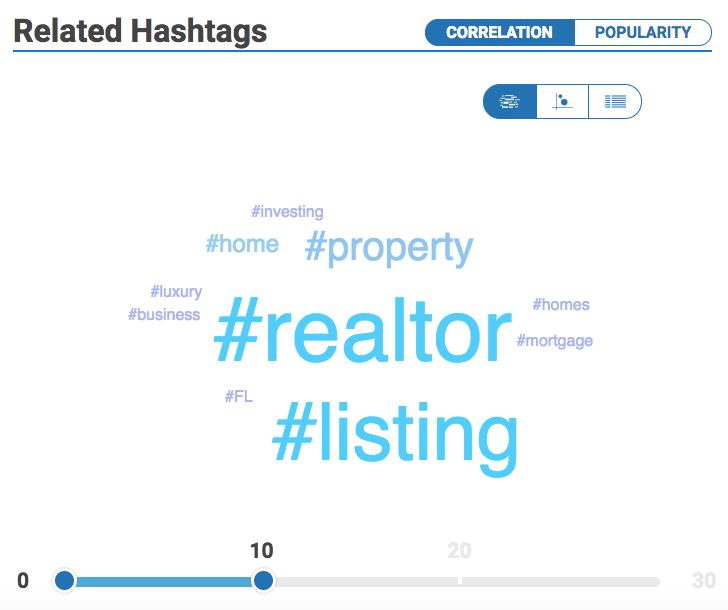
    hashtagify related hashtags

    Source

    You’ll also want to include hashtags for geographic areas where you operate (#FL), recent events (#openhouse), and search keywords for your target market (#listing).

    Using relevant hashtags in your real estate social media posts helps people find you. As mentioned above, you can also search for hashtags on Twitter to find potential homebuyers. Plus, tracking dedicated or branded hashtags can help you monitor the success of given campaigns.

    In the example below, the NYLA Agency has used three hashtags:

    • A Dedicated/Branded Hashtag (#NYLAagency)
    • A General Hashtag (#TheDreamTeam)
    • A Real Estate Hashtag (#RealEstateExperts)

    Pro Tip: Want to post a link to your blog or an article? Does the link cause your tweet to exceed the 280 characters limit? Use a link shortening tool like Bitly to compress your links. That way you have more room to write a CTA or engaging copy in your tweet.

    Did you know that you can use SEO techniques to increase the visibility of your Twitter profile? No? Want to find out how? Read our article: 7 Twitter SEO Tips: Leverage Your Social Presence for Better Traffic!

    Instagram Social Media for Realtors

    With Millennials taking over the home buying market, you can’t afford to overlook Instagram. Plus, as a photo sharing app, it’s a perfect place for real estate social media posts that contain images of properties.

    There are two important things you need when using Instagram – beautiful images and appropriate hashtags. Again, do not use stock images. It’s better to take amateur photos with natural filters than to try to post fancy stock images.

    Instagram real estate social media

    When it comes to choosing hashtags, you want to use a mix.

    • Popular Instagram Hashtags
    • Niche or Topic-related Hashtags
    • Industry Hashtags (Real Estate)
    • Location-based Hashtags
    • Branded Hashtags
    • Dedicated Campaign Hashtags

    15 Popular Instagram Hashtags for General Use

    • #love
    • #instagood
    • #photooftheday
    • #beautiful
    • #happy
    • #cute
    • #followme
    • #picoftheday
    • #follow
    • #summer
    • #art
    • #instadaily
    • #friends
    • #repost
    • #nature

    popular Instagram hashtags for realtors

    Notice that stephanillouz only uses a few popular Instagram hashtags in his post. He balances them with more targeted, location-based hashtags (#brentwood) and industry hashtags (#realestate).

    High volume hashtags give you reach, and niche hashtags put you in front of the right audience.

    Do keep in mind that you don’t want to overuse hashtags. Mix and match a couple of hashtags from each category to get a good balance.

    15 Examples of Niche or Topic Related Hashtags

    Notice that the house in the prior example is a luxury home with a pool. When your real estate social media post includes something niche or specific like a pool or a sunset you can use niche hashtags.

    • #luxurylife
    • #luxury
    • #luxuryrealestate
    • #modern
    • #architecture
    • #design
    • #pool
    • #poolwithaview
    • #homelibrary
    • #library
    • #librarygoals
    • #den
    • #beautifulrooms
    • #interiordesign
    • #homedecor

    niche Instagram hashtags for realtors

    15 Examples of Real Estate Industry Hashtags

    To hit the right audience, you’ll want to use industry hashtags. For real estate, good examples of industry specific hashtags include:

    • #realestate
    • #realtor
    • #justlisted
    • #forsale
    • #newhome
    • #househunting
    • #dreamhouse
    • #properties
    • #homelisting
    • #mortgage
    • #homeforsale
    • #homesweethome
    • #renovated
    • #fixandflip
    • #houses

    In the example below, chrissapp83 uses 9 real estate industry hashtags:

    branded hashtags for real estate agents

    Notice that he’s also used a branded hashtag #ChrisSappRealtor (in blue). Using branded hashtags can help you keep track of your real estate social media posts and their success. That’s true for Instagram, Facebook, and Twitter.

    He also uses a mix of niche hashtags – e.g., #poolwithaview.

    One thing he doesn’t do is use location-based hashtags or popular Instagram hashtags.

    Examples of Location-based Hashtags

    Using location-based hashtags is a great way to make sure the right audience is checking out your post. You can start small and tag your city, followed by your neighborhood, area, and state.

    You can also add variations of location-based hashtags. Let’s say you’re selling homes in Los Angeles. You might try #la and #losangeles. You can also mix it up by adding real estate terms – e.g., #nychomes or #orlandorealestate.

    • #[your city]
    • #[your neighborhood(s)]
    • #[your region or area]
    • #[your state]

    In the example below, Metro City Realty used customized, location-based hashtags including:

    • #orlandorealestate
    • #orlandohomes
    • #orlandohomebuyer

    location-based Instagram hashtags for realtors

    They also used four of the general real estate hashtags listed above including:

    • #homesforsale
    • #buingahome
    • #dreamhome
    • #househunting

    Examples of Branded or Dedicated Campaign Hashtags

    Using branded hashtags allows people to identify a post as a real estate social media post. Instead of seeing another aspirational home, they’ll understand that they can buy.

    As mentioned before, branded and dedicated campaign hashtags also makes it easier for you to keep track of your posts.

    • #[your real estate team]
    • #[your brokerage or agency name]
    • #[your name]
    • #[name of your social media campaign]

    For example, #ChrisSappRealtor is branded hashtag. Also, Snyder Pritchard Homes turns their agency name into a hashtag – #SnyderPritchardHomes – and adds the name of the parent company for good measure – #williamraveis.

    Pro Tip: What can you post on Instagram besides beautiful photos of homes? Try using Instagram Stories to show your day-to-day activities as a real estate agent. You’ll give your followers interesting, personal content to engage with, and you’ll build trust with your clients.

    Still not sure how to use Instagram for your real estate business? We’ve got you covered. Check out our article: Instagram for Your Business: 11 Tips for More Engagement

    YouTube Social Media for Realtors

    YouTube isn’t for everyone. If you’re not doing a lot of video content, you can shelve plans for a channel until later. But let’s say you do have the time and money to make videos.

    What kind of real estate social media posts are appropriate for YouTube? Well, the platform is perfect for posting video walkthroughs of new properties.

    Older clients especially find virtual tours helpful, but 48% of all buyers appreciate video walkthroughs. Another 27% find videos helpful in general.

    Here’s an example of a very basic video walkthrough of a typical home in Ohio:

    Notice that the person making the video is only using his phone and walks through the house pointing out the property’s features. There is nothing fancy about the video, but it still got over 100,000 views.

    Don’t want to speak? No problem. Here’s another video walkthrough that only uses music:

    Want to get more creative? Try catching up with clients after renovations. Testimonials or Before and After videos show that your properties have potential and that you’ve created trustworthy relationships with past clients.

    Pro Tip: Once you’ve created a video for YouTube, share it across other channels. Made a video for Facebook or Instagram? Reformat it for YouTube and post it on your channel. Videos are great real estate social media content that you can share across multiple platforms.

    Having a hard time getting views on YouTube? Want to know how to get more YouTube views for free? Read our article: 21 Tips on How to Get More Views on YouTube for Free

    LinkedIn Social Media for Realtors

    Again, LinkedIn is one of those social media platforms where it’s best to have a business page and to encourage all your employees to have their own personal profiles.

    That way clients can check out individual agents and still get information about your business.

    Use the platform to connect with other professionals, recruit new employees, and post professional content.

    What type of content is best for LinkedIn?

    RIGHT

    Design your real estate social media content for LinkedIn to establish yourself and your brand as trustworthy. Also, it’s a good idea to post content that establishes you as a thought leader in your industry.

    WRONG

    LinkedIn isn’t the best place to post listings or images of properties for sale. Use the platform instead to build integrity, trust, and expertise. That way, buyers and sellers who check you out on LinkedIn get the impression that they’re working with people who know what they’re doing.

    7 Real Estate Social Media Strategy Tips for 7 Days

    Once you’ve got your real estate social media profiles set up, what’s next? Here are seven ideas that you can try out or consider over the next seven days.

    So, let’s get started on a few ideas to boost your social marketing strategy.

    Day 1: Find and Create Facebook Groups

    Facebook groups are great for getting your content in front of a targeted audience. Also, you can think of joining real estate groups. In these groups, you connect with other realtors and share advice and initiatives. Here’s an example:

    local facebook groups for real estate agents

    To find local groups for listings, try “homes for sale [your city]” or other keyword combinations. You may be surprised to find content that isn’t real estate social media content.

    For example, “homes for sale Indianapolis” resulted in two groups with pets for sale. In that situation, use Facebook’s auto suggest feature to find more relevant keywords.
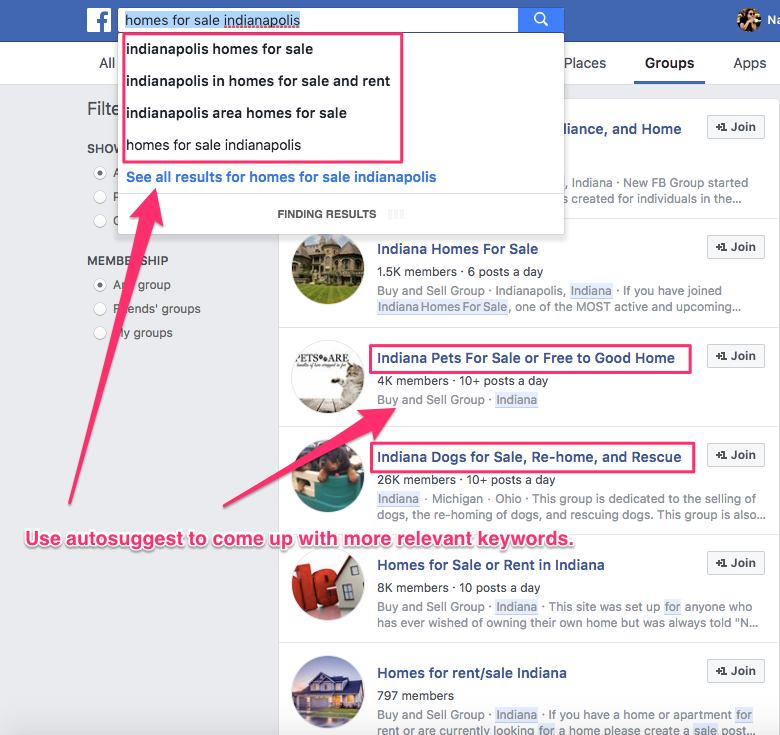
    joining facebook groups for real estate agents

    To find real estate related groups in your area use the keyword “real estate [your city].”

    real estate groups on facebook

    Creating a your own Facebook group isn’t difficult either. You can find the option in the drop-down menu. Select “Create Group,” give your group a name, add members, and choose your privacy settings. Click create and you’re done.

    Pro Tip: If you’re administering a Facebook group, be sure to put a link back to your main Facebook business page. That way all of your profiles are interlinked and connected.

    Day 2: Integrate Facebook Live Into Your Strategy

    Have you ever considered doing a Facebook Live Video of a walkthrough? Maybe you should. Why?

    Live streaming allows the audience to comment and react in real time. You can use the opportunity to conduct a Q&A session about the property. Plus your audience gets a feeling of exclusivity or of being an insider.

    Facebook also allows you to choose your audience for a live stream. That gives you a better opportunity to get your real estate social media content in front of the right people.

    Setting up live streaming is a bit more complicated than creating a group or an event. First, you need to download streaming software then you need to click “create a live stream.” You can go live from your Facebook page, an event, or a group.

    You’ll get something called a stream key that you paste into the software along with the server URL.

    While you’re streaming a live video, viewers can react and comment in real time. You can also write comments and respond to your audience while the video is streaming.

    You can also embed the live stream in a website by clicking on near the bottom of the page. You’ll get an HTML code that you can copy and paste to your website.

    Day 3: Organize an Event and Share It on Facebook

    Having trouble coming up with real estate social media ideas?

    When you go through a content dry spell, maybe it’s time for an event. Facebook events can range from local events and open houses to training or company events. You can organize events and invite guests.

    For example, The Pineapple Group, a real estate agency in Pennsylvania, organized a roller skating party:

    creating a facebook event for real estate agents

    The local roller rink went up for sale, so the Pineapple Group created a fun event for the whole community. As a part of the marketing effort for the property, they made photos and videos during the event.

    Such an event gave the agency an opportunity to connect with their community. They also created hype for a property and got great photos and videos for marketing purposes. Notice that almost 200 people liked the post thanking guest for coming to the event:

    real estate social media facebook event

    Pro Tip: Your event doesn’t have to be extravagant. Is there a local festival or charity run? What about that booth you set up every year at a conference or recruiting event? You know what you’ve got in the pipeline. Add it to Facebook and you’re good to go.

    Day 4: Find Free Advice to Share Across Channels

    Some days, you won’t have listing or an event. You won’t have videos or any real estate social media content at all.

    On days like these, try posting some free advice across your channels. What kind of advice? Here are some examples:

    • How to Move
    • How to Stage
    • How to Sell
    • The Buying Process
    • Neighborhood Tips
    • Renovations
    • Interior Design Trends
    • Real Estate Statistics

    Remember honest agents are what people want. The more advice your share and tips you give, the more honest and trustworthy you will seem to potential clients. Here’s an example of a real estate social media post with advice:

    advice real estate social media post

    Day 5: Consider Creating a Blog for Your Website

    While we’re on the topic of advice, a blog is one of the best places for detailed content of this sort. Real estate social media posts allow for a snippet of advice here and there. But blogs allow you to answer all your clients’ questions in detail.

    The thing is, 95% of all buyers use an online website as a source of information. A further 12% want to find information about the home buying process.

    Now, let’s say you have a blog with articles that walk new buyers through the home buying process. You use SEO best practices. Your articles are ranking well on Google. What is the result?

    You’re giving your audience what they want. Plus, your blog is bringing new people to your website and keeping them there. You’re boosting your organic traffic and generating promising leads. Nice, right?

    At the very least, your blog can establish you as an expert in your industry and build trust with your clients.

    No, blogs are not social media marketing, but they can go hand in hand with your social media efforts. That’s because you can push links out across all channels. Plus, you’ve got great content for your website and your newsletter. It’s a win-win.

    Day 6: Congratulate and Celebrate a Buyer or Seller

    Another great real estate social media post idea is to promote success stories.

    When someone finally buys or sells a house, you’ve got a success story on your hands. Ask your clients if they would be happy to share their story. Most will be proud to have their success shared with others.

    Plus, other clients will see that you secure the happiness and success of your clients. Congratulations, you’ve just made the whole experience that much more human.

    Here’s an example of how The Wright Group, realtors from Ohio, shared a buyer’s success story on Facebook:
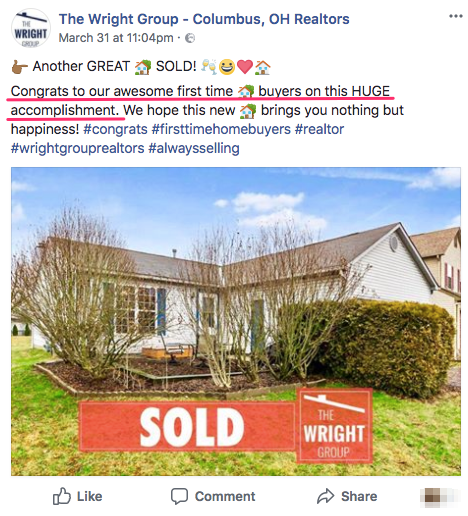
    homebuyer success facebook post

    Pro Tip: Notice that the names of the buyers are not mentioned in the post. If you want to take success stories to the next level, you can create a testimonial. Ask your successful buyers and sellers if they’d be willing to make a statement that you can share on social.

    Day 7: Consider Using Geo-targeted Ads on Facebook

    Unfortunately, Facebook made recent changes to their algorithms, placing an emphasis on content generated by family and close friends. What does this mean for your real estate social media content?

    That means that most of your followers aren’t going to see your posts. And if they do, it’s hard to hit them with the right content at the right time. That’s why it is now necessary to buy ads and promote your content.

    Buying targeted ads on Facebook gets your content in front of the right person at the right time. You’ve got a home to sell? A Facebook ad will put it in the feed of someone looking to buy. It’s unfortunate but necessary.

    Don’t want to spend too much money? Facebook points to Zephyr Real Estate as an ad solution success story. The San Francisco real estate agency used Ringtail’s ad automation solution, resulting in 76% lower cost per lead.

    Facebook ads for real estate agencies

    The solution allows you to auto-generate copywriting for ads. You enter the content it converts it to copywriting. That way you can send bulk ads out without having to waste time on creating copy for each individual ad.

    Conclusion

    You can make your real estate social media strategy as easy as picking a platform and posting images. You can take it to the next level with the 7 day idea strategy outlined in this article.

    Regardless, a good strategy is all about being online. Just be there. Connect with your audience. Build trust. And the rest will come.

  • SEO Competitor Analysis Guide

    SEO Competitor Analysis Guide

    Whether you’re just starting out with your online business or you’re pivoting your SEO strategy to be more competitive in your online market, SEO competitor analysis is one of the most important aspects of any SEO campaign.

    SEO competitor analysis helps you:

    • Understand your standing within your digital marketplace
    • Get data on competitor efforts
    • Benchmark your success
    • Find gaps in your strategy to improve upon

    However, a lot of SEO competitor analysis content dictates that somehow you already know who all your competitors are.

    This might be the case if you’re an SMB or you’re in an extremely niche industry, but for most businesses you may lack a picture of your entire SEO industry landscape.

    Ultimately, when it comes to how to do competitor analysis and understand your entire competitive landscape from an SEO point-of-view, you’ll need to:

    1. Conduct keyword research based on your value proposition
    2. Obtain an entire list of the most relevant and strongest domains
    3. Supplement this list with additional analytics when analyzing different parts of your competitors’ SEO

    That’s right: keyword research first, and everything else after.

    There is a common misconception within the industry that businesses automatically know who they’re biggest competitors are.

    While it may be true to a small degree when it comes to knowing who is selling a similar product, it’s rarely within the context of knowing how these competitors are exactly marketing those products and to what scale from an SEO perspective.

    Thus by identifying your keywords first and then using them to identify your competitor market, you can determine top industry competitors as well as identify up-and-coming industry competition.

    In this article we’ll go into how you can formulate an actionable picture of your SEO competitive landscape and acquire actionable data while benchmarking and eventually surpassing your market competition.

    Competitor Analysis Keyword Research

    A lot of times you’ll hear advice that says you should go out and just get a list of all of your competitors keywords.

    However, there’s a big problem with this:

    • Some competitors offer different solutions or products than you while still remaining in the same industry
    • They have different customer personas and are marketing to an entire different audience than you
    • They may take a blanket approach to your industry and want to rank for anything and everything remotely close to industry related keywords.

    Additionally, you have a business plan already, built and ready to go. Let your business plan inform your SEO, not the other way around.

    So then, how should you build your list of keywords to identify your seo competitors with?

    Value Proposition Based Keyword Research

    It’s the age old question every visitor asks on a demo call or even when they get to your website: what service does your business provide and how are you better than your competitors?

    I’m sure at this point you could dive into an entire monologue on your cutting-edge features and the tireless efforts of your teammates or employees.

    But as it should be on your homepage and product pages, your value proposition should be short, sweet, and to the point.

    Essentially, these few short words should define what it is your business does and a good value proposition should always:

    • Explain the problem your product or service solves
    • Demonstrate the benefits
    • Highlight your uniqueness or market differentiation

    But why is a value proposition necessary for keyword research?

    Well, for starters if you’re going to define your industry by keywords, you need to start with your business first.

    Too often there are websites that diversify their products or services to gain an edge within their markt. If this is at the forefront of a business model, it needs to be reflected in your SEO strategy.

    If we look go back to the elements of a value proposition, we can break these elements up into significant and unique types of keywords that we want to target:

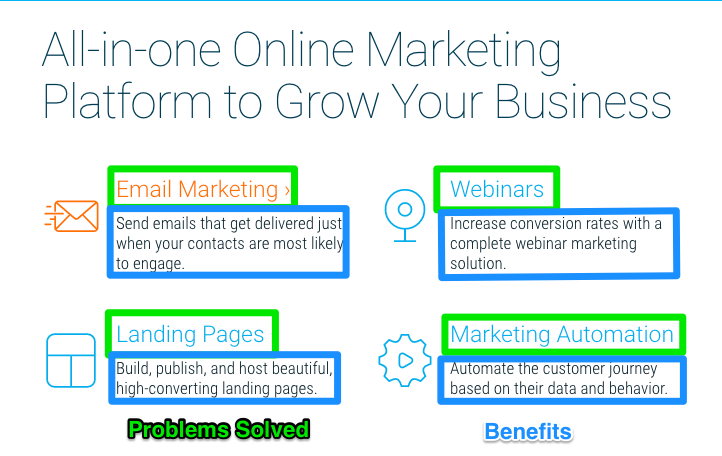
    • Problems solved: how to [keyword], [keyword] solution, or even just the short-tail name of the keyword; basically any typically transactional or related keywords
    • Benefits: cheap [keyword], free [keyword], and keywords that are centered around the benefit of your product or service.
    • Uniqueness: all-in-one [industry keyword], [keyword] comparison, [keyword] for [keyword], and keywords that will identify a unique aspect of your product that demonstrates scarcity.

    Problems-Solved Keywords

    These are typically going to be more short-tail related keywords and potentially the most competitive keywords in your industry. However, they can be very competitive long-tail keywords as well.

    Don’t let that scare you; every business should have its own short-tail version of keywords that they can one day aspire to rank for. Identifying these keywords early on will let you understand who the industry titans are in terms of SEO competition.

    Often times these are the H1s of a Landing Page; generic and informative.

    Benefit Keywords

    Benefit keywords are driven more at descriptive words used to sell a product, and thus are also in high-demand, albeit a bit less than industry short-tail keywords.

    Scrolling through most H2s on a product landing page will net you the majority of what these look like.

    value proposition keyword research for competitor analysis

    Uniqueness

    These are your more long-tail keywords that really help separate your brand from your competition. Sometimes you’ll find a combination of different industry keywords blended together to highlight the versatility of a product.

    Other times it may be that it’s an extremely niche field and thus is just a simple value proposition that can appear within an H1 or H2 on your landing page anyway.

    uniqueness value proposition for seo keyword research and competitor analysis

    In the above photo, they highlight that they’re a developer testing tool aimed at recruiters, which combines two starkly different fields with different skill sets.

    Uniqueness and benefit keywords should make up the bulk of your keyword list that you want to target or use to define your industry as they’re the largest combination of mid to long-tail keywords.

    Building Your Industry Keyword List

    Once you’ve evaluated your keywords based on your value proposition, it’s time to diversify them for your SEO benefit.

    There are a number of free keyword research tools that don’t require sign ups you can use for competitor analysis like:

    keyword research for competitor analysis

    Use these tools to identify keywords with a decent or high search volume based on the keywords you’ve attained through analyzing your value propositions.

    The size and scale of your keyword research will depend on the scope of your SEO campaign.

    Maybe there’s just a small niche of keywords that you want to become relevant for or quite possibly you’re trying to identify your industry as a whole. Whatever the case may be, keyword research is a mandatory step.

    Once you’ve got your list of keywords, it’s time to identify your SEO market competition.

    Identifying Your Industry’s Competitive SEO Landscape

    Great, now you have your keywords. How should you go about finding your seo competitors?

    There are a huge amount of seo competitor analysis tools out there and we’ve outlined the issues of a one-size-fits-all approach above in terms of just getting their keywords list and basing your strategy off of that.

    Remember, your defining your SEO strategy off of your business’ unique value proposition–you have something unique and different to offer consumers with your products. So you need to take an approach to your SEO that highlights and builds off of the strengths of your uniqueness.

    So for competitor website discovery in our example today we’ll use Unamo’s Industry Intelligence module, as it was built for the exact purpose of defining a market’s SEO competitor landscape based on pre-selected keywords.

    industry intelligence competitor analysis tool for competitor discovery

    What you get is a defined list of up to 250 domains that are scored by their strength and relevance to the keywords you’ve provided.

    From the list, you can begin to understand who your top SEO competitors are and begin to deconstruct their strategy or use it as a benchmark to monitor your progress over time.

    Using Your Competitor Data

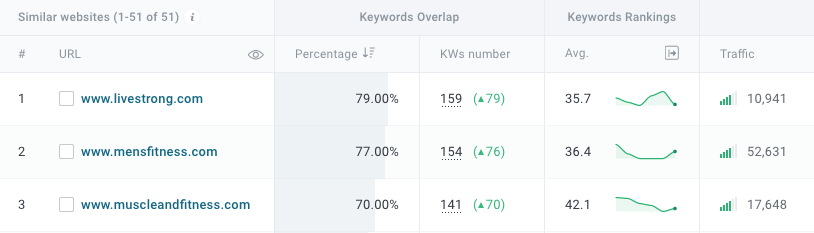
    competitor analysis keyword and backlink data

    In addition to your list of seo competitors, you’ll have definitive data on:

    • The volume of their backlink profile
    • The quality of their backlink profile
    • Estimated traffic from the keywords submitted
    • How relevant they are according to the keywords added

    This can help you tackle a few different avenues concerning their SEO strategy.

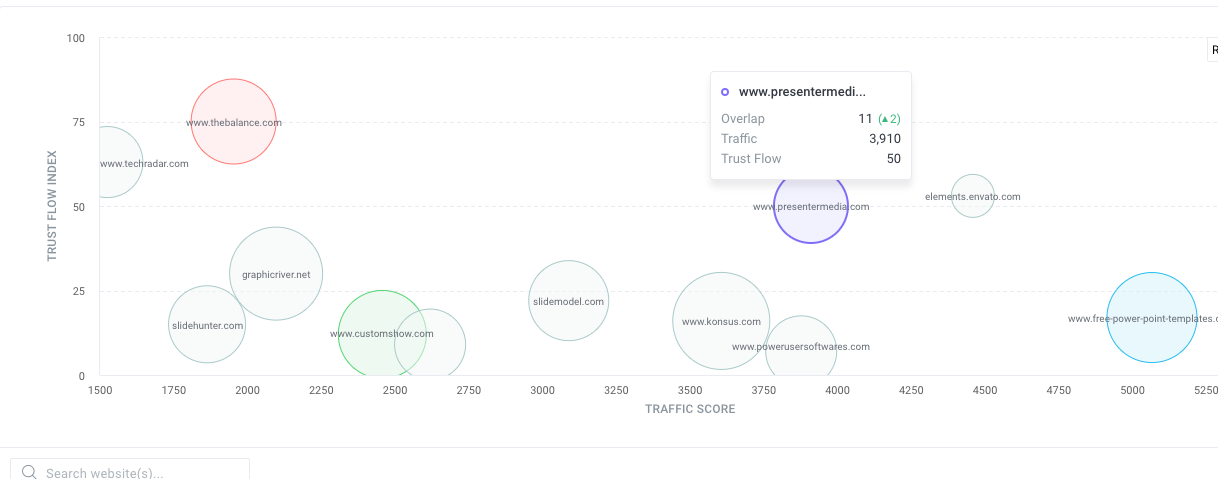
    First and foremost you’ll know which of your target keywords each domain is ranking for. The higher their overlap percentage, the greater their total relevancy is toward your website.

    To put it simply, your digital presence is similar.

    But what will distinguish their efficacy with these keywords is there estimated traffic. Websites with a high overlap and a higher traffic estimation will undoubtedly be the industry benchmark you want to emulate and surpass one day.

    technical seo competitor analysis

    Once you’ve understood which domains are the ones you want to target for your analysis, you can begin to pick away at the different parts of their SEO strategy.

    Identifying Competitor SEO Strategies

    Each facet of SEO has a what and a why behind it, thus by knowing which websites are the ones you want to get more in-depth data on, you can begin to pick away at their strategies.

    Technical SEO

    Each website has its own digital make-up. Whether they’re using specific subdomains, ccTLDs, or gTLDs, you can begin to understand how your competition chooses to tackle their SEO strategy based their website’s technical makeup.

    If you’re focal point for a specific search engine is country based, you can identify if most of your competition is using a gTLD like a .com or if they’ve gone a ccTLD route and used a .co or .pl.

    Google has come out in the last few years and said that using a specific gTLD won’t affect your rankings whereas ccLTDs can help Google distinguish a website that is targeted at a specific country.

    cctld and gtld competitor analysis

    This is all obvious information you can glean at a glance from your list of industry domains; however, getting into the details of their technical SEO strategy will require the use of additional tools.

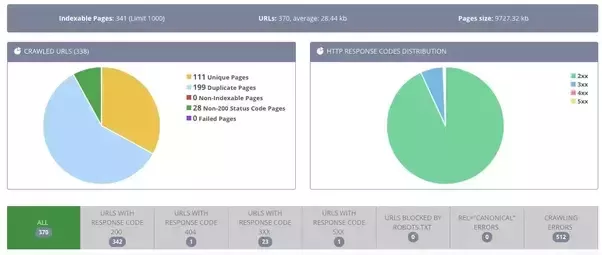
    Crawling Top Sites

    I would recommend crawling an entire site with certain technical SEO tools to determine how they structure subfolders and subdomains, internally link, and use on-page SEO as a whole.

    Tools I recommend for this are:

    technical seo competitor analysis for unique pages

    On a macro SEO scale, you can identify if you need to make any structural changes to your site that may seem to be giving your competitors an advantage.

    They’re not only good for understanding site architecture, but you’ll be able to glean the:

    While things like link-depth may not seem too important, they’re actually important metrics in determining how often Google crawls your site and how users may navigate from page to page.

    Understanding a competitor’s technical seo approach especially comes in handy when you’re taking a micro approach to your competitor’s content performance and want to make changes based on competitor data.

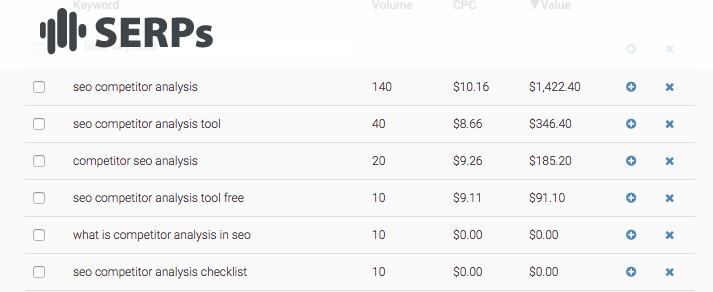
    To analyze top-ranking pages, simply locate the keyword you want to find SERP links for in your Industry campaign.

    competitor keyword gap analysis for seo

    This list can also be exported to create a keyword gap analysis spreadsheet so you can better understand which keywords certain competitors are ranking for that your website isn’t ranking for.

    Furthermore, from an on-page perspective, you can plug in the SERP link into a technical audit tool to glean their on-page SEO elements and analyze the differences across each one.

    on-page optimization competitor analysis for seo

    This is invaluable as far as expediting the amount of time you spend researching their on-page optimization strategy goes.

    Technical SEO competitor analysis has the benefit of being two-pronged in its micro and macro scale; you can attain enough data on either with one tool to implement big or small changes to your site based off of your competitor analysis.

    Backlink Research

    This is where some more robust backlink tools may come in handy as they can provide you with a website’s complete backlink profile.

    You can then find out where the bulk of their highest quality backlinks are coming from and emulate that content.

    Great tools for this process include:

    • Majestic
    • Ahrefs
    • SEMrush

    backlink data for seo competitor analysis

    I would recommend doing this more on a page-by-page basis; find their highest performing content and analyze its backlink profile first. It’s much easier to create a high quality piece of content and build links from it than it is to try to acquire a huge amount of links to your homepage.

    Thus, with your list of domains and their specific SERP links for target keywords, you’ll be able to identify the difficult of surpassing your competitors in terms of backlink quality and quantity as well as have a good idea of what kinds of sites you can also earn backlinks from.

    Be sure to try and emulate not just the link quality but the overall domain quality of each link you go through if you’re planning on earning links from the same site.

    Conclusion

    Most SEO competitor analysis templates have long argued that the keyword research portion of your analysis needs to happen after you find your top competitors.

    However, I would argue that each business has a separate value proposition and that your SEO strategy should be built to strengthen this value proposition.

    Locate the top keywords that best define your business and build your SEO strategy around them. Once you do, you’ll have a much more actionable list of direct competitors to base your competitor analysis on.

    Good luck!